
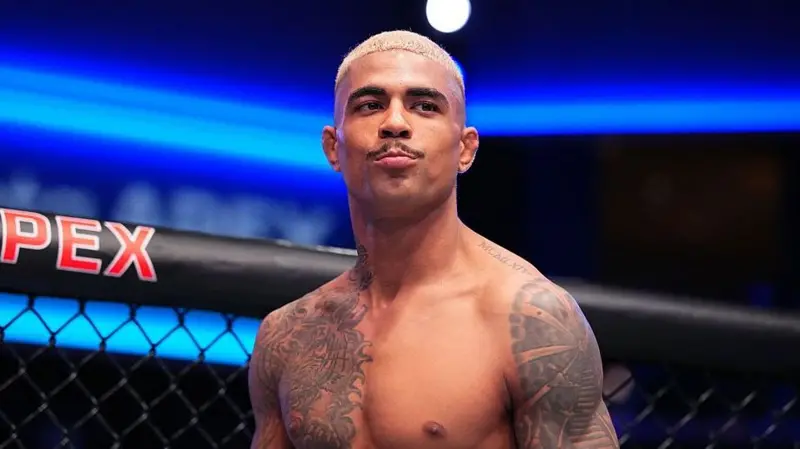
Sal Everett went from stocking Dana White’s refrigerator and working security around the UFC to knocking Ozzy Martin unconscious and earning a contract of his own, while Mateus Soares, Roque Conceicao and short-notice replacement Preston LaGrange joined him after an explosive night at the Meta APEX.
Meta Apex, Las Vegas, Nevada – Dana White’s Contender Series has spent nearly a decade selling the possibility that one performance can completely change a fighter’s life. On Tuesday night in Las Vegas, that premise became almost literal. Sal Everett arrived at the Meta APEX as someone who had already spent years working around the UFC, handling errands for Dana White, walking the building on graveyard security shifts and watching other fighters chase the opportunity he wanted for himself. Less than two minutes after the opening bell against Ozzy Martin, Everett was no longer an employee trying to reach the UFC. He was a UFC fighter.
The transformation became the defining image of DWCS 95, the ninth episode of the season and one of its most explosive nights. Four of the five fights produced first-round finishes, and White ultimately awarded contracts to Everett, Mateus Soares, Roque Conceicao and Preston LaGrange. The only winner who left without an offer was Alivia Bierley, whose unanimous decision over Summer Onley opened the card but failed to produce the urgency White wanted from fighters competing for a roster spot.
Everett’s story, however, overwhelmed almost everything else that happened inside the building. The 29-year-old welterweight entered against Martin with both fighters carrying perfect 4-0 professional records. Everett had already finished all four of his previous opponents in the first round, including one knockout in only four seconds, but this was different. The opponent was dangerous, the pressure was enormous and virtually everyone inside the UFC organization seemed to understand what the fight meant to him.
Martin initially made the moment uncomfortable. He attacked Everett’s body and legs with kicks and refused to behave like an opponent participating in somebody else’s feel-good story. White later acknowledged that people he trusted had warned him Martin was legitimate and that Everett was entering a genuine fight rather than a showcase designed around his UFC connections. Everett absorbed the early offense, settled behind his boxing and gradually forced Martin backward as the difference in punching power became apparent.
Everett trapped Martin near the fence and connected with the combination that ended the fight at 1:57 of the opening round. Martin collapsed unconscious as Everett recognized immediately that the fight was finished and declined to add unnecessary punches. The reaction around the cage was extraordinary for a Contender Series event. White removed his headset, the crowd exploded and Everett stood in the middle of a building where he had once worked security with his UFC future suddenly secure.
The knockout improved Everett to 5-0, with every professional victory ending in the first round. His résumé now includes three knockouts and two submissions, and his finishing rate extends through both his professional and amateur careers. What makes the record remarkable is how quietly Everett constructed it while simultaneously working inside the company he hoped would eventually employ him in a completely different capacity.
Everett first tried to work for the UFC in 2019 and was asked during the interview where he saw himself five years later. His answer was that he expected to be fighting for the UFC, an admission that initially cost him the job. He eventually entered the company through a third-party security agency before becoming White’s personal runner, performing ordinary tasks such as stocking refrigerators, handling laundry and completing errands while continuing to build his fighting career on the regional circuit.
White eventually became one of the people pushing Everett toward the opportunity. Everett recalled being in the back stocking White’s refrigerator when White told him that he had been speaking with the UFC matchmaking team and wanted to get him onto Contender Series. Everett’s response was simple: he was ready whenever White was. White later emphasized that Everett had not spent his time around the company lobbying for special treatment and said he was the one who encouraged the move to Contender Series as Everett approached 30.
That relationship created an obvious question entering the event. Everett was not simply another anonymous prospect trying to impress the UFC CEO. He worked for him. White acknowledged that people would inevitably claim Everett received preferential treatment because of those connections, but his response afterward was that Everett had eliminated any meaningful debate by what he did inside the cage. White said Sean Shelby and others had repeatedly warned that Martin represented a legitimate 50-50 fight and insisted Everett had earned the contract rather than been handed one.
The emotion became even clearer when White announced the contracts. He told Everett that the Meta APEX had hosted championship fights and that he could not remember the building ever becoming as loud as it had after Everett’s knockout. White praised him not merely as a fighter but as a person, saying virtually everyone inside the UFC who had encountered Everett genuinely liked him and respected the way he had worked his way upward through the organization. He then acknowledged the unusual circumstances with a fitting line, telling Everett that although he was already at the UFC, he was now officially welcome to the UFC as a fighter.
The contract also appears likely to end Everett’s previous job with the company. White said the financial terms of a UFC deal should allow Everett to support his family while focusing on fighting full time and suggested that future encounters with him would probably happen at the UFC Performance Institute rather than around the offices. For a fighter who spent nights walking through the APEX imagining himself competing there, the occupational change could hardly be more dramatic.
Everett was the emotional center of the night, but he was hardly the only prospect who forced White to pay attention. Mateus Soares produced the fastest finish of the card, needing just 63 seconds to stop Ryuho Miyaguchi in their bantamweight matchup. At only 5-foot-5, Soares entered as the significantly smaller fighter, but the physical difference meant little once he began throwing. He pressured immediately, swung with enormous power and eventually landed an overhand right that dropped Miyaguchi and ended the fight.
White appeared particularly intrigued by what Soares could become at only 22. Asked afterward about adding another young bantamweight to one of the UFC’s deepest divisions, White described him as explosive, talented and well-rounded, while emphasizing how unusual it is to see a fighter display that level of ability at such a young age. The performance moved Soares to 12-2 and gave the UFC another developmental piece in a division where prospects rarely receive much time to develop slowly.
Roque Conceicao earned his contract through a completely different kind of chaos. The Brazilian flyweight attacked Alexander Chavez aggressively from the opening seconds, landing combinations and forcing Chavez to react before the fight moved to the ground. Chavez eventually secured a takedown and appeared to be gaining control, but Conceicao attacked with a triangle choke from his guard. Chavez attempted to escape by lifting Conceicao and slamming him to the canvas, only to drive himself deeper into the submission. Conceicao tightened the choke and forced the tap at 3:37 of the first round.
The sequence was exactly the kind of moment Contender Series was designed to reward. Conceicao encountered adversity, remained dangerous from an inferior position and converted his opponent’s attempted escape into the mechanism that made the submission tighter. He improved to 12-3 and became the only contract winner of the evening to earn his opportunity through a submission rather than strikes.
Preston LaGrange completed the four-contract night under perhaps the most difficult competitive circumstances. A natural middleweight, LaGrange accepted the light heavyweight main event against Nell Ariano on extremely short notice and weighed only 199 pounds, considerably below the division’s 205-pound limit. Ariano managed to toss him to the canvas and control portions of the clinch, but LaGrange remained composed, returned to his feet and eventually landed a brutal elbow that dramatically changed the fight.
Once Ariano was hurt, LaGrange did not allow him to recover. He followed the elbow with punches, drove Ariano down onto all fours and continued attacking until Marc Goddard intervened at 2:24 of the opening round. The victory improved LaGrange to 7-1 and earned him a UFC contract in a weight class that is not even expected to be his permanent home. White said afterward that LaGrange shouted to him that fans should wait until they see what he can do at his natural weight.
The one fighter who won but did not receive a contract became an equally important part of the evening’s message. Alivia Bierley defeated Summer Onley by unanimous decision, 30-27, 29-28 and 29-28, after a competitive three-round bantamweight fight. Bierley had made a substantial personal sacrifice for the opportunity, reportedly leaving a six-figure job while pursuing her belief that fighting in the UFC was the path she was supposed to follow. She won the fight, but winning alone was not enough.
White’s explanation was blunt. He acknowledged the sacrifices professional athletes make but said both Bierley and Onley needed to demonstrate greater urgency in the third round. In his view, neither fighter showed enough desperation to prove that she absolutely had to be in the UFC. That distinction remains one of the defining characteristics of Contender Series. The scorecards determine who wins the fight, but White ultimately determines whether that victory creates a UFC career.
That contrast made DWCS 95 an almost perfect illustration of what the series has become. Four fighters produced finishes and received contracts. One fighter won a decision and left without one. White said that after the opening bout, everyone else on the card impressed him, and he again emphasized how dramatically the level of talent appearing on Tuesday nights has risen. In his view, the prospect pool keeps improving while the platform allows millions of fans to become familiar with fighters before they ever make their official UFC debuts.
White even claimed that Contender Series occasionally draws larger audiences than UFC Fight Night events, a remarkable development for something that began primarily as a prospect pipeline. The attraction is increasingly obvious. There is no long season, no tournament bracket and almost no time for a fighter to repair a poor impression. One night can create a career, and one cautious performance can leave a winner standing outside the UFC anyway.
DWCS 95 delivered that formula in its purest form. Soares announced himself with 63 seconds of overwhelming power, Conceicao survived a slam and converted it into a submission, LaGrange accepted a dangerous assignment above his natural weight and turned a brutal elbow into a contract, while Bierley discovered that victory and opportunity are not always the same thing on Tuesday nights in Las Vegas. Yet the night ultimately belonged to the fighter who had spent years standing only a few feet away from the dream he was chasing.
Sal Everett used to walk through the UFC’s building as an employee, stock Dana White’s refrigerator, handle errands and watch other fighters receive opportunities he hoped would eventually become his own. On Tuesday night, he walked into the same building undefeated, knocked another undefeated fighter unconscious in 1:57 and walked out with the contract that changes what his UFC identification means forever. He arrived as someone who worked for the promotion, and after one of the loudest moments the Meta APEX has produced, he left as someone who fights for it.
Andrew Carswell is a combat sports columnist and college writing professor, based in Las Vegas, NV, whose work examines the intersection of fighting, media, business, and culture. His commentary and analysis have been featured in various magazines, newspapers, and media outlets, including Yahoo! News, and USA TODAY. Blending journalistic insight and experience with a fan’s perspective, Carswell writes about the fight game as both a cultural phenomenon and a global business.