
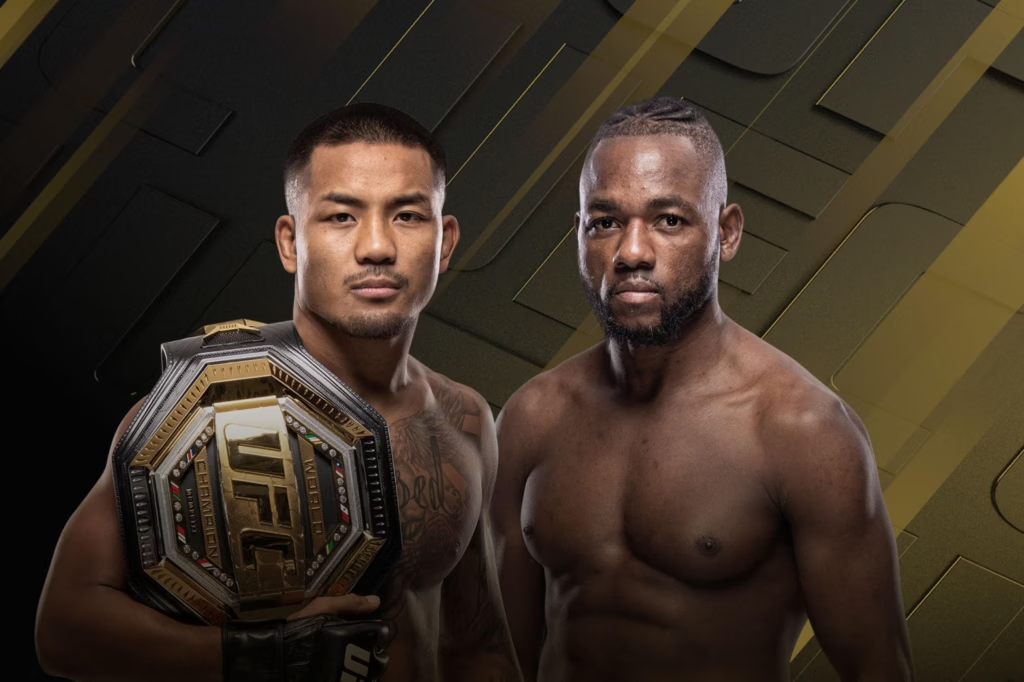
Carlos Prates says Islam Makhachev backed away from a January fight and insists the interim championship he will contest against Michael Morales is not the real belt, while Stephen Thompson believes Morales’ massive weight cut could become a problem, Manel Kape promises to take the flyweight title from Joshua Van, and Gable Steveson returns only months after a devastating 12-second knockout loss.
Toronto, Canada – UFC 336 has not even arrived in Toronto, and the card is already carrying the kind of tension normally reserved for fight week. At the top of the event, Joshua Van will defend the flyweight championship against Manel Kape, while Carlos Prates and Michael Morales meet for an interim welterweight title that neither man originally expected to exist. Beneath those championship fights, Gable Steveson returns to the Octagon under enormous pressure after one of the most damaging losses of the year. The result is a card where almost every major storyline involves somebody trying to prove that the label attached to him is wrong.
For Prates, that label is “interim champion.” He wants the belt, he wants the money and he understands what winning at UFC 336 would mean, but he refuses to pretend that defeating Morales would make him the true welterweight champion. Prates had expected to fight Islam Makhachev for the undisputed title in early 2027, and according to Prates, there had been verbal agreement around a January matchup before he was later informed that Makhachev would not compete at that time. Instead, the UFC booked Prates against Morales for interim gold and the right to face Makhachev later.
Prates has not hidden his frustration. He said the interim belt is “not a real title” in his mind because Makhachev remains the actual champion, and he placed responsibility for the situation directly on the Russian star. Prates said Makhachev had talked about wanting to remain active before later deciding not to fight in January, leaving Prates to compete for an interim championship he never asked for. He still wants the belt because it represents the next step toward the fight he really wants, but he has made clear that he will not view himself as the undisputed champion unless he eventually beats Makhachev.
That frustration has also sharpened the tone of what Prates says he wants to do next. He has already promised that if he gets through Morales, he intends to make Makhachev regret delaying their meeting. Prates said he plans to hit Makhachev hard enough to make him consider retirement, turning what began as a scheduling change into one of the more personal emerging rivalries in the welterweight division.
The irony is that Prates appears much less hostile toward Morales, the man actually standing between him and the interim belt. He considers Morales dangerous, young, strong and physically imposing, but also believes the matchup favors him stylistically. Prates originally expected the Makhachev fight and admitted he was disappointed when that opportunity disappeared, yet he now sees Morales as a less difficult stylistic challenge than the undisputed champion.
That confidence is rooted in one of the most violent runs in the division. Prates rebounded from his decision loss to Ian Machado Garry by knocking out Geoff Neal, then became the first fighter to stop Leon Edwards with strikes before later finishing Jack Della Maddalena. Those wins pushed him into title contention and reinforced the reputation he has built since entering the UFC through Dana White’s Contender Series. Prates has made a habit of hurting fighters who are rarely hurt, and he believes the calmness with which he applies pressure is as important as the weapons themselves.
Morales presents a different kind of problem. The undefeated Ecuadorian is one of the largest welterweights in the UFC, and his physical dimensions immediately create questions about whether Prates will be dealing with an athlete capable of overwhelming him with size, strength and pressure. Morales has already demonstrated that the weight does not prevent him from being explosive, and his first-round knockout of Sean Brady provided another reminder that his power translates against elite opposition.
Stephen “Wonderboy” Thompson, however, believes that same size could become Morales’ greatest weakness. Thompson is picking Prates to win because he believes extremely large welterweights can spend too much of their training camp focused on getting their bodies down to 170 pounds rather than developing skills and preparing strategically. Thompson pointed toward Morales walking around well above the division limit and argued that Prates’ consistency, experience and broader arsenal give him the advantage over five rounds.
The weight-cut question becomes even more significant because UFC 336 is scheduled for five championship rounds. Prates openly doubts Morales’ ability to maintain the same effectiveness deep into the fight because of how much weight he carries outside competition. He believes he can fight for five rounds or even longer and has suggested that Morales’ cardio remains one of the major unknowns. At the same time, Prates does not expect the judges to be necessary, predicting that the fight will end before the championship rounds are complete.
That combination makes the interim title fight more interesting than the controversy surrounding the belt itself. Morales is the undefeated young contender with enormous physical advantages and knockout power. Prates is the veteran finisher who has already proved he can hurt former champions and believes Morales has not yet encountered someone with his level of striking sophistication. The winner will leave Toronto holding a belt that Prates himself says is not the real one, but will also leave with the clearest possible claim to Makhachev.
Prates also has a larger personal mission attached to the fight. His rise has become part of the broader resurgence of the Fighting Nerds team, a group that experienced a difficult stretch before several of its most prominent members rebuilt momentum. Prates believes 2027 could become the year multiple members of the team finally capture UFC championships, and he will be the first with an opportunity to put gold around his waist.
The title fight above Prates and Morales carries a completely different kind of tension. Joshua Van enters UFC 336 as the reigning flyweight champion after tearing through the division and already making multiple defenses, while Manel Kape continues to speak as though the championship has merely been waiting for him to arrive.
Kape has not attempted to manufacture respect for Van in public. He has called Van his “son,” promised to slap him around and predicted that he will finish him quickly. At the same time, Kape insists he is approaching the championship fight without unusual emotion or pressure. His position is that the moment has been inevitable for years and that Jan. 30 is simply the night he finally collects what he believes has always belonged to him.
That confidence is particularly striking because Van has done almost everything possible to establish himself as the division’s new standard. At 25, he has climbed through the contenders, won the championship and defended it twice, yet Kape speaks about their matchup as though the younger champion is temporarily holding his property. Kape says he has spent years preparing for this exact opportunity and believes the title has effectively belonged to him long before the UFC officially gave him the chance to fight for it.
Stylistically, the matchup promises violence. Both fighters are aggressive strikers who are comfortable operating at speed, and Kape’s confidence comes from believing he already understands how Van reacts under pressure. Van’s rapid ascent suggests otherwise. He has repeatedly solved increasingly difficult opponents and now faces another major test against perhaps the most dangerous pure striker available at 125 pounds.
If the championship fights give UFC 336 its stakes, Gable Steveson gives the card one of its most compelling redemption stories.
Steveson entered the UFC as one of the most decorated wrestlers ever to transition into MMA. An Olympic gold medalist with elite athletic credentials, he was immediately viewed as a potential future heavyweight contender before his development had truly begun. That trajectory changed dramatically at UFC 331 when Sean Sharaf knocked him out with a single punch just 12 seconds into the opening round. The loss became one of the biggest upsets of 2026 and immediately transformed every question surrounding Steveson.
The UFC is not making him wait long to answer them. Steveson will return at UFC 336 against Terrance Chatman, who is 0-1 in the UFC after suffering a first-round submission loss to Anthony Wint. On paper, the matchup appears designed to give Steveson a chance to stabilize his career against an opponent who has also struggled at the UFC level. The problem is that Sharaf was supposed to represent a manageable developmental matchup as well, and that fight ended before Steveson had time to establish anything.
That makes Chatman far more dangerous to Steveson’s career than his record might suggest. Steveson is only 1-1 in the UFC, and another decisive loss could create serious questions about whether his Olympic wrestling background is translating quickly enough to survive in MMA. The pressure is not simply to win. He needs to demonstrate that the knockout against Sharaf was a disastrous moment rather than evidence of a deeper problem in his transition to the sport.
The contrast between Steveson’s situation and the championship fights above him is striking. Van, Kape, Prates and Morales are competing to determine who controls the top of their respective divisions. Steveson is fighting to prove he still belongs on the road toward that level. The accolades that made his arrival so fascinating now create even greater expectations because the UFC has already seen how quickly elite wrestling credentials can become irrelevant when a heavyweight lands clean.
That is what makes UFC 336 unusually compelling months before the opening bell. Almost every major fighter on the card has something larger than a simple victory attached to the night. Van is defending the championship against someone who believes it has always belonged to him. Kape is attempting to convert years of confidence and frustration into actual UFC gold. Morales is trying to prove that his undefeated record and enormous frame belong at championship level. Prates is fighting for a belt he openly refuses to recognize as the real championship because his attention remains fixed on Makhachev.
Even the retired Wonderboy has already entered the discussion by framing the co-main event around whether Morales’ greatest physical advantage could become his biggest liability. Thompson sees Prates as the more developed and proven fighter, but Morales has spent his entire professional career disproving the idea that someone his size should be able to move and finish opponents the way he does.
Then there is Steveson, whose fight may carry no championship but could have some of the most severe consequences on the card. Another victory can restart the development process and begin rebuilding the aura surrounding one of the most accomplished wrestlers ever to enter the UFC. Another crushing defeat could turn a once-celebrated heavyweight experiment into a career fighting for survival.
UFC 336 therefore arrives in Toronto with two championship fights, but the belts tell only part of the story. Carlos Prates is fighting for an interim championship he says is not real, Michael Morales is fighting to prove that his size and inactivity will not become liabilities, Manel Kape believes he is finally coming to collect a title that has belonged to him for years, Joshua Van is trying to remind everyone that the belt already has an owner, and Gable Steveson is returning to prove that 12 disastrous seconds did not define his future.
By the time Jan. 30 arrives, somebody will leave Toronto with championship gold, somebody will move directly toward Islam Makhachev, and somebody may discover just how quickly the UFC can move on when expectations become heavier than results. UFC 336 is still weeks away, but the fights have already begun everywhere except inside the Octagon.
Andrew Carswell is a combat sports columnist and college writing professor, based in Las Vegas, NV, whose work examines the intersection of fighting, media, business, and culture. His commentary and analysis have been featured in various magazines, newspapers, and media outlets, including Yahoo! News, and USA TODAY. Blending journalistic insight and experience with a fan’s perspective, Carswell writes about the fight game as both a cultural phenomenon and a global business.