
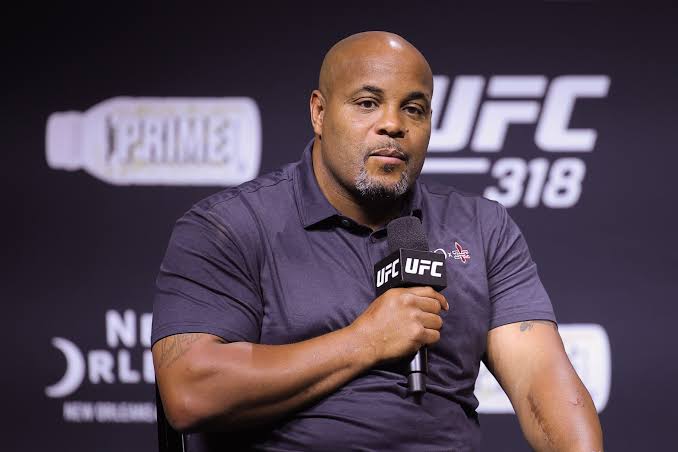
Dominick Reyes has accused the UFC Hall of Famer of poor preparation, factual mistakes and biased commentary after UFC 333, while Sean O’Malley coach Tim Welch says it has long seemed as though Cormier has “a little something” against his fighter.
Daniel Cormier spent years becoming one of the most respected fighters of his generation before transitioning from champion to broadcaster. He represented the United States in Olympic wrestling, won UFC titles in two divisions and built the kind of résumé that gives his analysis immediate credibility. This week, however, that credibility has become the center of an increasingly public debate.
Dominick Reyes ignited the controversy after knocking out Azamat Murzakanov at UFC 333 in Abu Dhabi. What initially looked like another major step in Reyes’ career resurgence quickly became something different once he watched the broadcast of his own fight on the way home. Reyes heard Cormier’s analysis, became increasingly frustrated by what he believed were factual mistakes and one-sided commentary, and unloaded publicly on the former two-division champion.
The first reaction was emotional. Reyes called Cormier a “low-IQ hater,” complained that commentators had marginalized his accomplishments and objected to being called “kid.” Cormier responded by telling Reyes to relax, explaining that he did not use the term disrespectfully and insisting that he praised Reyes when he performed well while criticizing him when necessary.
Instead of allowing the exchange to disappear into social media, Reyes decided to document his complaints. He created a new YouTube feature called “The Commentary Scorecard,” replayed sections of the UFC 333 broadcast and graded the commentary team based on what he believed they got right and wrong.
That changed the dispute from personal anger into a broader criticism of Cormier’s preparation.
Reyes highlighted a moment when Cormier discussed Murzakanov moving into southpaw, arguing that the analysis was incorrect because Murzakanov is naturally a southpaw and regularly fights from that position. Reyes interpreted the mistake as evidence that Cormier either had not adequately researched the fighter or was simply speaking without enough preparation.
He also objected to how Cormier described his own career. During the broadcast, Cormier discussed Reyes recovering from his losing streak and returning to fights against highly ranked opponents. Reyes argued that he never stopped facing ranked competition during that period and said the framing minimized the level of opposition he continued fighting even while struggling.
Reyes’ criticism went beyond factual details. He said the broadcast spent too much time discussing Murzakanov while failing to explain what Reyes himself was doing technically. Reyes pointed toward his movement, leg kicks and outside work as examples of important action he believed received too little attention until the knockout came.
He also challenged Cormier’s comments about referee Mike Beltran. After Reyes hurt Murzakanov and eventually secured the finish, Cormier joked that Beltran could have stopped the fight earlier but apparently “wanted to see murder.” Reyes argued that comments like that can help create damaging narratives around referees and defended Beltran for allowing two highly ranked fighters enough opportunity to determine the outcome.
When Reyes finished grading the broadcast, he gave Jon Anik a B or B-plus, Paul Felder an A and Cormier an F-plus. More importantly, he said the point of the exercise was accountability. Fighters are judged publicly after every performance, Reyes argued, and commentators should be expected to prepare, improve and remain unbiased as well.
Reyes expanded that argument during his interview with Ariel Helwani. He acknowledged Cormier’s greatness as a fighter but rejected the idea that championship credentials automatically make someone elite at every component of broadcasting. Being a great fighter, Reyes argued, does not automatically make someone an expert in every area of striking, movement or technical analysis.
He went further when asked whether he believes Cormier favors fighters from the Caucasus region. Reyes said yes and claimed he has noticed examples across numerous fights over several years. That remains Reyes’ opinion rather than an established fact, but it shows that his frustration extends well beyond one UFC 333 broadcast.
Cormier, meanwhile, has responded as though he does not believe there is a real personal feud. He said he likes Reyes, praised his UFC 333 performance and suggested the two could simply speak privately. Reyes has since clarified that he does not need Cormier to like him. What he wants, he says, is prepared and unbiased commentary.
Then, Tim Welch entered the conversation.
Welch, the longtime coach and close friend of former UFC bantamweight champion Sean O’Malley, appeared with Helwani to discuss Petr Yan’s victory over Merab Dvalishvili and the possibility of another Yan-O’Malley fight. During that discussion, Welch raised his own questions about Cormier.
Welch was surprised that O’Malley did not receive more attention as Yan’s possible next opponent and wondered whether Cormier had something against him. Welch repeatedly acknowledged that he could be wrong, but said it has long seemed as though Cormier has “a little something against Sugar” and does not particularly enjoy seeing O’Malley win.
Welch’s criticism was considerably less direct than Reyes’. He did not accuse Cormier of failing to prepare or present a list of factual errors. Instead, he questioned whether Cormier’s natural preference for wrestling sometimes influences how he evaluates fights and pointed toward the controversial first Yan-O’Malley bout as one example.
That distinction matters. Reyes and Welch are not making identical accusations. Reyes is alleging poor preparation, factual mistakes and recurring bias. Welch is expressing a suspicion that Cormier may not particularly like O’Malley and may give wrestling more weight than Welch believes it deserves. Both remain opinions rather than established findings.
What makes the situation noteworthy is the timing. Within days of Reyes launching a public campaign questioning Cormier’s broadcasting, another prominent coach connected to one of the UFC’s biggest stars independently raised his own concern about Cormier’s treatment of a fighter.
The larger question is now becoming difficult to ignore: how much should a commentator’s competitive background affect what viewers hear?
Cormier’s wrestling expertise is one of the reasons he became valuable behind the microphone. He can recognize grappling sequences and positional battles many viewers cannot see. Critics like Reyes and Welch, however, are now asking whether that same background occasionally shapes his interpretation too strongly.
Reyes has taken the discussion even further by challenging the idea that former fighters should receive automatic deference as analysts simply because they competed at the highest level. His argument is that fighting and broadcasting are separate jobs. Cormier’s championships prove he was an extraordinary mixed martial artist, but Reyes believes commentary still requires preparation, neutrality and continued development.
There is history behind that criticism. Dominick Cruz has previously questioned Cormier’s preparation and publicly criticized his commentary habits. Reyes’ complaints therefore do not arrive in complete isolation.
What is new is the method. Reyes has effectively reversed the traditional relationship between broadcaster and fighter. Commentators usually grade the athletes in real time. Reyes is now replaying the broadcast and grading the commentators afterward.
That could become uncomfortable if other fighters follow his lead. Broadcast mistakes can now be clipped, timestamped and challenged directly by the athletes being discussed. A fighter who believes his strategy was misunderstood no longer has to complain vaguely about disrespect. He can show the exact moment and explain why he believes the analysis was wrong.
The controversy is not yet proof that Daniel Cormier is biased. Reyes’ regional-bias claim remains his interpretation, while Welch himself repeatedly admitted he could be wrong about O’Malley. Cormier has praised Reyes and rejected the idea that his criticism was personal.
What the controversy does show is that fighters are increasingly willing to challenge the authority of the UFC broadcast itself.
For years, Cormier has been paid to break down everybody else’s performance. This week, the fighters started breaking down his.
Andrew Carswell is a combat sports columnist and college writing professor, based in Las Vegas, NV, whose work examines the intersection of fighting, media, business, and culture. His commentary and analysis have been featured in various magazines, newspapers, and media outlets, including Yahoo! News, and USA TODAY. Blending journalistic insight and experience with a fan’s perspective, Carswell writes about the fight game as both a cultural phenomenon and a global business.