
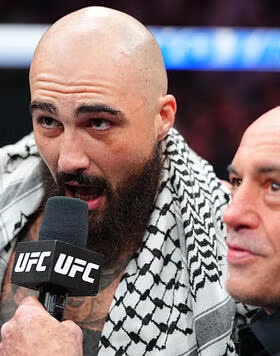
Gable Steveson entered UFC 331 as an Olympic gold medalist, unbeaten MMA prospect and one of the largest betting favorites the sport had ever seen. Twelve seconds later, Sean Sharaf had knocked him out, shattered a sportsbook record and transformed a life that, only weeks earlier, included staggering debt, bankruptcy plans and sleeping on the floor.
Three weeks before Sean Sharaf walked into the Octagon at UFC 331, there was nothing glamorous about his life. There was no championship belt on the wall, no endorsement deal waiting, no financial security and no guarantee that he would even remain on the UFC roster much longer. Sharaf was sleeping on a mat on the floor with his belongings packed into luggage, struggling through serious financial problems and preparing for a fight almost everyone expected him to lose. By the time he walked out of the cage in Los Angeles, he had authored one of the most improbable moments in UFC history.
Gable Steveson was supposed to be the next great heavyweight attraction. The Olympic gold medalist entered UFC 331 unbeaten at 4-0 in professional MMA, with all four victories coming by knockout, and carried the kind of résumé that immediately separated him from almost every developmental heavyweight the UFC had ever signed. His wrestling credentials were elite, his athletic upside was obvious, and the betting market reflected the expectation that Sean Sharaf represented another step in a carefully accelerating rise. Depending on the sportsbook, Steveson closed anywhere from roughly minus 1800 to beyond minus 3000, making him one of the largest favorites ever attached to a UFC fight.
Sharaf stood on the opposite side of that expectation. He had already lost his first two UFC appearances, had been stopped previously in his career and understood that another defeat could potentially end his run with the promotion. He later admitted that he entered the matchup believing he might be fighting for his job, which stripped the moment of any illusion that this was simply another opportunity. Sharaf did not have the luxury of planning three fights ahead because he was trying to survive one.
The contrast became even more extraordinary once the details of Sharaf’s life outside the cage emerged. UFC middleweight champion Sean Strickland later shared messages Sharaf had sent him approximately three weeks before UFC 331, including a photograph showing Sharaf’s sleeping arrangement on the floor with his possessions packed around him. Strickland responded by telling him to buy an inexpensive mattress, and Sharaf said he planned to purchase an air mattress from Walmart. It was a startling glimpse of how far removed Sharaf’s reality was from the major UFC stage he was about to enter.
The financial problems ran much deeper than a lack of furniture. Sharaf later acknowledged that he had accumulated substantial debt and was preparing to file for bankruptcy. After moving to Las Vegas before signing with the UFC, he said he began gambling while attempting to find a way into Dana White’s orbit, including spending time around high limit casino areas in hopes of meeting the UFC CEO. He also experimented with options trading and took out loans during years spent trying to finance a fighting career that offered little stability and few sponsors.
Sharaf had effectively spent years betting on himself long before anyone could legally bet on him, and by the time Steveson stood across from him in Los Angeles, the market had decided that bet was a terrible one. Sharaf entered as approximately a plus 1000 underdog, while Steveson was treated as close to inevitable. The matchup looked particularly unforgiving because Sharaf understood exactly what he was facing. Steveson was not simply another heavyweight with strong wrestling. He was an Olympic champion.
Sharaf had wrestled in high school and openly admitted that he had not even reached the highest levels of competition there. Pretending he could match Steveson credential for credential would have been foolish, so Sharaf and his coaches built the strategy around refusing to be intimidated by those credentials. The message throughout camp was simple: do not respect the wrestling so much that you stop fighting.
Sharaf expected Steveson to take him down and understood that it might happen repeatedly. His responsibility was to get back to his feet, stay in Steveson’s face and force the decorated wrestler to deal with pressure and punches instead of allowing the entire contest to unfold on Steveson’s terms. Sharaf did not need to become the better wrestler in one night. He needed to make Steveson uncomfortable long enough for something else to happen.
That something arrived almost immediately. Sharaf landed the left hand and recognized the effect before almost anyone watching had processed what they were seeing. He later described the instant realization that followed the punch, essentially understanding that the fight was there to be finished. He attacked, followed with a hammer fist and, just 12 seconds after the opening bell, the Olympic gold medalist was finished.
The statistical significance of the result quickly became clear. BetOnline listed Steveson’s loss as the largest UFC betting upset in the sportsbook’s history, surpassing a list filled with some of the sport’s most famous shocks. Ronda Rousey’s loss to Holly Holm, Georges St-Pierre’s defeat against Matt Serra and Amanda Nunes’ loss to Julianna Peña all appeared below Steveson’s defeat on that list. Those fights had become reference points for what could happen when MMA rejected conventional wisdom, and Sharaf had just produced a betting upset larger than all of them according to that sportsbook’s historical numbers.
It was not merely that Steveson lost. It was how little time Sharaf needed to destroy the assumptions surrounding him. Twelve seconds did not allow for a long strategic breakdown, a fatigue issue or a gradual accumulation of damage. There was no prolonged wrestling exchange in which Sharaf slowly discovered a weakness. The bell rang, Sharaf put his hands on one of the most celebrated combat sports athletes of his generation and the entire heavyweight landscape changed almost immediately.
The scene felt even more surreal to Sharaf because of where it happened. His first UFC appearances had taken place at the Apex, but UFC 331 brought him back into a major arena environment in Los Angeles, close to where he grew up in Santa Ana. Friends, supporters and people who had prayed for him were in attendance. Dana White was cage side, Joe Rogan was there, and Sharaf later described trying to prevent himself from becoming overwhelmed by the scale of the moment before producing the kind of finish that ensured he would never forget it.
The upset also carried a strange sense of inevitability for the man who produced it. Sharaf revealed that he had been thinking about Steveson long before UFC 331 was officially booked. His management had previously been approached about the possibility of Sharaf facing Steveson on the White House card, and Sharaf immediately expressed interest. He had followed Steveson through wrestling, watched his involvement with professional wrestling and anticipated that the Olympic champion would eventually make a serious move into MMA.
When the fight finally arrived, Sharaf had also spent months in training environments that kept him continuously engaged. He had prepared for a scheduled fight with Tai Tuivasa before withdrawing after suffering a broken nose, then spent additional time helping another heavyweight prepare for competition. Instead of entering UFC 331 from a standing start, Sharaf had effectively lived in camp. What appeared externally to be an impossible assignment had become something he had quietly rehearsed long before the public knew the fight would happen.
There was also a psychological freedom that came from having almost nothing left to protect. Sharaf said he had reached a point where he simply surrendered himself to the fight. He knew he had lost twice in the UFC, knew another defeat could result in his release and knew the public had already decided what was supposed to happen. Instead of allowing those realities to tighten him, Sharaf said he felt as though he was playing with house money because everyone had already counted him out.
That mentality became especially powerful in a year Sharaf described as filled with improbable results. He pointed toward Justin Gaethje’s victory over Ilia Topuria and Sean Strickland’s own upset success as reminders that perceived certainty inside MMA can disappear with one exchange. Those fights mattered to him because they made the impossible feel less impossible. Sharaf did not need the rest of the world to believe he could beat Steveson because he only needed enough evidence to convince himself.
The victory immediately changed the economics of Sharaf’s career as well. He received a $50,000 sponsored bonus for the knockout, and Dana White added another $50,000. Sharaf planned to use the money to help his mother, including helping her move toward retirement. The same fighter who had recently been sleeping on the floor suddenly left UFC 331 with a six figure bonus attached to the biggest victory of his life, while Strickland jokingly told him afterward that it was finally time to upgrade the mattress.
Even Sharaf seemed to understand how quickly his world had changed. Before the Steveson fight, he was contemplating whether another loss would cost him his UFC career. Afterward, he suddenly had media requests, a public relations team telling him how to handle interviews and a level of recognition he had never experienced. He had recently signed a new UFC contract, and the conversation around him shifted almost instantly from roster survival to how large his future opportunities could become.
The upset has already been immortalized beyond the Octagon. Topps announced that Sharaf’s knockout of Steveson would become his first official trading card, transforming the image of the finish into a collectible representation of the moment his career changed. For a fighter who entered UFC 331 largely known only to dedicated fans, the knockout produced the rare transformation in which a single punch created both a sporting result and a piece of UFC history.
Steveson’s future will now become one of the other major stories emerging from the result. He remains only 26, his wrestling accomplishments have not disappeared and one knockout does not erase the enormous athletic ability that made him such a fascinating MMA prospect. But the defeat exposed how brutally unforgiving the transition into elite mixed martial arts can be, particularly for a developing fighter whose reputation has already created expectations far beyond his experience level.
Former UFC champion Henry Cejudo argued afterward that Steveson needs time to improve defensively and should devote himself completely to developing his striking rather than rushing through the learning process. That may prove to be one of the lasting lessons of UFC 331. Wrestling greatness can provide an extraordinary foundation for MMA, but it cannot eliminate the danger of the four ounce gloves worn by the man standing across the cage.
For Sharaf, however, the story is no longer about being the opponent chosen to test someone else’s future. He is now part of the heavyweight conversation himself. The two UFC losses that once threatened to define his run have been replaced by a knockout people will replay for years, and the man who wondered whether he was one defeat away from losing his job suddenly has the kind of victory capable of changing everything that comes after it.
The details make the transformation difficult to believe even when placed side by side. A former Marine who left the service as a sergeant, buried himself in debt while chasing a fighting career, gambled in Las Vegas hoping to cross paths with Dana White, contemplated bankruptcy, slept on the floor and entered UFC 331 as an enormous underdog somehow needed only twelve seconds to rewrite the entire story. That combination of desperation, preparation and opportunity created the kind of moment that explains why mixed martial arts remains almost impossible to predict.
There will be bigger paychecks to chase now, better living arrangements to make and far greater expectations attached to every fight Sharaf accepts. None of those things existed when he entered the cage against Gable Steveson, and perhaps that was part of what made the moment possible.
Sharaf spent years fighting for the opportunity to be noticed, and when that opportunity finally arrived, he needed only twelve seconds to make sure nobody could ever ignore him again.
Andrew Carswell is a combat sports columnist and college writing professor, based in Las Vegas, NV, whose work examines the intersection of fighting, media, business, and culture. His commentary and analysis have been featured in various magazines, newspapers, and media outlets, including Yahoo! News, and USA TODAY. Blending journalistic insight and experience with a fan’s perspective, Carswell writes about the fight game as both a cultural phenomenon and a global business.