
The Rise of a Pioneer: Inside the Ring
Born in 1935, Patterson forged his path to greatness through discipline and an unorthodox style. Standing six feet tall with a short reach for a heavyweight, he compensated with blinding speed, supreme athleticism, and his signature “gazelle punch” – a technique involving a dynamic spring toward opponents.
His accomplishments remain etched in sports history:
-
Olympic Glory: He captured the middleweight gold medal at the 1952 Helsinki Olympic Games.
-
Historic Milestone: In 1956, at age 21, he defeated Archie Moore to become the youngest boxer in history to win the world heavyweight title.
-
Resilience: He became the first heavyweight in boxing history to regain the championship title after losing it.
Patterson accumulated a professional record of 55 wins, 8 losses, and 1 draw. Yet, the traits driving his success – courage, tactical depth, and an unyielding work ethic – exposed him to cumulative physical trauma.
The Unseen Toll: Alzheimer’s Diagnosis
Decades after his 1972 retirement, the structural realities of repetitive head trauma caught up to him. Patterson was diagnosed with Alzheimer’s disease, battling the neurodegenerative condition for approximately eight years before his passing in 2006 at age 71. The cognitive decline stripped away the intricate memories of his championship pedigree. For a man whose identity was built on precision, physical mastery, and public leadership – including serving as chairman of the New York State Athletic Commission – Alzheimer’s represented a profound erosion of self.
Janet Patterson: The Architecture of Care
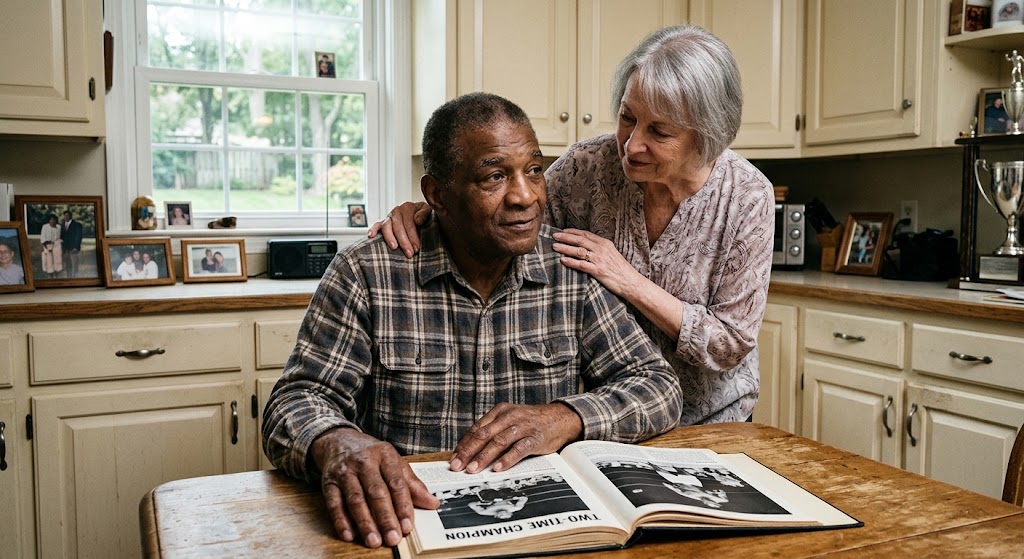
In the face of profound cognitive regression, the logistical and emotional burden of survival shifted entirely to his wife, Janet Patterson. While history chronicles fighters under the bright lights of an arena, true endurance was mirrored at home. Janet’s role as his primary caregiver was indispensable. As the disease advanced, erasing his recollection of past victories, Janet acted as his external memory. She anchored his daily reality, placing championship memorabilia into his hands and reminding him of who he was. Her commitment went beyond medical management; she provided psychological stability, dignity, and a protective barrier against a world he could no longer navigate independently.
Analyzing long-term caregiving reveals that individuals like Janet are the unseen structural pillars of athletic legacies. Without her systematic dedication, patience, and emotional fortitude, the final chapter of a great champion would have lacked safety and structure. Floyd Patterson’s life illustrates a sobering truth: while championships are won under the spotlight, the hardest battles are fought in silence, sustained by the steady hands of a devoted caregiver.
This video provides a look into Floyd Patterson’s later years and the vital role his wife Janet played as his caregiver while he battled cognitive decline.

Combat Sports & Martial Arts Writer| Partnership Marketing and Digital Strategy Lead (Combat Sports)
I have been an avid viewer of Boxing and MMA for almost three decades. Since 2001, I have enjoyed watching the UFC. I hold an academic background in Gerontology from Madonna University, and spent 25 years working across both clinical and non-clinical healthcare settings. But a lifelong passion for writing and martial arts eventually pulled me toward a new chapter. Today, I write for FightMatrix.com. Additionally, I interview professionals in the Combat Sports sector.