
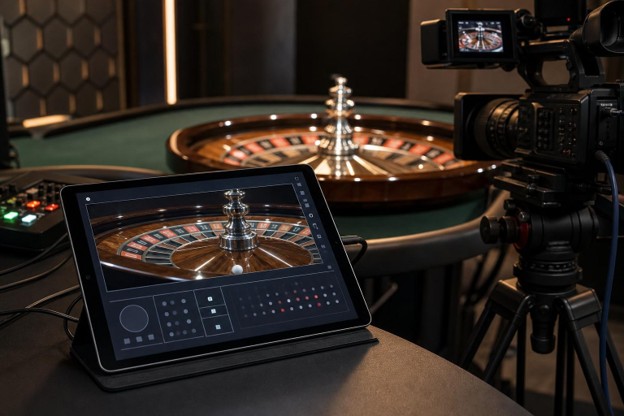
A roulette ball drops into a pocket. On a phone, the winning number appears beside the live picture, then the account balance changes. What looks like a single moment has passed through cameras, reading equipment, game software, and an operator’s account system.
Each has a separate job. The camera shows what happened, while other equipment supplies a result the software can process. Meanwhile, instructions from individual players travel back through the interface. Following that exchange explains what happens behind the broadcast.
How the Table Becomes Data
Readers researching cashclawe app, where players control real claw machines remotely, can apply the same question to any live-table interface: how does the software know what just happened?
Dedicated equipment supplies that information. Card scanners register cards during dealing, while roulette wheels can use embedded sensors to detect the winning number and send it to other software. Some wheel equipment also logs ball speed, direction, and events such as a mis-spin.
Those readings allow the platform to process the result under the game’s rules. The physical action on camera becomes a digital record that can be matched against wagers.
There is also a procedure for handling reading errors. GLI-19’s technical standards address the accuracy of automated recognition and require a manual operating mode for corrections. Players must be informed when that mode is used.
The Player Sends Instructions Back
A live table also receives input from the people watching. Through the interface, a player submits a wager, makes a game decision, or types a message.
Each action follows its own path. A betting instruction enters the wagering process. A blackjack decision determines how that player’s hand proceeds. A dealer can read a chat message and answer aloud, bringing a text exchange into the audio broadcast.
The same roulette spin can therefore serve players with different selections and amounts wagered. Software has to keep those wagers associated with the right accounts while distributing the shared result.
That requires a clear sequence. Each instruction needs to belong to the correct round and arrive at the appropriate stage of play.
Keeping the Round in Order
Internet connections introduce latency, the delay between an event happening and appearing on a device. Systems need to coordinate betting and results around that delay.
New Jersey’s table game simulcasting rules require servers to prevent access to an outcome before a wager is finalized. Dealer-verified results must be recorded before they are posted.
Other state live game frameworks likewise require results to be recorded before reaching the gaming platform. Providers may also have to establish, enforce, and disclose minimum connection requirements.
A common clock helps put these events in order. State communication standards can require platform components to use a synchronized date and time, giving the system a shared reference for player instructions, game activity, and results. Participants must be able to see the platform date and time when logged in.
From the Result to the Account
After the result is recorded, it has to be matched to accepted wagers and reflected in account activity. Studio technology and the operator’s account system handle connected parts of that process.
The information moving between them includes sensitive details. Regulated US markets require secure transfer of wagers, results, account information, and financial transactions.
Location checks add another control. Under typical US state specifications, a static connection is checked before the first wager and then every 20 minutes, shortened to five minutes within one mile of the permitted boundary. A change in IP address triggers an immediate check.
Spending and time controls also belong in this account discussion. Gambling carries financial risk, and setting limits establishes boundaries around participation. Anyone concerned about their gambling can seek confidential support through 1-800-GAMBLER.
What Remains After Play Ends
Once a round finishes, its records allow staff to examine the sequence later. Live game frameworks can require continuous recordings sufficient to reconstruct play, with game times identifiable to within one second of the system clock.
Those recordings generally remain available for at least 90 days. Material connected to an investigation must be retained until the investigation concludes.
Electronic records follow a separate schedule. State data logging standards can require secure information sufficient to recreate wagering and account activity, including identity and location checks, for at least five years. Specified data adjustments must also be logged, with the person responsible and the values before and after the change.
If a player disputes a round, these records give operators and regulators a way to examine the physical play alongside its associated transactions. The number briefly displayed over the roulette wheel becomes part of a much longer account of what happened.