

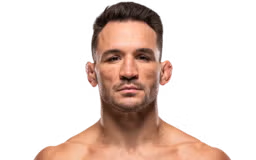
Michael Chandler has never needed much help turning a fight into theater. For most of his UFC run, the former Bellator champion has fought like a man trying to detonate the building before the final horn, whether that meant walking through danger, creating chaos, or giving fans the kind of violence that makes highlight reels feel too small for the moment.
But, on Sunday night, at UFC Freedom 250, Chandler says the moment itself may be bigger than anything he has ever walked into.
Chandler returns June 14th on the White House lawn against Mauricio Ruffy, stepping into one of the strangest, loudest, and most historically loaded fight settings the UFC has ever created. The event has been discussed for months as a spectacle that once seemed almost impossible to pull off. Now, the Octagon is being built outside the White House, the massive “Claw” structure is rising over the South Lawn, and Chandler is no longer talking about the event as an idea. He is talking about it as the kind of stage he believes he was made for.
“It seemed like an unrealistic, unattainable, no way the UFC was going to be able to pull this thing off a couple months ago,” Chandler said. “Now, then it got announced and then now I’m announced on the card. So, here we are, man. I’m excited.”
For Chandler, the White House setting is not just another arena with a different address. He said most of his 30-plus professional walkouts have taken place in familiar conditions: an indoor venue, a cage in the middle, controlled lighting, controlled temperature, controlled sound, and the same kind of fight-week rhythm. This one, he said, will feel completely different, right down to the air touching his skin when he walks outside instead of into a climate-controlled arena.
That difference has become one of the biggest storylines surrounding the event. Joe Rogan has questioned whether elite-level fights should happen in uncontrolled outdoor environments, and Chandler knows the variables are real. Weather, humidity, heat, rain, and even bugs could become part of the fight. But, Chandler is not running from any of it. He has leaned directly into the chaos, joking about outdoor training sessions where bugs became part of the workout and saying the only thing he can do is “control the controllables.”
“If I’m doing it in 80-degree weather, humid, hot, bugs, rain, whatever, the goal remains the same,” Chandler said. “Go out there, get my hand raised.”
That line captures where Chandler is mentally entering this fight. He is not pretending the questions around him are imaginary. He knows exactly what the conversation sounds like. At 40 years old, riding a three-fight losing streak, with only one win in his last six appearances, Chandler understands why some believe the best version of him may already be gone. Chandler enters UFC Freedom 250 with a 23-10 record, a 2-5 UFC mark, and a recent run defined by elite opposition, violent fights, and painful setbacks.
His most recent loss, a damaging defeat to Paddy Pimblett at UFC 314, appears to have forced the deepest reassessment of his career. Chandler did not dress it up. He called the performance disappointing, said he was unhappy with how he competed, and admitted he needed time to step back, “lick” his wounds, recalibrate, and define who he is as a fighter.
That loss may have become a turning point. Chandler is returning after 14 months away from the Octagon, and he has warned fans not to expect the same “Iron” when he steps back into the cage in Washington, D.C. For years, fans and analysts have debated whether Chandler’s UFC career could have looked different if he had fought with a less reckless, less entertainment-first style. Now, after the Pimblett fight, Chandler seems to be entering this matchup with a sharper understanding of what has worked, what has failed, and what has to change.
Chandler said the time away allowed him to become more mature, accept what happened, and move forward from a period that included waiting on Conor McGregor, losing that fight, pivoting to Charles Oliveira at Madison Square Garden, falling short there, and then rushing too quickly into the Pimblett fight while still coming off an injury.
“I believe you’re going to see the best version of me on the White House lawn on June 14th,” Chandler said.
The age question is another piece of this story, and Chandler is attacking it head-on. He rejected the idea that turning 40 means a fighter automatically falls off. Instead, he argued that his training is now more intelligent than it was in his twenties. His nutrition is better. His mental game is better. His training is more calculated, planned, and cerebral. In his words, it is no longer about running his head into a brick wall every day.
That is the heart of Chandler’s message heading into Ruffy: fans have every right to doubt him, but he believes they are about to be wrong. He acknowledged that after the Pimblett fight, people can reasonably say he has fallen off, that he will never become champion, or that Ruffy may smash him and send him into the sunset. Chandler said people have every right to believe that. He just believes he is going to prove them wrong.
The opponent makes that mission even more dangerous. Mauricio Ruffy is surging, younger, explosive, and walking into this fight with momentum. Chandler is walking in with pressure, age questions, and the weight of a career that has always felt one win away from another blockbuster. That is why this matchup works. It is not just veteran vs. prospect. It is Chandler trying to prove that the violent version fans loved was not the only version he had left.
Chandler also made clear that the Pimblett loss did not make him want to become someone else. He said he needed to get back to the basics of who he is, describing himself as a “meaningful specific, not a wandering generality.” After years of borrowing pieces from other fighters and trying to add layers, Chandler said the real answer is simpler: he is Michael Chandler, a pressure fighter, foot on the gas, in your face.
That may be the most interesting tension of this fight. Chandler says he has matured and become more cerebral, but he is also promising to return to the pressure-fighting identity that made him famous. If he can blend those two versions, the wild man and the veteran, the chaos merchant and the technician, UFC Freedom 250 may become more than a comeback attempt. It may become the night Chandler rewrites the conversation.
The McGregor shadow still follows him, too, because it has followed him for years. Chandler and Conor McGregor coached against each other on “The Ultimate Fighter,” built up a massive fight, watched it collapse, and then watched the possible rebooking drift away. Now, McGregor is returning against Max Holloway instead, leaving Chandler focused on Ruffy, while still acknowledging that the McGregor story may not be finished.
Chandler said the entire McGregor saga had become an “up-and-down soap opera” over the better part of two years, but he now feels “a million miles away” from it because of his focus on Ruffy and the White House card. Still, he wished McGregor well, said the sport is better when McGregor is active, and made it clear he expects their paths to cross eventually.
“Whether me and Conor fight in the UFC or not, Conor and I will compete against each other at some point, in some venue, somewhere, somehow, some way,” Chandler said. “The story is there, the animosity is there, but also the mutual respect is already there. It’s got all the makings of a blockbuster.”
For now, though, Chandler is not selling McGregor as the immediate prize. He is selling Ruffy as the immediate problem. And, he is not being subtle about how he sees the fight ending.
“I’m going to knock out Mauricio Ruffy on the White House lawn,” Chandler said. “And then we’ll see what happens after that.”
That is vintage Chandler, but the context around it feels different. He is not just promoting another action fight. He is attaching his comeback to a once-in-a-lifetime setting. He called the White House card the biggest stage possible, saying that fighters who claim they did not want to be part of it are not being honest about what prizefighters really chase. To Chandler, every athlete wants the brightest lights, the biggest audience, and the moment that captures people’s emotions. In his view, nothing is bigger than fighting on the White House lawn.
“I was born for a stage such as this, for a moment such as this,” Chandler said. “I’m just excited to go out there and celebrate America’s birthday, be draped in the red, white, and blue, and just go out there and get a win.”
That is the version of Chandler arriving at UFC Freedom 250: bruised, doubted, older, recalibrated, patriotic, still chasing Conor somewhere down the road, and fully aware that this could either be the start of one more run or the night the critics say they were right all along.
But, Chandler has always lived best in the space between danger and opportunity. The White House lawn gives him both. Against Mauricio Ruffy, under the lights, outside the most famous residence in America, Chandler gets the kind of stage that can make a fighter look reborn or finished.
He says it will be the former.
And, for a fighter who has spent his entire career turning chaos into currency, there may not be a more fitting place to prove it than inside a cage built on the South Lawn.
Andrew Carswell is a combat sports columnist and college writing professor, based in Las Vegas, NV, whose work examines the intersection of fighting, media, business, and culture. His commentary and analysis have been featured in various magazines, newspapers, and media outlets, including Yahoo! News, and USA TODAY. Blending journalistic insight and experience with a fan’s perspective, Carswell writes about the fight game as both a cultural phenomenon and a global business.