
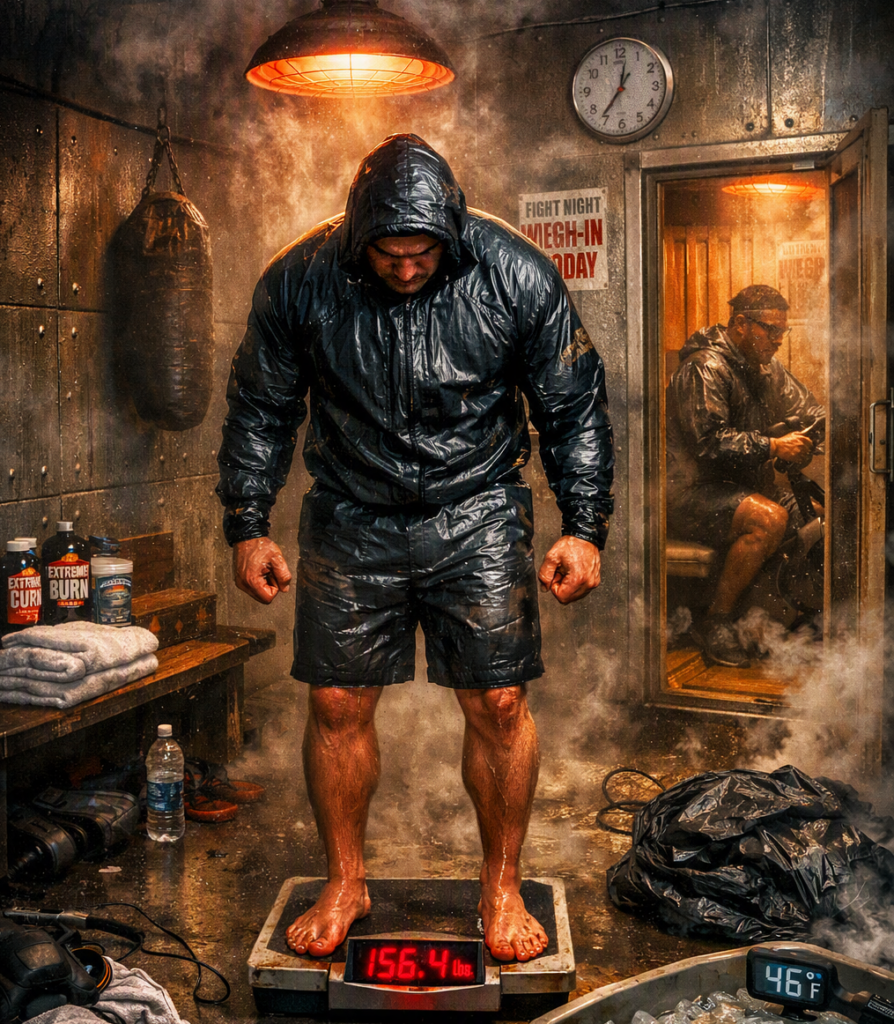
A fighter steps on the scale a day before the bout 8% lighter than his walking-around weight, most of the loss water. He rehydrates overnight and feels close to normal by morning. Inside the cage, the gap shows. His first combination lands a fraction slow, his grip weakens by the second round, and his read on the counter is half a beat late. Each of those is a measurable effect of going to work with a brain and a muscle system still short on water.
Strength and Power Under a Water Deficit
Strength falls before a fighter feels weak. Research on athletes puts the threshold at about 2% of body mass lost to dehydration, the point where measurable declines in strength, power, and endurance begin. A loss of 3% to 4%, common in a hard cut, lowers muscular strength by around 2% and muscular power by around 3%, while high-intensity endurance falls by close to 10%.
The numbers hold up in controlled testing. A 2025 study of elite karate athletes dehydrated to 2% body mass loss recorded lower squat jump height and weaker knee extension and flexion than the same athletes tested while hydrated. An MMA round demands repeated explosive output, so a power deficit compounds across 15 or 25 minutes of fighting. A 3% drop in power is the difference between a takedown that finishes and one that stalls.
Blood Volume and a Slower Engine
Speed depends on blood as much as muscle. Plasma, the liquid part of blood, is mostly water, so a dehydrated fighter circulates less of it. Stroke volume and cardiac output fall while the heart rate rises to compensate, and the blood thickens and grows harder to pump. Less of it reaches the working muscle and the brain.
The result is a fighter who fatigues faster and recovers slower between exchanges. Core temperature goes up as less blood reaches the skin to shed heat. A combination that was sharp in the first round arrives late in the third, slowed by a circulatory system moving oxygen on a reduced supply.
Putting the Water Back
Replacing fluid takes more than drinking water. Sweat contains sodium and potassium, and plain water alone dilutes the sodium that remains and does little to restore the balance a muscle cell needs. Fighters who rehydrate well pair fluid with sodium, often through a measured electrolyte powder for hydration mixed into water, along with some carbohydrate to pull fluid into the bloodstream.
The ratio matters more than the volume. A liter of water with the right sodium content stays in the body better than 2 liters of plain water, which the kidneys flush before it reaches the tissue that needs it.
Reaction Time and Decision Speed
A fight is a series of fast reactions. The opponent drops his hand and the lead shoulder turns, and the counter has to fire inside a fraction of a second. Dehydration slows that loop. Water makes up roughly 75% of brain mass, so a fluid deficit reaches the brain early. A 2018 meta-analysis of hydration studies found that water loss past 2% of body mass impairs attention, executive function, and motor coordination, the exact systems a fighter uses to see an opening and act on it.
Accuracy suffers even more than raw speed. Research on hydration and mental performance shows decisions get less reliable when the brain is short on water, and that rehydrating reverses part of the loss. Participants brought back to normal hydration scored better on reaction and decision tasks than they did while dry. The effect is largest on tasks that mix speed with judgment, which is most of what a fighter does under pressure. In a cage, a slightly worse read turns a slip into a punch taken.
The Weight-Cut Problem in MMA
MMA built this problem into its schedule. Fighters weigh in 24 to 36 hours before the bout, which created an incentive to cut hard, make the contracted weight, then rehydrate. Surveys of fighters find that most use saunas or sweat suits to drop the last few pounds. At one UK MMA event in 2017, 43% of competitors were severely dehydrated before they fought, and by some estimates 39% of fighters enter the cage dehydrated.
The risk goes past performance. Dehydration from a hard cut drains cerebrospinal fluid, the layer the brain floats in, and thins the cushion that absorbs a blow. The extreme weight cutting common in MMA makes that danger routine. Cutting more than 5% to 8% of body mass in under a week reliably degrades performance and strains the heart. After deaths tied to extreme cuts, the promotion ONE Championship banned dehydration-based weight cutting and moved to weight checks and hydration tests.
Limits of Overnight Rehydration
Rehydration after the weigh-in does not reset the body to its walking weight. Fluid moves back into the bloodstream within hours, but the water inside muscle cells returns more slowly, and a fighter can step into the cage a day later still short on water in ways he cannot feel. Studies on fighters who reach severe dehydration through rapid cuts show performance stays below baseline even after a full night of drinking and eating. A fighter may put 8 to 10 pounds back on the scale in that window while cellular rehydration still trails the number the scale shows.
That lag is the part most fighters underrate. The scale shows a normal number by fight night while the body is still behind, and that gap appears in the rounds that decide the result. A cut that looks recovered on the outside can still cost a step of speed and a measure of power when the bout goes long.
The Price of a Hard Cut
A fighter controls his training, his game plan, and his weight cut. The cut is the one that can quietly erase the other two. Strength down a few percent, power down more, a slower read, a heart working harder, and a brain with less protection. Each effect is small on its own, and together they decide close fights.
The fighters who manage this do not gamble on overnight recovery. They cut less, they rehydrate with both fluid and sodium, and they treat hydration as part of the fight itself, planned before the cut starts. The scale rewards the hard cut. The cage charges for it.