
UFC Freedom 250 arrived surrounded by lawsuits, political arguments, weather concerns, security questions, and weeks of speculation over whether the most ambitious night in UFC history could actually be pulled off. By the time the final fireworks exploded over Washington, D.C., all of that noise felt small compared to what had just unfolded on the White House South Lawn.
The UFC did not just stage a fight card at the White House. It staged a spectacle that somehow lived up to the madness around it. The lawsuit had been dismissed. The storm held off. The production worked. The crowd delivered. The fighters delivered even more. And, in the end, UFC Freedom 250 became exactly what Dana White promised it could be: a once-in-a-lifetime collision of sports, history, patriotism, entertainment, and violence.
It was not perfect because it was normal. It was perfect because it was unlike anything the sport had ever seen.
Seven fights. Seven finishes. No scorecards. No judges. No dull stretches. No quiet walk to the finish line. Every bout ended before the final horn, turning a card that had been mocked, questioned, and dissected for months into one of the most action-packed events the UFC has ever produced. On a night when the promotion needed its fighters to justify the scale of the stage, every single one of them understood the assignment.
The South Lawn became a temporary combat-sports cathedral. The Octagon sat in front of the White House. The massive “Claw” structure towered over the scene. Service members, politicians, celebrities, VIPs, and UFC legends packed the venue, while tens of thousands more watched nearby on giant screens at the Ellipse. The national anthem, military flyovers, Marine Band walkout music, fireworks, and historic backdrop gave the night the feel of a national ceremony wrapped around a fistfight.
The UFC leaned all the way into the moment. Fighters walked through historic White House rooms on their way to the cage, turning the building itself into part of the broadcast. President Donald Trump and Dana White walked from the White House toward the Octagon as the show opened. The U.S. Marine Band became one of the unexpected stars of the night, performing walkout music in a setting no MMA fan had ever seen before. The Blue Angels and Thunderbirds helped set the tone early, and a late-night B-1 flyover shook Washington with the kind of sound that made the event feel impossible to ignore.
For months, the central question had been whether UFC Freedom 250 was too big, too controversial, too political, or too strange to succeed. The answer came fight by fight, finish by finish, roar by roar. Whatever people thought about the idea going in, the event itself delivered. It was loud, strange, violent, patriotic, dramatic, and completely unforgettable.
Then, Justin Gaethje (28-5-0) gave the night the ending it needed.
Gaethje entered the main event as the American underdog against Ilia Topuria (17-1-0), the undefeated lightweight champion and one of the most dangerous fighters in the sport. Topuria was younger, sharper, unbeaten, and favored heavily. He had built the kind of aura that makes fans talk about dominance before the fight even begins. Gaethje, meanwhile, was the veteran warrior with years of damage behind him, walking into the biggest stage of his career with many people wondering if he still had enough left to survive, much less win.
He did more than win. He authored one of the greatest late-career performances, and upsets, in UFC history.
From the opening round, Gaethje refused to let Topuria turn the fight into a coronation. He landed jabs, uppercuts, and hard right hands early, opening damage on the champion and making it clear that this would not be a quick highlight-reel night for Topuria. The champion answered with brutal body work in the second round, badly hurting Gaethje and creating the kind of moment where the fight seemed ready to swing back toward the favorite. Topuria chased submissions, looked dangerous, and nearly took control.
But, Gaethje survived. Then, he changed the fight.
By the third round, the underdog started building momentum. His jab found Topuria’s face again and again. His combinations began to land with more authority. The undefeated champion started backing up. Blood covered Topuria’s face. A ringside doctor nearly stopped the fight after checking his vision. The crowd grew louder, sensing that the impossible was becoming real right in front of the White House.
Topuria was allowed to continue, but the fight had already shifted. In the fourth round, Gaethje kept pouring on damage, landing with the kind of durability, pressure, and violence that has defined his career. By the end of the round, Topuria’s corner had seen enough. The undefeated champion did not come out for the fifth.
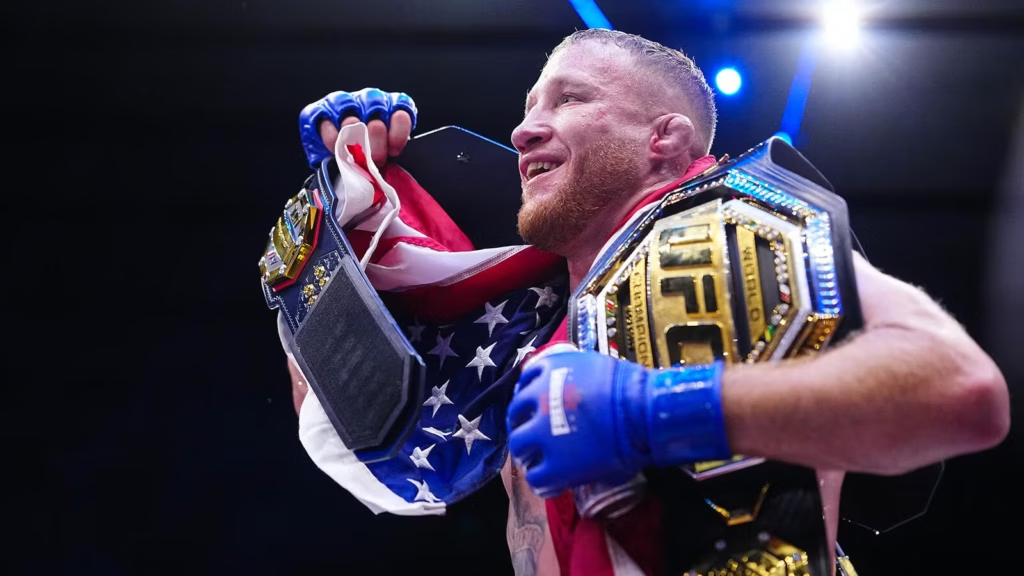
Justin Gaethje, a 6-to-1 underdog on the most American stage imaginable, was the new UFC lightweight champion.
His post-fight line instantly became part of the event’s mythology. “I’m from America. Two hundred and fifty years ago, we were way bigger than six-to-one dogs,” Gaethje said after the win. It was the perfect quote for the perfect upset: patriotic, defiant, emotional, and completely in tune with the night around him.
Then came the image the UFC will replay forever. Gaethje climbed the cage, backflipped into celebration, shook President Trump’s hand, fist-bumped the first lady, and later stood in the Octagon as Trump, his family, and Dana White joined the celebration while fireworks lit up the sky. The moment felt less like a normal post-fight scene and more like a sports movie that had somehow been allowed to happen in real life.
It would have been enough if the main event were the only major story. It was not.
Ciryl Gane (14-2-0) stunned the crowd by stopping Alex Pereira (13-4-0) in the co-main event and claiming the interim heavyweight title. Pereira arrived with the possibility of becoming a three-division UFC champion, a storyline that could have pushed him into even deeper all-time greatness. Instead, Gane reminded everyone that heavyweight is not a division where dreams survive without consequences. He used pressure, size, movement, and clean striking to hurt Pereira, finish him in the second round, and reopen the heavyweight picture.
The silence after Gane’s finish told the story. The crowd had expected Pereira magic. Instead, it got a French heavyweight statement.
Sean O’Malley (20-3-0) added another star moment with a second-round stoppage of Aiemann Zahabi (14-3-0). Josh Hokit (10-0-0) stopped Derrick Lewis (29-14-0) in the second round. Mauricio Ruffy (14-2-0) overwhelmed Michael Chandler (23-11-0) in the first. Bo Nickal (9-1-0) finished Kyle Daukaus (17-5-0) in the first. Diego Lopes (28-8-0) opened the night by stopping Steve Garcia (19-6-0) in the second. One by one, the fights kept ending violently, quickly, and decisively.
By the time Gaethje and Topuria walked out, the card had already become a promoter’s dream. Six fights had ended in six finishes. The main event only made it historic.
That is why Dana White’s post-fight reaction sounded like a victory lap. White said the event doubled the UFC’s all-time merchandise record, came in 40 percent under budget, and exceeded expectations across the board. He said he had just gotten off the phone with David Ellison, who was ecstatic about the event’s performance on Paramount. White called the night “monstrous” and said nearly 200,000 people came through the Ellipse over two days.
Even the weather became part of the story. All day, the UFC worried about storms threatening the event. Instead, White said the storm split around the White House, the breeze came through perfectly, and the conditions ended up better than expected. For a promotion that had spent the week preparing for every possible disaster, even the sky seemed to cooperate.
That was the feeling of the entire night. Everything that could have gone wrong became part of why the event felt bigger when it went right.
The lawsuit that tried to stop UFC Freedom 250 was dismissed before fight night. The critics who said the event should never happen watched it happen anyway. The weather that threatened the show moved aside. The logistics that seemed impossible somehow worked. The crowd that could have been distracted by politics got a fight card full of finishes. The fighters who could have been overwhelmed by the stage produced one of the most violent and memorable cards in recent UFC history.
And, then there was Sean Strickland, because of course there was.
Strickland was not on the card, but he still became part of the week’s drama. After days of speculation over whether he had been banned from the event, he showed up around UFC Freedom 250 activities and was eventually escorted out of the Fan Fest on the Ellipse when authorities said a surge of fans created safety concerns. He was not arrested. He was not cited. But, his removal became one more surreal subplot in a week that already had almost too many of them.
That is the thing about UFC Freedom 250: it was overflowing with storylines before the first fight started, and somehow the fights still became the biggest story.
That is not easy to do. The stage was so massive that it could have swallowed the card. The political spectacle could have overshadowed the athletes. The White House setting could have turned the whole thing into a novelty act. Instead, the fighters made the event legitimate. They gave the night blood, stakes, upsets, knockouts, finishes, and a main event worthy of the stage.
For the UFC, that is the ultimate win.
This was not just another big card. It was a statement about what the promotion has become. Twenty-five years ago, the UFC was still fighting for acceptance. Now, it can build an arena on the White House lawn, bring combat sports into one of the most recognizable spaces in the world, attract massive crowds, dominate the sports conversation, and create a night that even critics had to acknowledge was impossible to ignore.
White called it a “one of one” event and said the UFC would never do it again. Maybe he means it. The cost, security, pressure, and complexity were enormous. The event reportedly carried a massive price tag, required extraordinary coordination, and demanded a level of production that would be difficult to duplicate anywhere, let alone at the White House.
But, that may be why it worked so well. It felt rare. It felt ridiculous. It felt like something nobody was supposed to see twice.
UFC Freedom 250 was not just successful because the UFC pulled it off. It was successful because the event delivered at every level that mattered. The spectacle looked massive. The crowd stayed invested. The broadcast had unforgettable visuals. The fighters produced finishes. The main event gave the country an American underdog story. The co-main delivered a heavyweight shock. The entire card moved with urgency. And, by the end, the lawsuits, complaints, and doubts had been replaced by the image of a new champion celebrating under fireworks on the White House lawn.
That is the kind of night sports are built to create but almost never do.
A historic venue. A wild card. A perfect storm that did not hit. A court battle that failed. A promoter who gambled big. A president cageside. A crowd chanting. A champion breaking. An underdog rising. Seven fights. Seven finishes.
UFC Freedom 250 was supposed to be controversial. It was supposed to be complicated. It was supposed to be risky. It was all of those things.
But, more than anything, it was spectacular.
Andrew Carswell is a combat sports columnist and college writing professor, based in Las Vegas, NV, whose work examines the intersection of fighting, media, business, and culture. His commentary and analysis have been featured in various magazines, newspapers, and media outlets, including Yahoo! News, and USA TODAY. Blending journalistic insight and experience with a fan’s perspective, Carswell writes about the fight game as both a cultural phenomenon and a global business.