
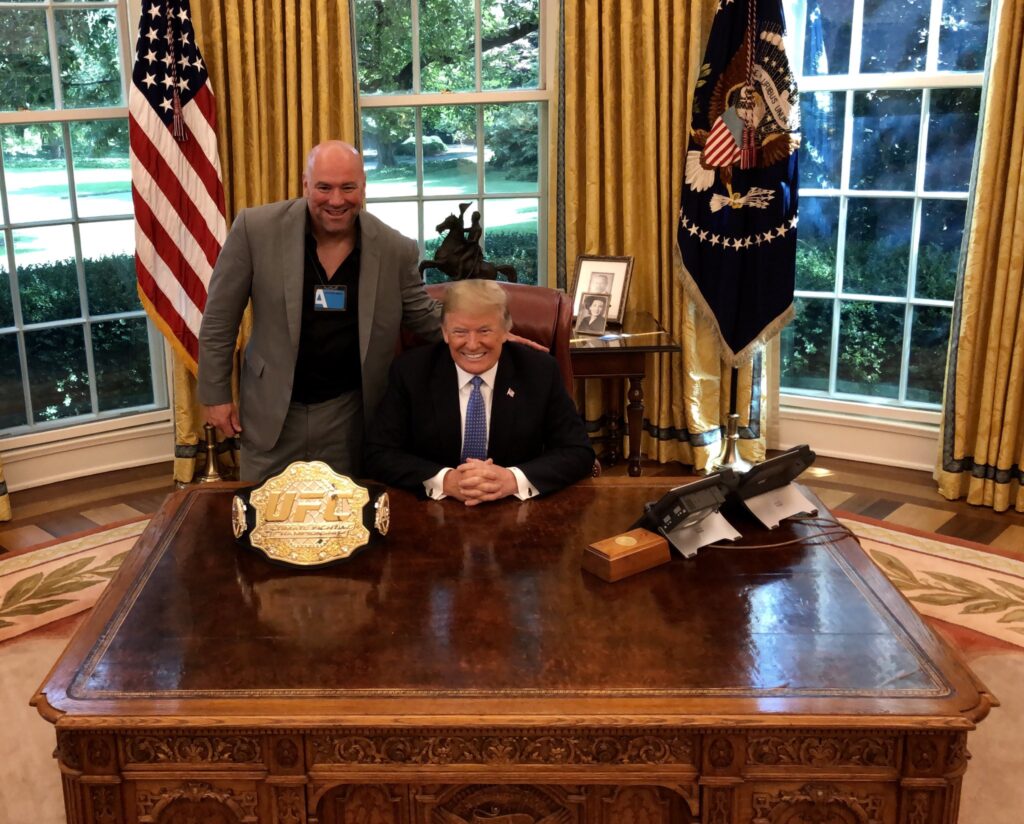
By Dan Scavino Jr., Public Domain, Link
Washington, D.C. – Dana White walked into fight week with a lawsuit seeking a temporary injunction, the weather questions, the Sean Strickland drama, the Super Bowl comparisons, the Trump spectacle, the Travis Pastrana stunt, the custom gloves, the GOAT debate, the guest-list chaos, and the massive “Claw” structure all swirling around him at once.
And somehow, as he met with reporters on Tuesday, he still sounded exactly like Dana White.
Less than a week before UFC Freedom 250 takes over the South Lawn of the White House, White did not pretend the noise was surprising. He did not act shocked by the legal challenge. He did not flinch at the online theories that the event could be shut down by rain, lightning, politics, protest, logistics, or a federal courtroom. Instead, White said the UFC expected all of it.
“We were expecting a lawsuit,” White told reporters in Washington. “We expected everything coming into this event. We thought it would be sooner. We knew it was going to come. We didn’t know who or how, but we knew it was coming.”
That line may be the cleanest summary of the entire week. UFC Freedom 250 is no longer just a fight card. It is a legal battle, a political argument, a construction project, a television experiment, a patriotic spectacle, and maybe the most ambitious live event the UFC has ever attempted. The closer it gets, the more it feels like the real fight is not just happening inside the Octagon. It is happening around the Octagon before the first bell ever rings.
White did not dive into the legal details. His message was simpler: the UFC knew this was coming, and the machine is still moving.
That machine is massive. White said the South Lawn setup is only part of what fans will see. He described the Ellipse as “a whole other animal,” with enormous screens, outdoor viewing areas, and infrastructure built to handle the event beyond the limited crowd inside the White House grounds. Crews even had to install temporary cell towers to make sure emergency messages could reach people if needed. In White’s telling, this is not just a cage in a famous backyard. It is a temporary combat-sports city built in one of the most security-sensitive spaces in America.
The centerpiece is the Claw, the massive lighting and stage structure rising over the South Lawn. White said crews have been testing the lights, using cranes while they can, and then relying on workers he described as “rock climbing guys” to climb the structure, without the cranes, and adjust lighting problems after the cranes leave. He said the Octagon is already up, production chief Craig Borsari has backup canvases ready, and the team has planned for everything that could possibly go wrong.
White also said Trump is fascinated by the construction. According to White, Trump called him to praise the work being done on the Claw and joked about keeping it on the lawn after the event. White said Trump first offered him “10 cents on the dollar” for it, then later lowered it to “five cents on the dollar,” leading White to joke that by the time it is over, the UFC might be paying Trump, instead.
Weather has become another storyline, but White brushed that off, too. He said he is not checking forecasts because Borsari is on top of it, and he mocked the idea that online panic would stop the show. If it rains, snows, or gets messy, White said the UFC is going. If there is lightning, they will pause and work around it the way sports events have always worked around lightning.
The viewership conversation may be just as combustible as the lawsuit. White has said he expects “Super Bowl-type numbers” for UFC Freedom 250, an enormous claim for an event airing on Paramount+. Some coverage has pushed back on that projection by pointing out that Paramount+ has fewer subscribers than a traditional Super Bowl audience. But White clarified that he is not thinking only about the domestic audience. He said the event is global and claimed it will be available in almost a billion homes worldwide.
That is why White sees Sunday as more than a fight night. He said if there were ever a night for a fighter to deliver in their career, this is it. The event has the media attention, the global curiosity, the political heat, and the novelty factor all at once. Ilia Topuria predicting he will knock out Justin Gaethje in two minutes is no longer just another confident fight-week quote. If Topuria actually does it on this stage, White knows the UFC could have a superstar moment sitting in the middle of a national spectacle.
The same goes for Alex Pereira. White doubled down on the idea that if Pereira beats Ciryl Gane and captures heavyweight gold, the GOAT conversation changes immediately. He did not frame Pereira as “his” GOAT. He said if Pereira wins a third UFC belt after previously making 185 pounds, it would be hard for anyone to argue against him.
Still, White refused to get dragged into what comes next. He would not commit to Pereira’s future, Ilia’s future, a possible Islam Makhachev path, Tom Aspinall’s place in the heavyweight picture, or whether Aiemann Zahabi would be next for a title shot if he wins. Over and over, White returned to the same answer: he is not thinking past Sunday.
The Sean Strickland controversy gave White his funniest and sharpest moment. Strickland had claimed he was banned from the White House event, setting off another round of speculation about politics, free speech, and who was being allowed into the UFC’s most unusual fight night. White’s answer was classic Dana: sarcastic, blunt, and then direct.
“Everybody’s banned apparently,” White said. “Apparently everybody is banned.” Then he joked that Strickland is “banned from humanity,” saying he starts fights and had made it clear he did not want to be part of the event. But, after the joke, White was clear: nobody is banned. No media members are banned. No music is banned. Diego Lopes’ walkout song was not banned. In White’s words, “Nobody’s banned. Nothing is banned.”
White’s explanation was less dramatic and more practical: there is only so much room. He said there are only 4,300 tickets for people actually able to see the fight from inside the event space. He also said the White House has around 1,000 credentialed media members, and all of them obviously cannot just show up. The same goes for fighters, celebrities, political figures, and everyone else trying to get inside the fence.
That scarcity has turned the guest list into its own fight. White said the UFC was still waiting on the president’s final list, and that Trump’s ticket allotment had grown from 1,000 to roughly 1,400. He also described a pre-fight reception where he has 95 tickets and the president has 95 tickets. When asked who was invited, White refused to say. When asked what criteria he used for his own tickets, his answer was simple: whoever he wants to go.
The UFC is also trying to make the broadcast itself feel symbolic. White said the fights will all be on Paramount and that the show will tell “the story of America” from the first fight to the last. He said there will be a national anthem, flyovers, and other elements the UFC does not normally include in standard events. In other words, this is not being presented as a regular card with patriotic decorations. It is being built as a combat-sports pageant wrapped around America’s 250th birthday.
That patriotic spectacle now includes Travis Pastrana. White said Pastrana approached him at Power Slap and said he wanted to do a backflip at the White House. The original idea was to backflip over the Octagon, which White said was not possible, but after making calls, the UFC found a way for Pastrana to do a dirt bike backflip on the South Lawn on Saturday.
That detail almost makes the whole thing feel like a parody of itself, except it is real. The White House lawn is getting a UFC arena, a massive Claw, custom red and blue gloves, flyovers, a national anthem, a federal lawsuit, a presidential guest list, title fights, Paramount streaming, and a Nitro Circus legend flipping a dirt bike.
White knows that. He said the sport’s rise from being frowned upon in America to fighting on the White House lawn is “surreal.” He pointed back to the UFC’s early days at the Trump Taj Mahal in 2001 and tied the moment to the sport’s long climb from the margins to the center of American pop culture.
He even zoomed out further, saying that from 2001 to now, it is hard to name a better or crazier sports story than the UFC. He referenced the long battle to get into New York and said the UFC now owns eight of the 10 biggest events in Madison Square Garden history. That point is bigger than a brag. It is the foundation of White’s entire argument. The UFC was once treated like something that had to fight for legitimacy. Now it is being staged in front of the White House.
There are business stakes everywhere, too. White called combat sports a business of momentum, and UFC Freedom 250 arrives just before Conor McGregor’s return next month and another major stretch of UFC programming. White said McGregor remains a powerhouse and that the upcoming gate should break the Sphere record. But, when asked whether McGregor might attend the White House event, White said no. Then, of course, sarcastically, he clarified again: McGregor is not banned.
That is the Dana White posture heading into UFC Freedom 250. Critics see a lawsuit. White says he expected it. Fans see weather risk. White says they will work around it. Strickland says he is banned. White says nobody is banned. People question the Super Bowl comparison. White says the world is watching. People wonder if the Claw can even be pulled off. White says wait until everyone sees it in person.
The result is a fight week that feels bigger than fighting, even though the fights are still enormous. Topuria vs. Gaethje could reshape lightweight. Pereira vs. Gane could reshape the GOAT debate. Chandler vs. Ruffy, O’Malley vs. Zahabi, Hokit vs. Lewis, Nickal vs. Daukaus, and Lopes vs. Garcia all sit inside a card designed to feel less like a normal UFC event and more like a national broadcast experiment.
But, the real story might be White himself, standing in the middle of the storm and selling chaos as confidence. He has built the UFC brand on the idea that pressure is not something to avoid. It is something to package, promote, and monetize. UFC Freedom 250 may be the purest version of that philosophy the company has ever produced.
A lawsuit is trying to stop it. A former champion says he was shut out. Critics say it is political. Fans say it is historic. White says the UFC is ready for all of it.
And, on Sunday night, if the lights work, the weather holds, the courts stay out of the cage, and the fights deliver, UFC Freedom 250 may become exactly what White keeps promising: an epic event that will never, ever be matched.
Andrew Carswell is a combat sports columnist and college writing professor, based in Las Vegas, NV, whose work examines the intersection of fighting, media, business, and culture. His commentary and analysis have been featured in various magazines, newspapers, and media outlets, including Yahoo! News, and USA TODAY. Blending journalistic insight and experience with a fan’s perspective, Carswell writes about the fight game as both a cultural phenomenon and a global business.