
When a fight ends in a split decision, the first thing a lot of fans do is look up the judge who scored it the other way, and that name is all over social media within minutes. Adalaide Byrd has carried a reputation since September 2017, when she scored Canelo Álvarez’s first fight with Gennady Golovkin 118–110 for Canelo, while her two colleagues had it a draw and a narrow Golovkin win.
So which UFC judges really are the odd one out most often, and is any of them doing it more than chance would explain? I went through every UFC decision on record to find out.
How I counted
UFCStats has the names and scores of all three judges for 4,043 UFC decisions with a winner from May 2001 to October 24, 2026. In 867 of them, two judges agreed on the winner and the third didn’t. Usually the third judge picked the other fighter, and 62 times he or she scored it a draw. That third judge is the odd one out.
If judges were interchangeable, each of the three would be the odd one out a third of the time. But with small numbers, luck moves things around a lot. Toss a coin 25 times and you will get 12 or 13 heads less than a third of the time. So for every judge I also worked out a luck range: where 95 out of 100 interchangeable judges would land after sitting on that many split panels. A judge above that range would be seeing fights his own way. A judge inside it may just have had a few unlucky nights.
The list
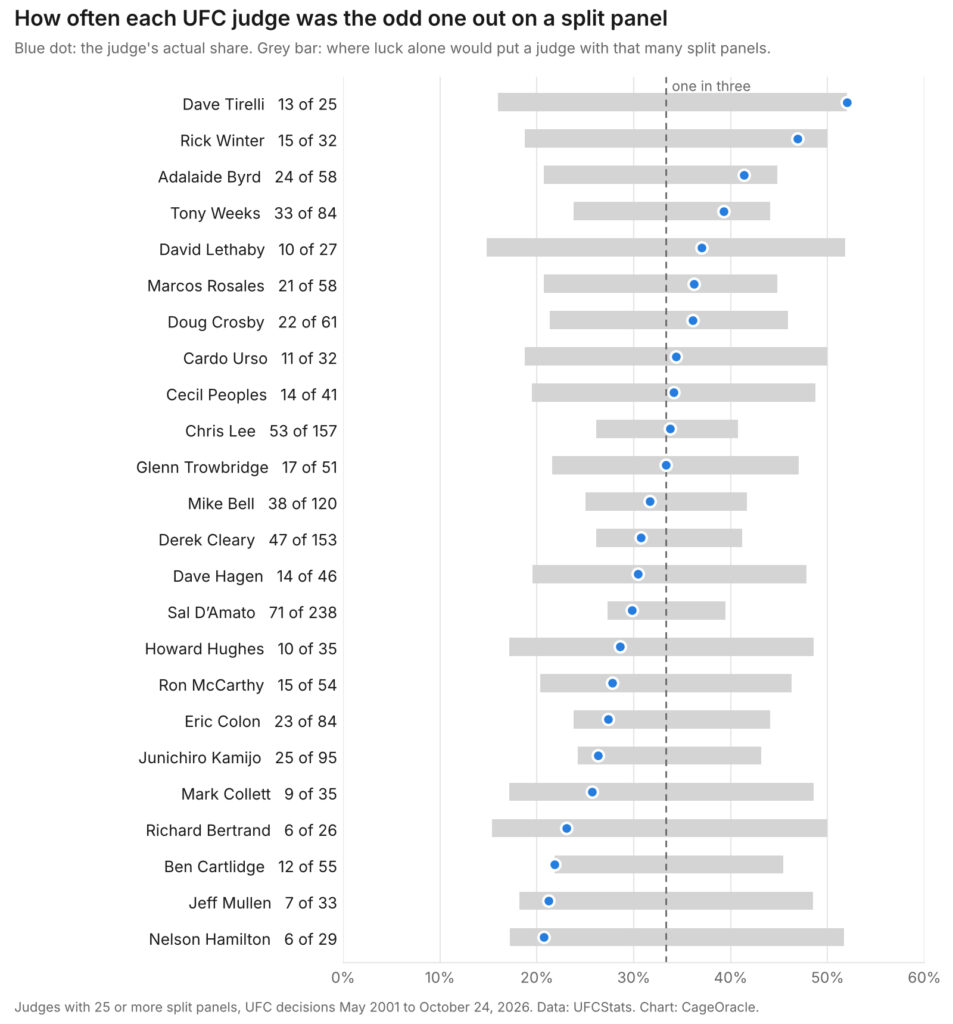
Dave Tirelli tops the list. He was the odd one out on 13 of his 25 split panels, 52%, which puts him right on the top edge of his luck range. An interchangeable judge would get to 13 or more about 4 times in 100. That sounds rare, but 29 judges have sat on at least 20 split panels, and with that many judges you would expect about one of them to get there by luck alone. Rick Winter is second at 15 of 32 (47%), still inside his range.
Every judge who has sat on at least 25 split panels. The blue dot is how often he or she was the odd one out, and the grey bar is where luck alone would put a judge with that many panels.
Then come the names fans already know. Byrd was the odd one out on 24 of her 58 UFC split panels (41%), and Tony Weeks on 33 of 84 (39%). Both are high, and both are inside the range luck allows for that many panels: 21% to 45% for Byrd, 24% to 44% for Weeks. Even for Byrd, being the lone dissenter happens on about one card in 11 that she writes.
The busiest judges sit almost exactly where chance would put them. Sal D’Amato has written more UFC scorecards than anyone, 1,165 of them, close to one in every ten. He has sat on 238 split panels and been the odd one out on 71, or 30%. Chris Lee is at 34%, Derek Cleary at 31% and Mike Bell at 32%. Put the five busiest judges together and it comes to 234 of 763, or 31%.
At the other end, Nelson Hamilton (6 of 29), Jeff Mullen (7 of 33) and Ben Cartlidge (12 of 55) were the odd one out only about one time in five. Cartlidge, who has sat on the most panels of the three, is right at the low edge of his range. These are the judges who most often ended up on the same side as the rest of the panel.
So the straight answer is Dave Tirelli, followed by Rick Winter, Adalaide Byrd and Tony Weeks. But no judge with a real body of work is the odd one out more often than luck can explain.
What the odd judge sees
If the name doesn’t explain the split, what does? I matched each split panel with the fight’s stats from UFCStats. Across all of them, the two judges in the majority went with the fighter who landed more significant strikes 62% of the time.
About half of the split panels, 456 of them, were a striker against a grappler: one fighter landed more significant strikes, the other had more control time. The typical gap was about 15 significant strikes on one side against two and a half minutes of control on the other. In those fights, the lone judge sided with the grappler 59% of the time, while the two judges in the majority went with the man who landed more.
That was true before the 2017 scoring changes (58%) and it has been true since (59%). And it doesn’t come from one judge who loves wrestling. D’Amato was the lone vote for the grappler 23 times. If that role went around the panel at random, he would have had about 26. Cleary had 18 against about 16, and Lee 12 against about 17. In other words, it isn’t the same judge taking the grappler’s side every time.
A big last round doesn’t steal it
Another popular theory is that the odd judge got carried away by the last round. I don’t see it in the scorecards. In 184 split panels, the fighter who lost the strike count over the whole fight won the final round on strikes. He got the two judges 40% of the time, about the same as any fighter in a split who lost the strike count (38%). So winning the last round didn’t seem to help him much.
Splits are getting rarer
The odd one out is also turning up less often, whoever it is. From 2010 to 2024, 21% of UFC decisions were split decisions, and no single year went below 15%. In 2025 it fell to 14%, and in 2026 it is 13% so far. Over the two years that is 61 split decisions out of 452, where the old rate would have given about 96. I couldn’t find one clear reason for the drop. I go through the explanations I ruled out, along with how scoring has changed since the 2017 rules, in the full study of UFC judges on CageOracle.
The bottom line
When a fight goes to a split, the name of the odd judge tells you less than fans think. Over hundreds of panels, the busy judges break from their colleagues about a third of the time, which is what you would expect if the job were handed out at random. The fight itself tells you more. When a striker out-lands a grappler who holds him down and the panel splits, the two judges more often than not go with the strikes, and the lone judge goes with the control.
About the author
Jason Lam is a former Wall Street algo trader who runs CageOracle, a free UFC analytics site that tracks every sportsbook’s odds, Polymarket, expert picks and its own prediction model, and publishes data studies like this one.
About the data
UFC decisions with a winner from May 2001 to October 24, 2026 with all three judges’ names and scores on UFCStats: 4,043 decisions, 12,129 scorecards and 517 judges. A split panel is one where two judges agree on the winner and the third names the other fighter or a draw. The luck range is where 95 in 100 judges would land if each were the odd one out a third of the time. Fight stats are UFCStats totals for the whole fight, and for the final round where stated.
Full table
Every judge who has sat on at least 25 split panels, from most often the odd one out to least.
| Judge | UFC years | Cards | Split panels | Odd one out | Share | Luck range |
| Dave Tirelli | 2010–2026 | 159 | 25 | 13 | 52% | 16%–52% |
| Rick Winter | 2011–2026 | 121 | 32 | 15 | 47% | 19%–50% |
| Adalaide Byrd | 2006–2026 | 267 | 58 | 24 | 41% | 21%–45% |
| Tony Weeks | 2001–2026 | 409 | 84 | 33 | 39% | 24%–44% |
| David Lethaby | 2018–2026 | 198 | 27 | 10 | 37% | 15%–52% |
| Marcos Rosales | 2001–2021 | 231 | 58 | 21 | 36% | 21%–45% |
| Doug Crosby | 2001–2022 | 273 | 61 | 22 | 36% | 21%–46% |
| Cardo Urso | 2009–2019 | 123 | 32 | 11 | 34% | 19%–50% |
| Cecil Peoples | 2001–2013 | 160 | 41 | 14 | 34% | 20%–49% |
| Chris Lee | 2006–2026 | 706 | 157 | 53 | 34% | 26%–41% |
| Glenn Trowbridge | 2004–2020 | 237 | 51 | 17 | 33% | 22%–47% |
| Mike Bell | 2013–2026 | 562 | 120 | 38 | 32% | 25%–42% |
| Derek Cleary | 2012–2026 | 710 | 153 | 47 | 31% | 26%–41% |
| Dave Hagen | 2006–2022 | 180 | 46 | 14 | 30% | 20%–48% |
| Sal D’Amato | 2007–2026 | 1,165 | 238 | 71 | 30% | 27%–39% |
| Howard Hughes | 2009–2024 | 152 | 35 | 10 | 29% | 17%–49% |
| Ron McCarthy | 2015–2026 | 281 | 54 | 15 | 28% | 20%–46% |
| Eric Colon | 2007–2026 | 415 | 84 | 23 | 27% | 24%–44% |
| Junichiro Kamijo | 2010–2026 | 481 | 95 | 25 | 26% | 24%–43% |
| Mark Collett | 2011–2026 | 173 | 35 | 9 | 26% | 17%–49% |
| Richard Bertrand | 2006–2019 | 119 | 26 | 6 | 23% | 15%–50% |
| Ben Cartlidge | 2013–2026 | 280 | 55 | 12 | 22% | 22%–45% |
| Jeff Mullen | 2001–2017 | 158 | 33 | 7 | 21% | 18%–48% |
| Nelson Hamilton | 2001–2011 | 131 | 29 | 6 | 21% | 17%–52% |