
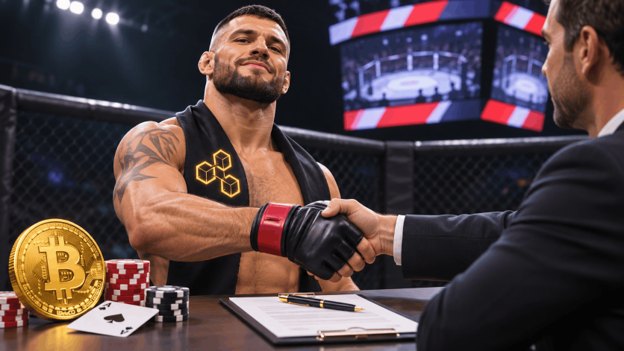
A fighter can spend months preparing for a bout that is over in less than five minutes, yet the attention around that fighter keeps going long after the final bell. Fans follow training footage, press conferences, rankings, rivalries and interviews between events, so a recognisable name can keep a brand in front of them even when there is no live fight to watch.
That gap between a short fight and a long news cycle helps explain why crypto gambling platforms have started signing individual fighters instead of relying only on advertising during UFC broadcasts. Rainbet is the clearest example in 2026. Justin Gaethje joined as a brand ambassador in July, middleweight champion Sean Strickland followed in August, and flyweight champion Joshua Van signed soon after. At the end of October, Alexander Volkanovski announced a multiyear partnership with the brand moments after his UFC 333 win over Movsar Evloev.
The list of names is less interesting than the business question behind it. What does a gambling company actually gain from sponsoring a professional fighter, and why are crypto casinos in particular so keen to be part of the sport?
Where does the crypto casino business fit in?
A sportsbook has an obvious reason to advertise around a fight, because viewers may want to bet on the outcome. A crypto casino’s link to the sport is less direct, since slots, blackjack and roulette have nothing to do with who wins a bout. Several operators, Rainbet among them, combine casino games and sports betting on the same platform, take digital currencies alongside other payment options, and use UFC odds, fighter interviews and event campaigns to build recognition for the whole product range.
The United States shows how that works in practice. Licensed sportsbooks such as bet365, which operates in more than a dozen states, can sit inside the UFC broadcast, while real-money online casinos are licensed in only a handful of states. Offshore crypto operators, usually holding Curaçao or Anjouan licences, fill part of that gap. For American fight fans, many of the tested crypto casinos open to them pair a casino lobby with a sportsbook covering UFC cards. Not every brand that sponsors a fighter takes American customers, though. Rainbet’s own published terms list the United States among its restricted countries, so a US fan who sees a fighter’s promotion still has to check whether they can sign up at all.
None of this means MMA fans are necessarily interested in casino gaming. It means a multi-product operator can use sports sponsorship to build one brand across several types of gambling. How well that works is hard to judge from the outside, because sponsorship announcements rarely reveal how many new customers a fighter brings in or how long they stay.
Why are crypto gambling companies sponsoring MMA fighters?
They want to reach combat sports fans through personalities those fans already follow. A traditional advertisement runs for thirty seconds and disappears, while an athlete partnership can surface again and again through interviews, social media posts, training content and fight-week coverage. In MMA this matters more than in most sports, because fighters often build public identities that are partly independent of the promotion they compete for.
The three UFC names on Rainbet’s roster show how different those identities can be:
- Sean Strickland draws attention through outspoken interviews and a confrontational public persona, often well beyond the result of his latest fight.
- Justin Gaethje is known for an aggressive style and a long record of entertaining bouts, which gives him a clear sporting identity with fans.
- Alexander Volkanovski brings a championship career, a technical reputation and a lighter-hearted public side, which reaches a different part of the audience.
Each one gives a sponsor a different way to talk to fans. The brand does not need its ambassador to win every fight, because what it is paying for is the audience remembering the partnership. Sporting merit and fame rarely line up neatly either. Alexander Volkanovski’s career record includes more featherweight title-fight wins than anyone in UFC history, yet that number tells a sponsor very little about how many fans will remember its name.
Three ways betting and crypto brands buy visibility in MMA
Recent deals across the sport show three distinct approaches, each buying a different kind of exposure.
1. Individual fighters: personality and attention
Rainbet’s partnerships with Strickland, Gaethje, Van and Volkanovski follow the athlete-ambassador model. The brand is not limited to one scheduled event, since it can appear in promotional videos, social posts and whatever other activities the contract covers. Volkanovski’s launch campaign, released straight after his title defence, is a good illustration of how a deal can be timed to the moment a fighter is most in the news.
The flexibility is the main advantage. A fighter can generate a lot of attention during a title run, and interviews or training videos keep reaching fans between bouts. The weakness is that a fighter’s public behaviour is never fully predictable, and the same outspoken comments that bring attention can also bring reputational problems for the sponsor. Strickland shows both sides: Sean Strickland’s fight record is that of a two-time middleweight champion, yet in February 2026 his microphone was cut mid-rant at a UFC press conference in Houston.
2. Official sportsbook deals: a place in the broadcast
In March 2026, UFC named bet365 its official sports betting partner in the United States and Canada, replacing DraftKings, which had held the role since 2021. bet365 already had a similar arrangement with UFC in the UK and Ireland. The new agreement goes well beyond a logo near the cage, with on-screen odds, betting information and other integrations built into the broadcast.
An individual athlete introduces a gambling brand through personality, whereas an official sportsbook partnership links betting information directly to the viewing experience. Fans may barely notice the difference, but for the advertiser it decides where the brand appears and how often.
3. Crypto partnerships: a connection to the sport itself
Crypto.com offers a third route. Its relationship with UFC began in 2021, when it became the promotion’s first official fight-kit partner. In April 2026 the two announced that Crypto.com would co-present UFC Freedom 250, held on the White House South Lawn on 14 June, and fund a $1 million fighter bonus pool paid in its CRO token, which UFC described as the biggest bonus in its history.
Crypto.com is a cryptocurrency platform, not a crypto casino, and the difference is worth keeping in mind. Exchanges, crypto sportsbooks and online casinos may sit in the same digital-asset world, but they sell different products. The sponsorship logic still overlaps, since each is buying visibility through fighters, major events or the wider MMA audience.
Does a fighter’s ranking decide their sponsorship value?
Rankings and sponsorship valuations answer different questions. A ranking is built on competitive results, the quality of opposition and recent form, while sponsorship value also depends on audience reach, public recognition, personality and marketability, none of which appear in a fight record. A technically outstanding fighter may have a modest social media following, and another may attract huge interest despite recent defeats.
In a sport where rankings, title opportunities and popularity rarely move in step, that gap is easy to see. FightMatrix’s current MMA rankings are built only on official results and give a solid sporting reference, but they were never meant to rank fighters as commercial endorsers. A gambling company could in theory sign the top-ranked fighter in every division, yet in practice it may get more exposure from a controversial or especially entertaining personality further down the list.
Can MMA fighters promote betting companies without betting on fights?
Yes, within the law, their contracts and the promotion’s rules. In October 2022, UFC changed its Athlete Conduct Policy to stop fighters and their close associates from betting on any UFC bout, while still allowing sponsorship deals with sports betting companies where the law permits them.
That separates two activities fans sometimes mix up, endorsing a betting brand and personally betting on a fight. The distinction exists because fighters, coaches and others close to the competition can hold information ordinary bettors do not have. In September 2023, UFC added a partnership with ProhiBet to monitor prohibited betting by athletes, coaches, employees and officials, so sponsorship arrangements now run alongside integrity controls instead of replacing them.
Does a fighter’s endorsement make a crypto casino trustworthy?
An endorsement creates a commercial relationship, not an independent check on the operator. A well-known fighter can be an effective ambassador without ever having looked at a company’s financial controls, withdrawal procedures or licensing conditions, so those questions need checking separately, by looking at where the operator is licensed and how it handles payouts and complaints.
Crypto payments do not guarantee anonymity, instant withdrawals or any protection against gambling losses either. An endorsement can show how a gambling company markets itself, but on its own it says nothing about whether that company deserves a customer’s trust.
What comes next for MMA and crypto gambling sponsorships?
2026 has shown several models running at the same time. Rainbet has built a roster of combat sports personalities, bet365 has taken the official UFC sportsbook role in two major markets, and Crypto.com has used event sponsorship and crypto-paid bonuses to extend a relationship that began five years ago. None of this proves that every MMA promotion will attract more crypto gambling money in 2027, or that crypto casino advertising will push out traditional sportsbook deals.
What these deals do show is that combat sports give advertisers far more than a short window during a live broadcast. A fighter can be a competitor, an interview subject, a social media personality and a commercial ambassador all at once, which gives a brand several ways to reach the same fans. For gambling operators, the challenge is turning that attention into lasting business without letting promotion undermine sporting integrity or consumer protection.
For fighters, a sponsorship adds another income stream, but it also ties their reputation to a company they do not control. For fans, the most useful point is the simplest one: how good a fighter is inside the cage tells you very little about the gambling company paying for the endorsement.
18+. Gambling involves risk. Only bet what you can afford to lose, and seek support if gambling stops being fun.