
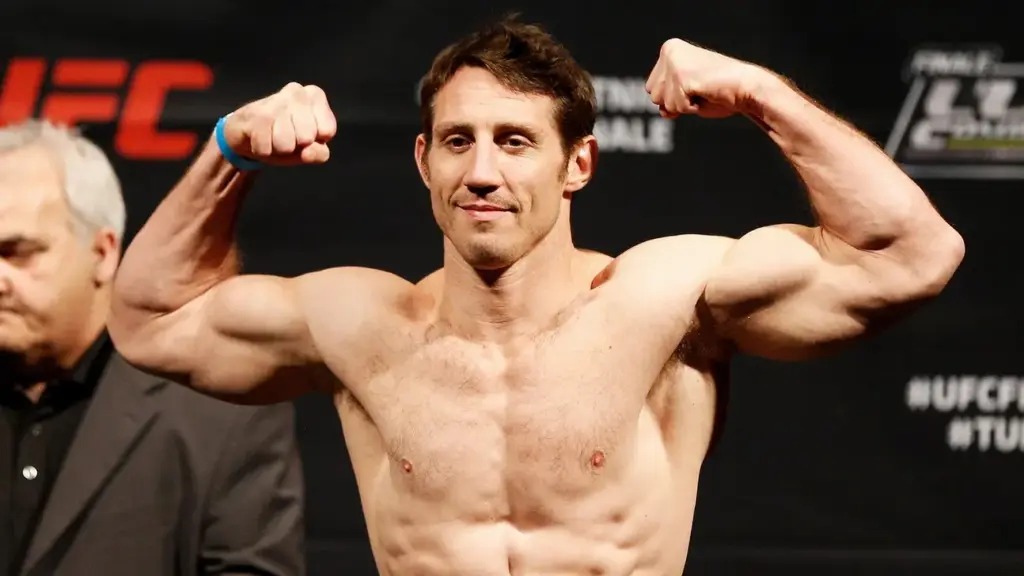
The former UFC middleweight and U.S. Army Green Beret was reportedly shot three times in the leg during a Sept. 17 ambush in eastern Democratic Republic of Congo that left about 20 people dead or wounded, survived a lengthy evacuation and eventually reached Walter Reed, prompting prayers from Anderson Silva and members of the combat sports community.
Bethesda, Maryland – Tim Kennedy spent much of his adult life moving between two worlds where danger was expected. He fought elite middleweights inside the UFC and served in U.S. Army Special Forces outside of it, building one of the most unusual résumés in combat sports. Nearly a decade after his final appearance inside the Octagon, however, Kennedy has survived an encounter far removed from anything governed by a referee, a commission or a five-minute clock.
Kennedy was shot three times in the leg during a Sept. 17 ambush in South Kivu province in the Democratic Republic of Congo while reportedly working with Vectus Global, a private security and consulting operation founded by Erik Prince. Approximately 20 people were killed or wounded in the attack, according to accounts citing people familiar with the incident, and Kennedy eventually underwent a lengthy evacuation before reaching medical care. He is now receiving treatment at Walter Reed National Military Medical Center outside Washington.
The first major public reassurance about Kennedy’s condition came from Wisconsin Rep. Derrick Van Orden, a former Navy SEAL who said he had personally spoken with Kennedy following the attack. Van Orden confirmed that Kennedy was alive and asked people to pray for his recovery and his family, providing an important update after days of uncertainty surrounding the former fighter’s condition.
The details emerging around the attack make Kennedy’s survival even more remarkable. Reports indicate he was struck three times in the leg as the group he was traveling with came under attack in eastern Congo. One account described a recovery operation that took approximately eight hours, while another report placed the delay between the ambush and recovery at roughly eight to 10 hours. Kennedy was eventually evacuated through Burundi and Johannesburg before reaching Walter Reed in the United States.
Not everyone in the group survived. Former New Zealand Special Air Service soldier Justin Conaglen was among those reported killed, along with several Congolese victims. Another foreign security contractor was also wounded. The precise casualty total has varied slightly across reports, but multiple accounts agree that roughly 20 people were either killed or injured during the attack.
For Kennedy, the incident represents a dramatic return to the kind of dangerous operational environment that had helped define his public identity long before most MMA fans knew his name. Kennedy served in U.S. Army Special Forces and deployed to Iraq and Afghanistan while simultaneously building a professional fighting career. That combination eventually became inseparable from his reputation, making him one of the rare UFC athletes whose life outside the cage could appear every bit as intense as the one inside it.
What Kennedy was doing in Congo requires considerably more context than simply describing him as a former fighter working security. He was reportedly operating with Vectus Global, the security organization founded by Prince, who previously founded Blackwater. Prince’s work in Congo initially centered on helping the government improve control over revenue from the country’s enormously valuable mineral sector, but reporting indicates the operation later expanded closer to active security and military support.
Eastern Congo contains immense mineral wealth while also remaining the center of a complicated and deadly regional conflict. Cobalt, copper, lithium and tantalum extracted from the country are critical to everything from smartphones and electric vehicles to defense technology. Control of territory, mining revenue and supply routes has therefore become intertwined with a conflict involving Congolese forces, armed groups and neighboring Rwanda.
Vectus personnel reportedly became involved in security work around Uvira and other strategically important areas as the Congolese government confronted the M23 rebel movement. The United Nations and Western governments have accused Rwanda of supporting M23, while Rwanda has repeatedly denied backing the group. Some sources familiar with the Sept. 17 attack have alleged that Rwandan forces were responsible for the ambush, but no government has publicly established responsibility for the attack.
One theory offered by a Congolese government source was that a surveillance drone used by the group may have been tracked back to their location. Other sources described the ambush as sophisticated enough to suggest the involvement of highly capable forces. Those assessments remain allegations rather than a publicly established account of responsibility, and the circumstances surrounding precisely how Kennedy’s group was located remain unclear.
Kennedy’s own role has also not been fully detailed publicly. Reports describe him as working with or under contract for Vectus Global, but the exact responsibilities he had during the mission have not been independently established. His trip had not been publicly announced beforehand, and reporting indicates his precise military status at the time was also unclear.
That uncertainty has not prevented the combat sports world from rallying around a man many fighters spent years knowing as one of the UFC’s toughest middleweights. Anderson Silva was among those who publicly reached out after learning what happened. Silva sent Kennedy and his family prayers and strength, while also acknowledging the death of Conaglen and the others affected by the ambush.
The message carried additional weight because Silva and Kennedy belonged to the same era of UFC middleweight history. Kennedy never fought Silva, but he spent years competing among many of the names who defined the division during and immediately after Silva’s historic championship reign. Hearing that a former colleague had been shot repeatedly during a deadly overseas operation moved Silva to address Kennedy directly and encourage his recovery.
Kennedy’s MMA career itself was substantial long before the events in Congo placed his name back into international headlines. He retired with an 18-6 professional record after competing in both Strikeforce and the UFC, twice challenging for the Strikeforce middleweight championship and later establishing himself among the UFC’s most recognizable middleweights.
His résumé included victories over former UFC champions Michael Bisping and Robbie Lawler, along with wins over Roger Gracie, Rafael Natal and several other established fighters. His victory over Bisping in 2014 remains one of the defining performances of his UFC career, while his knockout of Natal at UFC Fight for the Troops 3 became another memorable moment in a career that frequently intertwined fighting with military service.
Kennedy last competed in December 2016 at UFC 206, where he lost to Kelvin Gastelum. By then, his place in MMA had already become unusual because fans rarely separated the fighter from the soldier. Interviews routinely moved between training camps and deployments, and Kennedy openly presented himself as someone whose understanding of physical danger had been shaped by experiences considerably more serious than professional competition.
His military record later became the subject of scrutiny after Kennedy acknowledged that he had incorrectly described aspects of his service, including statements implying that he had received a Bronze Star Medal with Valor. Kennedy apologized and clarified that he had received a Bronze Star in 2006 for his work planning combat operations in Iraq, but not the valor designation he previously suggested. The Army was subsequently reported to have opened an investigation into aspects of his service record.
That controversy remains part of Kennedy’s public history, but it is separate from what happened in Congo. Whatever arguments have surrounded his past statements, the available reporting about Sept. 17 describes a former UFC fighter and Special Forces veteran who was caught in an extraordinarily dangerous attack, suffered three gunshot wounds and survived while others around him did not.
The broader circumstances also make this more than another story about an MMA veteran encountering danger after retirement. Kennedy’s presence in Congo places one of combat sports’ most recognizable former fighters inside a much larger geopolitical struggle involving mineral wealth, private security companies, rebel movements and competing regional interests.
Prince’s operation reportedly began with an agreement intended to improve Congo’s ability to collect revenue from its mineral industry and combat smuggling and tax fraud. Over time, reporting indicates that the work expanded into areas involving border security, aircraft, drones, military advice and foreign personnel. That evolution brought contractors much closer to one of the world’s most volatile conflicts and ultimately placed Kennedy in the convoy that was attacked on Sept. 17.
For MMA fans, however, the most immediate concern remains Kennedy himself. Walter Reed has declined to discuss individual patient care, citing federal privacy law, and people close to Kennedy have not publicly provided a detailed medical prognosis. The clearest confirmed public development is that Kennedy survived, has been able to communicate and reached the United States for treatment.
That alone is significant considering the circumstances being described. Kennedy reportedly survived three gunshot wounds, endured hours before evacuation, traveled out of central Africa and ultimately reached one of the United States’ most prominent military medical facilities. The same man who spent years being introduced to UFC audiences as a fighter with an extraordinary tolerance for adversity is now facing a recovery that has nothing to do with rankings, title shots or wins and losses.
Kennedy built his public life around the idea that fighting and soldiering were inseparable parts of who he was. His professional MMA career ended almost a decade ago, but danger clearly did not disappear when he removed the gloves for the final time. On Sept. 17, thousands of miles from the Octagon and deep inside one of the world’s most complicated conflicts, that reality became brutally clear.
Now, the story is about survival. Tim Kennedy made it out of the ambush alive, made it back to the United States and is receiving treatment while the families of those killed are left confronting a far different outcome. As Anderson Silva, myself, and others throughout the MMA world send prayers toward Kennedy, the hope is no longer for another victory inside the cage. It is simply that one of the sport’s most unusual veterans can complete another recovery and eventually make it home.
Andrew Carswell is a combat sports columnist and college writing professor, based in Las Vegas, NV, whose work examines the intersection of fighting, media, business, and culture. His commentary and analysis have been featured in various magazines, newspapers, and media outlets, including Yahoo! News, and USA TODAY. Blending journalistic insight and experience with a fan’s perspective, Carswell writes about the fight game as both a cultural phenomenon and a global business.