
Most AI video workflows still behave like a clip factory.
You generate an 8-second hook. Then a product orbit. Then a lifestyle insert. Then you spend the afternoon hiding seams on a timeline. The model looked fine in isolation. The sequence does not.
If your deliverable is a complete ~30-second beat — product story, fashion walkthrough, explainer arc, cinematic mini-scene — the brief has to change before the generator does. Longer coherent generation only helps when the input is written like a mini production, not like a mood board caption.
This guide is a briefing method. It is not a model beauty contest and not a platform ranking. When you need an engine built for that longer multimodal job, Seedance 2.5 is the tool this workflow assumes.
The real failure mode is not “bad AI”
It is mismatched scope.
Short-clip tools reward spectacle: one camera move, one hero moment, one pretty frame. A 30-second piece needs:
- an opening that establishes the subject
- a middle that develops the claim or action
- a close that resolves or sells
- continuity pressure across those beats
If your prompt only says “cinematic skincare ad, soft light, luxury,” you asked for atmosphere. You did not brief a sequence.
Write the video as four timed blocks
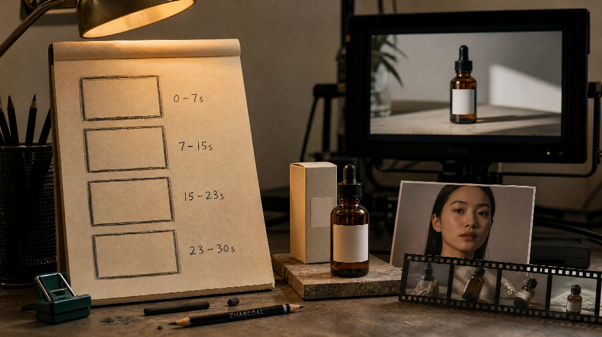
Before you upload anything, sketch the piece on a notepad with second ranges. Keep it boring and specific:
| Time | Job | Visual | Sound |
| 0–4s | Hook / establish | Product or lead enters frame | Music bed starts; no dialogue yet |
| 4–14s | Proof / action | Close-ups, motion, benefit shown | Optional VO line 1 |
| 14–24s | Lifestyle / context | Subject used in a real environment | VO line 2 or SFX |
| 24–30s | Resolve / CTA | Clean hero hold + text space | Music resolve |
You can rename the blocks for fashion, education, or short narrative. The point is the same: every second range owns one job. When the middle collapses into “more pretty shots,” stitch-thinking sneaks back in.
Pack references by role, not by vibe
Longer multimodal models can take a fat kit — images, short video refs, audio — but unlabeled piles still confuse them.
Give every asset a job:
- Identity lock — hero face / character sheet / approved talent still
- SKU lock — product packshot, label, colorway
- Location lock — one environment family, not five cities
- Motion lock — a short clip that shows the walk, pour, unbox, or gesture you want
- Audio lock — music bed or VO tone reference
If two images fight (two different bottles, two hairstyles, two lighting schemas), delete one before you generate. Continuity is easier to protect upstream than to repair after.
Prompt like a shot list, not a poem
A useful 30-second brief usually includes:
- Subject + objective in one sentence
- Shot order with approximate timestamps
- Camera language (push-in, tracking, static hero, insert)
- What must stay consistent (outfit, bottle, room, time of day)
- What must not appear (extra logos, random text, unwanted subtitles, second character)
Example shape (adapt the product):
0–4s: marble table, serum bottle from Identity/SKU refs, slow push-in. 4–14s: texture close-ups and soft water reflection, no new packaging. 14–24s: same bottle in a bright bathroom lifestyle beat. 24–30s: centered hero hold with clean negative space for end card. Soft daylight throughout. No on-screen text. Use music ref for pacing.
That reads like direction. “Make it viral and premium” does not.
Run one continuity test before the hero render
Do not burn a full 30-second production pass on an untested kit.
- Generate a shorter preview (or a reduced version of the same brief)
- Check only three things: subject recognition, geography, and label/readability
- Fix the brief or the reference pack — not the hope that a reroll invents discipline
- Then commit to the full-length pass
If second 12 invents a new bottle, your SKU lock failed. If the room changes temperature between blocks, your location lock failed. Those are brief problems.
A simple scorecard for “ready to generate”
Mark yes/no:
- Timed blocks written
- Each reference has a role
- One primary identity and one primary SKU
- Camera verbs assigned to ranges
- Negative list written
- Preview continuity check passed
Four or more “no” answers means you are still in clip-factory mode.
Bottom line
Longer AI video does not remove directing. It makes weak briefs more expensive.
Write second ranges. Label references. Prompt as a shot list. Preview continuity before the hero render. Use a longer multimodal generator when the deliverable actually needs one coherent 4–30 second piece.
When the method is clear, the model can execute. When the method is vague, no amount of rerolls will stitch a film out of five lucky clips.