
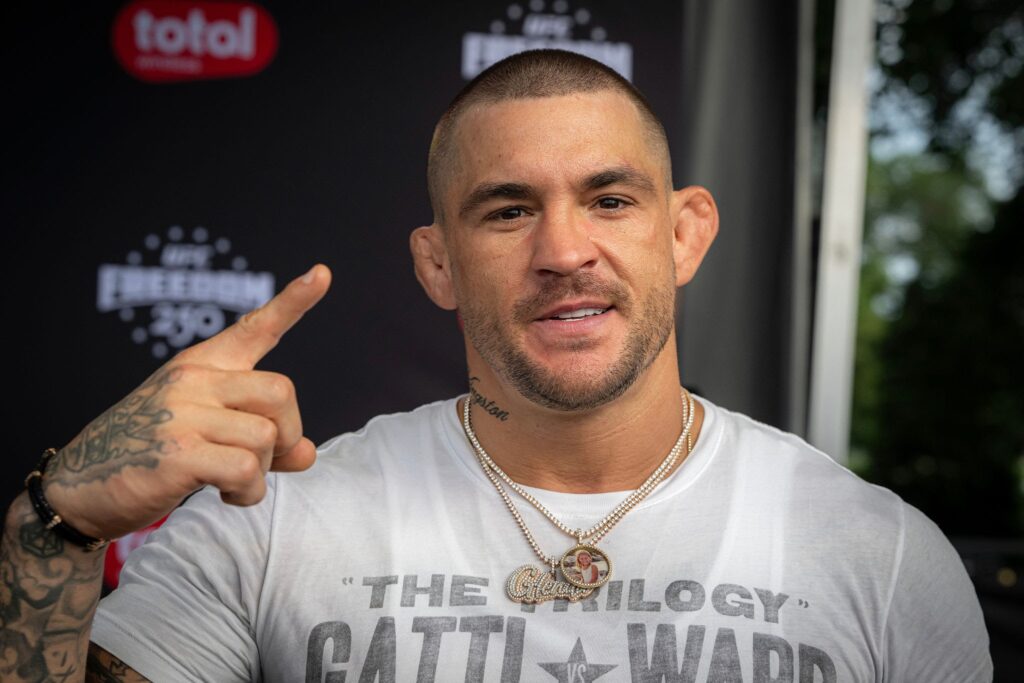
One year after laying down his gloves, Poirier opens up about the airport arrest that threatened his future, the drinking problem he could no longer deny, the painful family cycle he intends to break, and the daily work required to rebuild his life.
Dustin Poirier had every reason to cancel the interview. His flight home from Florida had been delayed, an airline change sent him through Dallas, and a missed connection forced him to rent a car and drive more than six hours through the night to Lafayette, Louisiana. He finally reached home around six in the morning, but only hours later, tired and searching for the wireless headphones he had misplaced during the trip, Poirier still appeared for his scheduled conversation with Ariel Helwani.
That small decision captured much of what followed. Poirier was exhausted, uncomfortable, and discussing the most embarrassing public moment of his life, but he showed up anyway.
Nearly one month after his arrest for public intoxication at Atlanta’s airport, the former UFC interim lightweight champion spoke openly about the incident, the consequences that followed, and the internal struggles that intensified after his retirement. He did not blame the airport staff, the responding officer, his family, his father, retirement, or the pressure of being recognized everywhere he goes. Instead, he repeatedly returned to the same point. He made the decisions, and he must accept what comes next.
Poirier described the arrest as a moment of self-sabotage that he may have sensed long before it happened. During filming for an upcoming documentary, he had reportedly wondered aloud how he might eventually get in his own way once fighting was gone. He did not remember making the statement until the filmmaker later reminded him, but the words took on a darker meaning after the airport incident.
For nearly two decades, fighting gave Poirier a schedule, an identity, and somewhere to direct every part of himself. Training camps demanded discipline. Opponents gave him a target. The pursuit of a championship required his full physical and emotional attention. Once that structure disappeared, Poirier discovered that financial preparation was not the same as emotional preparation.
He had investments. He had created security for his wife and children. He had built a respected foundation and positioned himself for television work after retirement. What he had not fully prepared for was the mental impact of burying the fighter he had spent most of his life becoming.
Poirier described his retirement celebration in New Orleans as one of the most meaningful nights of his career. Lil Wayne accompanied him during his final walk to the Octagon, his city celebrated him, and the UFC provided the kind of farewell most fighters never receive. He remains overwhelmingly certain that he will not return to competition. Still, he admitted that part of him felt the weight of how final everything became when he laid down his gloves.
The ceremony honored his career, but it also closed the door on the routine that had protected him from too much unstructured time. Poirier said he had warned people for years that idle hands made him dangerous. Without a fight camp consuming his days, he began overthinking, struggling emotionally, and using alcohol in a way that was no longer connected to celebration.
Poirier explained that he was not drinking every day. He could go weeks without alcohol and did not experience the physical withdrawal symptoms he once associated with alcoholism. His problem appeared after the first drink. Once alcohol entered his body, he found it extremely difficult to stop. A single glass of wine could become a bottle, followed by another. A social drink could become an entire night of excess.
He now recognizes that pattern as a form of alcohol use disorder.
The most troubling change occurred after retirement. For much of his life, Poirier drank during parties, celebrations, and social gatherings. After fighting ended, he realized he was drinking to process emotion. Rather than confronting what he was feeling, he was attempting to silence it. He described that behavior as running away from his thoughts and acknowledged that the approach was harming both himself and the people closest to him.
The arrest became the moment he could no longer minimize the problem.
Poirier said he was in a poor mental state on the day of the incident and knowingly made choices he should not have made. His memory remains incomplete, but he recalled becoming involved in an argument with airline employees before police were called. Although some reports indicated he had been removed from a plane, Poirier said he did not remember ever boarding the aircraft. What he remembered more clearly was the shame of later watching the footage.
The video showed a version of Poirier that he did not recognize as the husband, father, fighter, and community leader he has spent years trying to be. He apologized for his behavior, including offensive language captured during the encounter, and said his upbringing did not excuse words that should never have been used.
He also expressed gratitude for the officer who handled the situation. Poirier said the encounter could have ended far worse considering his condition and state of mind. He praised the officer for remaining calm and has attempted to contact him personally, either through a phone call, message, or written letter, to offer his thanks.
Legally, Poirier said he is facing a misdemeanor public intoxication charge. He acknowledged that consequences could include a fine and potentially more serious penalties, though he does not expect the situation to result in jail time. His attorney has told him that his immediate return to therapy and continued efforts to address the underlying problem could help resolve the case favorably.
Poirier made clear that he is not seeking special treatment. He believes accountability requires accepting both the good and bad consequences of his actions.
One consequence arrived almost immediately. Bud Light terminated its sponsorship agreement with Poirier, costing him what he described as several hundred thousand dollars remaining on the contract. The financial loss was significant, especially because it affected money that would have benefited his family, but Poirier also acknowledged the obvious conflict that would have existed if he continued advertising alcohol while publicly committing to sobriety.
He did not criticize responsible drinkers or argue that everyone should stop consuming alcohol. His conclusion was personal. Other people may be capable of having one or two drinks and walking away. He is not.
Poirier has now vowed never to drink again.
The promise is not presented as a temporary reset or a thirty day challenge. He described it as a permanent decision that has changed the direction of his life. He said his children will never again see him intoxicated or remember him saying and doing things he did not mean because of alcohol.
That promise carries even greater significance because of Poirier’s relationship with his father.
Poirier revealed that his father is homeless in Louisiana and continues to struggle with severe alcoholism. According to Poirier, his father receives a Social Security payment, spends several days in a hotel, drinks and gambles until the money is gone, and then returns to the street until the next check arrives. The two have not spoken in several months.
Poirier said he would purchase a home for his father if he committed to sobriety. His sister located him and explained that the family was willing to help, but Poirier believes his father has chosen alcohol over recovery. Years of drinking have already damaged marriages, friendships, and relationships with children, grandchildren, and great grandchildren.
The airport incident occurred on Father’s Day, and Poirier acknowledged that his father had been heavily on his mind. It was the first Father’s Day in years that passed without communication between them, and the emotion contributed to his poor mental state. Still, Poirier refused to use that pain as an excuse. His father’s decisions may help explain the family history he is confronting, but Poirier believes his own choices remain his responsibility.
That is why his most important declaration was not about Bud Light, the arrest, or his public image. It was about ending the cycle.
Poirier said the pattern stops with him.
His son Kingston will not grow up remembering a father consumed by alcohol. His daughter will not watch him repeat the behavior he witnessed in his own childhood. Poirier cannot force his father to change, but he can prevent the same destruction from reaching another generation of his family.
That mission has returned him to therapy with a seriousness he admits was missing before. Poirier previously attended therapy regularly and developed practices that helped him manage his thoughts, including reading and writing each morning. Once he began feeling better, he stopped doing the work.
He now understands that mental health cannot be treated like a problem that disappears after a few successful sessions. Poirier compared therapy to training. A fighter does not stop going to the gym after winning five consecutive fights simply because he now knows how to compete. The skills must be practiced every day. The body must continue working, and the mind requires the same discipline.
There is no single breakthrough, miracle pill, or morning when every mental struggle disappears. For Poirier, recovery means reading, writing, attending therapy, waking up early, and allowing his wife to hold him accountable. It means continuing the routine even when he feels strong enough to convince himself he no longer needs it.
The public nature of his mistake made that process more difficult. Poirier temporarily deleted social media because he knew criticism, jokes, and edited clips would reach him from every direction. He described the incident as taking a public loss and understood that he was not mentally prepared to watch the world react while he was attempting to stabilize himself.
Unlike most people, Poirier does not receive the privacy to make mistakes, correct them, and return when he is ready. His lowest moments become videos, headlines, and social media content. Leaving those platforms gave him time to focus on his family, therapist, and immediate support system without allowing strangers to shape the recovery process.
When he eventually returned, Poirier found more compassion than he expected. Fighters, friends, fans, and colleagues reached out to support him. Some athletes even began imitating the pose he made during the arrest footage, turning an embarrassing image into a strange symbol of defiance. Poirier admitted the original moment was painful but said he remains determined to transform it into something positive.
The UFC also responded with support. Poirier said Hunter Campbell contacted him the day after the arrest and assured him that the organization would not allow someone who had fought for the company for more than fifteen years to handle the crisis alone. Campbell offered assistance and told Poirier the UFC had his back.
That call mattered because Poirier feared he had destroyed the post retirement career he had begun building. He wanted to work as an analyst, remain connected to the sport, and continue appearing on television. In the immediate aftermath, those opportunities became uncertain. CBS evaluated the situation, and Poirier temporarily stepped away from his broadcast work.
Returning to the studio for his weekly program made him feel that life might be moving toward normal again. Even after delayed flights, a missed connection, and a six hour drive home, Poirier said he remained grateful simply to be working.
The interview also addressed Sean Strickland, who publicly criticized Poirier before later removing the comments. Poirier said Strickland contacted him privately after a day or two. Once they spoke, Strickland deleted the posts. Poirier did not express resentment and dismissed the situation as another example of people having opinions.
His willingness to move forward did not prevent him from speaking bluntly about other fighters. Poirier questioned why Michael Chandler continues competing after a series of losses and increasing damage. He made clear that the comments were not personal. The two former opponents have settled their differences, but Poirier believes every veteran fighter must eventually ask what he is still fighting for.
Poirier retired because championship contention no longer felt like a realistic path. He had made enough money and refused to become a fighter who continued entering wars only to collect a paycheck. In his view, age does not improve speed, reflexes, or athleticism. Power may remain, which can convince fighters they are always one punch away from reversing their decline, but Poirier believes families, long term health, and quality of life must eventually become part of the calculation.
He also discussed Conor McGregor’s potential return, noting that the severity of McGregor’s reported knee injuries will determine whether another comeback is realistic. After years away from competition, another extended recovery could make returning at an advanced age even more difficult. Poirier believes McGregor may try, but he was unwilling to predict whether the former champion could successfully reclaim his old form.
Those fight discussions offered a reminder that Poirier remains one of MMA’s sharpest voices. He has shared the Octagon with McGregor three times and Max Holloway three times. He has defeated Justin Gaethje, Chandler, and several of the best lightweights of his generation. Part of him still watches those men compete and wonders whether he could remain among them.
He knows he must let that feeling go.
The more important fight is happening outside the Octagon now. It is the fight to remain sober, continue therapy when he feels better, rebuild trust, protect his family, and avoid repeating the choices that destroyed his father’s relationships. It is less glamorous than a championship bout and offers no applause after each successful day.
Poirier may have lost money, damaged his public image, and frightened himself with how quickly one terrible decision threatened everything he had built. Yet he also believes the incident may become the moment that saves him from a far greater collapse.
He cannot erase what happened in Atlanta. He can only decide what the moment becomes.
For most of his career, Dustin Poirier showed the world how to survive inside a cage. Now, in retirement, he is learning that survival can also mean asking for help, accepting consequences, and choosing every morning not to become the man he once feared he might be.
Andrew Carswell is a combat sports columnist and college writing professor, based in Las Vegas, NV, whose work examines the intersection of fighting, media, business, and culture. His commentary and analysis have been featured in various magazines, newspapers, and media outlets, including Yahoo! News, and USA TODAY. Blending journalistic insight and experience with a fan’s perspective, Carswell writes about the fight game as both a cultural phenomenon and a global business.