
Recently, I thought about the effects of inactivity and wondered if age is a compounding factor. Does an older fighter suffer more from inactivity than a younger fighter?
Below, are the statistics for win % by the amount of inactivity prior to a fight.

Once we get past the slight improvement seen in the 91-180d segment, it is a pretty gradual decline in win %.
Let’s look at some age-specific data. The age ranges themselves were driven by my desire to split the fight data (by count) as evenly as possible.
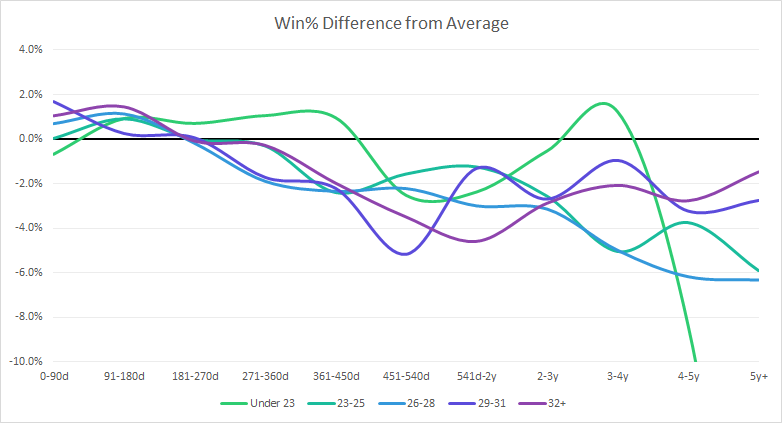
It seems that all age groups benefit from staying active, especially the “Under 23” group. They see a win percentage improvement at inactivity periods of slightly beyond one year! I would not take the large dip at the higher inactivity periods for the “Under 23” group very seriously. The data is thin — how many fighters will be in this age group and have that many years of inactivity since their last fight? Not many.
All in all, the age groups track pretty similarly, but the older groups seem to handle extended inactivity a little better than the younger groups.
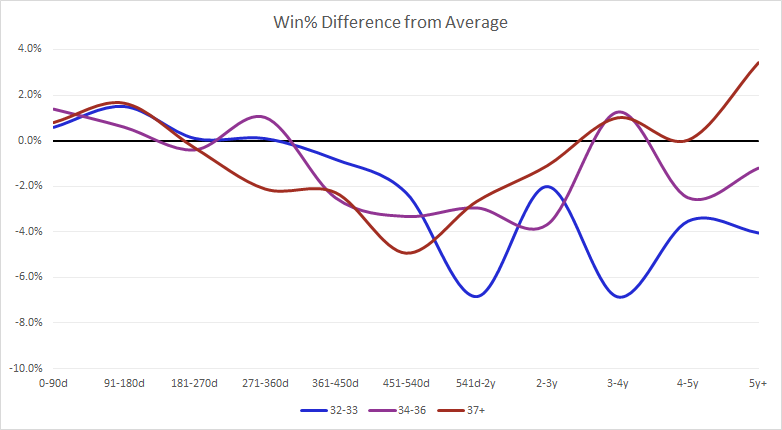
Interesting. Perhaps maturity plays a role here? I would’ve expected the opposite…
Taking the sport as a whole, it is easy to say that staying active matters, but how much impact do other factors have, like matchmaking? Is a fighter returning from 4 years of inactivity more likely to have a favorable match-up or a terrible one? Does this impact fighters of different ages in a similar manner?
Note: The data that drives the line charts is a subset of the data used for the win percentages in the first image as we do not have birth dates for all fighters. The win rate for fighters with birth dates is much higher than those without. Hardly anyone records the birth date of a 0-2 fighter.
I welcome discussion in the comments section…