
If you’ve watched a UFC event recently, you’ve probably noticed something impossible to miss. Casino and betting logos are everywhere – on the octagon mat, splashed across fighter shorts, woven into broadcast graphics, and even baked into the live odds tickers that pop up between rounds. This isn’t coincidence, and it isn’t subtle. The relationship between MMA and casino platforms has become one of the most aggressive sponsorship pipelines in all of professional sports. But how exactly did we get here, and why does this particular marriage work so well? Let’s dig into the mechanics behind how sponsorship in MMA and casino platforms are connected, what’s driving the money, and where things are heading next.
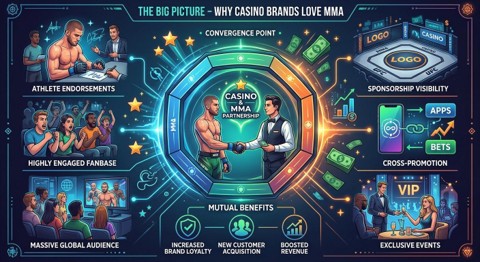
The Big Picture – Why Casino Brands Love MMA
A Young, Digitally Native Audience
Mixed martial arts, and the UFC in particular, attracts a fan base that gambling operators dream about. The audience skews young, digitally engaged, and comfortable with mobile apps. That last point matters enormously. Casino platforms and sportsbooks aren’t just looking for eyeballs – they want users who will download an app, deposit funds, and start wagering within minutes. MMA fans fit that profile better than almost any other sports audience. According to SBC News, the UFC generated almost $90 million from commercial partnerships in the first half of 2026 alone, with more than 100 commercial partners across its ecosystem. A significant chunk of that money flows from betting and casino brands, and the reason is straightforward: as the UFC’s own partnership announcements have demonstrated, the demographic overlap between MMA viewers and potential gambling customers is enormous.
When you compare MMA to, say, golf or tennis, the difference in audience behavior is stark. MMA fans are active on social media, they follow fighters personally, and they consume content voraciously across YouTube, TikTok, and streaming platforms. For a casino brand trying to acquire new customers at scale, that kind of engagement is gold. Furthermore, the sport’s event-driven nature – big cards every few weeks, with clear narratives and rivalries – creates natural betting moments that operators can build campaigns around. This isn’t just advertising; it’s a funnel designed to convert fans into betters, and betters into casino players, often lured deeper into the ecosystem through incentives like online casino bonuses that are promoted alongside fight-night specials and wagering sign-up offers.
The Sportsbook-Casino Crossover
Here’s something a lot of people don’t realize. Many of the brands sponsoring MMA aren’t just sportsbooks. They’re full-stack gambling platforms that also run online casinos with slots, table games, and live dealer products. Bet365, which became the UFC’s official sports betting partner in the U.S. and Canada in March 2026, is a perfect example. Sure, the partnership promotes sports wagering – on-screen betting tickers, fighter odds, same-game parlays – but bet365 also operates a massive online casino product. So when a UFC viewer downloads the bet365 app to place a fight wager, they’re one tap away from the casino lobby. As MyMMAnews reported, fight sponsorship and casino cross-sell are increasingly bundled together, meaning MMA serves as a gateway into the broader gambling ecosystem. That’s a critical distinction, and it’s the real engine behind these sponsorship dollars.
How the Money Flows – Two Tiers of Sponsorship
Organization-Level Deals
The biggest sponsorship contracts in MMA happen at the promotional level. The UFC, as the dominant global promotion, commands premium rates. When bet365 replaced DraftKings as the official U.S. and Canada betting partner in early 2026, the deal was described as multi-year and long-term. Integration kicked off at UFC 326: Holloway vs. Oliveira 2 on March 7 at T-Mobile Arena in Las Vegas and covered more than 40 fights throughout the year. These organization-level partnerships include broadcast integrations, arena branding, digital content, and exclusive access to UFC intellectual property. They’re expensive, they’re exclusive, and they lock out competing brands from the most visible sponsorship inventory in the sport.
This creates an interesting dynamic. Because bet365 holds the exclusive organizational rights for the U.S. and Canadian markets, rival casino and sportsbook brands can’t simply buy the same broadcast placement. They’re forced to find alternative pathways to reach MMA fans. And that’s exactly what’s been happening through the second tier of sponsorship.
Fighter-Level Ambassador Deals
If you can’t sponsor the promotion, sponsor the fighter. That’s the logic driving a wave of individual ambassador deals between casino platforms and MMA athletes in 2026. As detailed by industry analysts tracking iGaming sponsorship trends, the strategy mirrors what’s been happening across streaming and content platforms, but MMA’s unique fighter-fan relationship makes it especially potent. Here are the key developments that illustrate this trend:
- Rainbet signed UFC middleweight Sean Strickland as a brand ambassador in October 2026, following earlier visibility with Justin Goethe in July of the same year.
- BC Game announced Roberto Sold as a global brand ambassador on November 3, 2026, with the deal covering digital marketing campaigns, fight-night promotions, and interactive fan experiences.
- Random made headlines in October 2026 by offering all UFC fighters $10,000 per month – that’s $120,000 annually per fighter – in a remarkable roster-wide sponsorship push.
- Rainbet explicitly broadened its sponsorship strategy into both boxing and MMA during 2026, signaling that combat sports as a whole are becoming prime real estate for casino brands.
- The UFC’s 100-plus commercial partnerships reported by SBC News in August 2026 include a substantial and growing number of gambling-related brands operating at both the organizational and individual levels.
- According to Fight Matrix, the number of UFC fighters carrying casino and betting sponsorships has grown measurably throughout 2026, creating what amounts to a two-tier sponsorship ecosystem.
- Casino operators are now competing directly with each other for fighter sponsorship inventory, driving up the price and visibility of these deals across the sport.
What’s particularly fascinating about Random’s approach is the scale. Rather than cherry-picking a handful of big names, they essentially tried to sponsor the entire roster. That kind of mass strategy suggests these platforms see MMA fighter endorsements not as vanity branding but as a customer acquisition channel with measurable ROI. Each fighter becomes a walking billboard with a loyal social media following – and every post, every walkout, every Instagram story becomes a touchpoint for potential gambling customers.
Comparing the Sponsorship Landscape
To understand how sponsorship in MMA and casino platforms are connected at different levels, it helps to see the key 2026 deals side by side.
| Sponsor | Type of Deal | Fighter/Entity | Key Features | Announced |
| bet365 | Organization-level | UFC (U.S./Canada) | Broadcast tickers, live odds, 40+ fight integrations | March 2026 |
| Rainbet | Fighter ambassador | Sean Strickland | Digital campaigns, fight-night branding | October 2026 |
| BC Game | Fighter ambassador | Roberto Sold | Marketing campaigns, fan experiences | November 2026 |
| Random | Roster-wide offer | All UFC fighters | $10,000/month per fighter | October 2026 |
| Rainbet | Multi-sport expansion | Multiple fighters (boxing + MMA) | Cross-sport ambassador strategy | 2026 ongoing |
Looking at this table, a clear pattern emerges. The organizational deal is exclusive and tightly controlled, while the fighter ambassador market is wide open and increasingly competitive. Casino platforms that can’t buy the top-tier UFC partnership are flooding into fighter-level sponsorships instead. The result is a sponsorship ecosystem where gambling brands are essentially omnipresent across MMA – whether you’re watching the broadcast, following fighters on social media, or attending live events.
Regulatory Realities and Compliance Considerations
Navigating a Patchwork of Rules
Money and enthusiasm aside, there are real regulatory constraints shaping how these sponsorships function. U.S. federal law still restricts certain sponsored or advertised betting schemes tied to professional sports, and operators must navigate a state-by-state patchwork of advertising and licensing rules. This means a casino brand’s sponsorship activation might look very different in Nevada than it does in New York or Texas. Indeed, the primary compliance challenge in 2026 isn’t whether gambling brands can sponsor combat sports – clearly they can and do – but how they advertise through those sponsorships.
Current deals are structured cleverly to accommodate this complexity. Ambassador agreements, brand visibility placements, and fan activations are marketing formats designed to be adaptable. A fighter’s social media post promoting a casino platform, for example, can be geo-targeted to jurisdictions where that platform is licensed. Broadcast integrations can be toggled on or off depending on local regulations. No major new federal legislation specific to MMA-gambling sponsorships emerged in 2026, but operators remain cautious. Getting it wrong isn’t just a fine – it could mean losing a license in a key market.
The Ethical Conversation
There’s an elephant in the room here, and it’s worth acknowledging. When every fighter on a card is potentially sponsored by a gambling platform, and the broadcast itself features live betting odds, the line between sporting entertainment and gambling advertisement gets blurry. Critics argue that this level of saturation normalizes gambling for younger audiences. Supporters counter that regulated sponsorship brings transparency and accountability. As analysis from MyMMAnews has explored, the implications of betting sponsorships for fighters and the sport itself remain a topic of active debate. Wherever you fall on that spectrum, the tension isn’t going away. If anything, expect it to intensify as more money pours in.
What Comes Next – Trends Shaping the Future
Accelerating Competition for Sponsorship Inventory
The pace of announcements in late 2026 tells a story. Random’s open letter in October, Rainbet signing Strickland the same month, BC Game locking down Sold in early November – the cadence is quickening. Casino platforms are racing to secure MMA sponsorship real estate before competitors snap it up. With bet365 holding the exclusive organizational partnership for U.S. and Canada, the fighter ambassador market is the primary battleground, and it’s getting crowded fast.
What does this mean for fighters? Frankly, it’s a payday. When platforms like Random are offering $120,000 a year to every fighter on the roster regardless of ranking, the financial floor for MMA athletes rises. For mid-tier fighters who aren’t headlining pay-per-views, casino sponsorship money can be transformative. Certainly, this shifts the economics of being a professional fighter in ways that would have been unimaginable just a few years ago.
Multi-Product Gambling Integration
The convergence of sportsbook and casino branding through MMA is perhaps the most significant structural trend. Operators aren’t just promoting fight betting anymore. They’re using MMA as a customer acquisition channel for their entire gambling portfolio – slots, live casino, poker, crypto wagering, you name it. The blueprint was arguably set when Stake.com became the UFC’s first-ever official betting partner, establishing the template for deep, multi-product integration that subsequent deals have expanded upon. Every sponsorship touchpoint is designed to move fans from fight content into an app where dozens of gambling products await. This multi-product strategy means the value of MMA sponsorship to casino platforms is actually higher than the sports betting revenue alone would justify, because the lifetime value of a customer who crosses over into casino products is substantially greater.
Expect more interactive fan experiences, fight-night promotions tied to casino bonuses, and deeper integration between fight content and gambling platforms. The infrastructure is being built right now, and 2026 has been the year it really accelerated.
The connection between MMA sponsorship and casino platforms isn’t a passing trend or a quirky sidebar to the fight business. It’s a structural feature of how combat sports are financed, marketed, and consumed in 2026. From bet365’s massive organizational deal with the UFC to Random’s audacious roster-wide offer, gambling money is reshaping every layer of the sport. Whether you’re a fan, a fighter, or a platform operator, understanding this relationship matters – because it’s only getting deeper. Keep your eyes on the octagon, but maybe pay attention to the logos too. They tell you where the sport is really heading.