
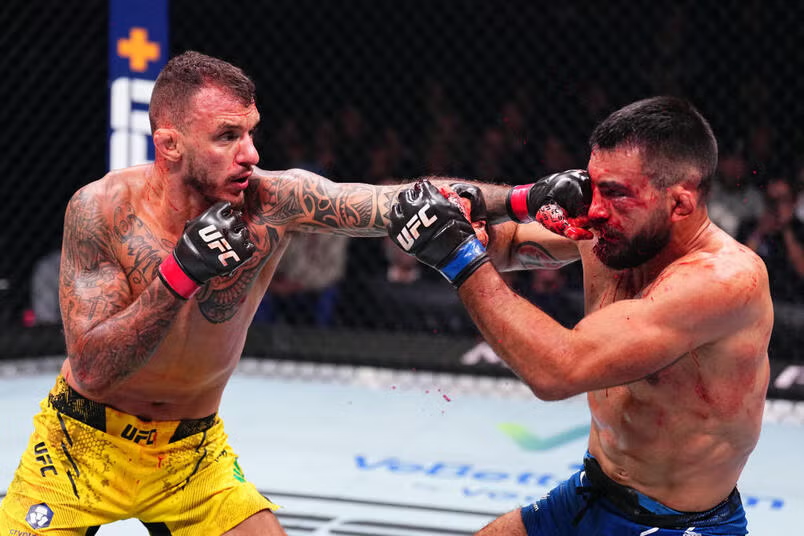
Dan Miragliotta’s decision to stand Renato Moicano up while he controlled Tom Nolan’s back has triggered an extraordinary backlash across MMA, with Joe Rogan questioning the sport’s legitimacy, Daniel Cormier demanding consequences, John McCarthy calling the decision unfair and Moicano revealing the controversy may have cost him half of his fight purse.
Renato Moicano had spent most of the first round and the beginning of the second turning the UFC Vegas 123 main event into exactly the kind of fight he wanted. He had taken Tom Nolan down, climbed onto his back, locked his legs around the Australian’s body and forced a dangerous young striker to spend extended stretches defending instead of attacking. Then referee Dan Miragliotta intervened, ordered both men back to their feet and changed the fight in a matter of seconds. Nolan immediately capitalized, badly hurting Moicano late in the second round, carrying that momentum into the third and eventually finishing the Brazilian with ground strikes at 1:28.
Nolan had earned the biggest victory of his career, but almost immediately, the conversation surrounding the result shifted away from the winner and toward the referee who had removed Moicano from one of the most dominant positions in mixed martial arts. What followed has become one of the most remarkable officiating controversies the UFC has faced in years, with Joe Rogan, Daniel Cormier, Jon Anik, John McCarthy, Matt Brown, Henry Cejudo, Gilbert Burns, Caio Borralho and veteran coach Ray Longo all questioning the decision in some form.
Some are calling for accountability. Others are questioning whether referees should ever be permitted to remove a fighter from back control. A few have gone even further, wondering whether the UFC’s well-known preference for action and finishes is indirectly creating an environment where grappling is treated as something that needs to be interrupted. There is no evidence that the UFC instructed Miragliotta to stand the fighters up or attempted to influence the result, and several of those raising the broader question have explicitly acknowledged that. What is undeniable is how quickly one officiating decision altered the competitive landscape of the main event.
Moicano himself has been unusually measured about it. Speaking less than 48 hours after the loss, he repeatedly credited Nolan and refused to blame him for what happened. Moicano said Nolan beat him fairly, described him as a talented striker and acknowledged that he simply took advantage of the opportunity presented to him. His frustration is directed toward the intervention that created that opportunity in the first place.
When Miragliotta ordered the standup, Moicano said his immediate reaction was disbelief. He had Nolan’s back and believed he was working toward a finish even though the submission was not developing quickly. Moicano acknowledged that Nolan had defended intelligently, controlling hands and preventing him from producing the damage he normally creates from the position, but he rejected the idea that inactivity justified removing the position entirely.
That distinction is central to the controversy because back control with a body triangle is not simply another neutral ground exchange. It is among the strongest offensive positions available in MMA, and Moicano had earned it through his own grappling. The question being asked throughout the sport is why Nolan’s inability to escape became a reason to return both men to a neutral standing position.
John McCarthy, one of the most influential referees in MMA history, framed the issue in precisely those terms. McCarthy said referees can demand activity when a fighter is merely holding position, but they cannot reasonably demand that someone improve when he has already achieved one of the best positions possible. Moicano was hand fighting, throwing short strikes and looking for opportunities to create the rear-naked choke. In McCarthy’s view, that constituted work rather than stalling.
McCarthy’s broader objection was competitive fairness. Moicano had used his skill set to force Nolan into exactly the situation he wanted, and escaping that position should have been Nolan’s responsibility. When Miragliotta ordered the restart, McCarthy argued, the referee effectively solved Nolan’s problem for him and gave the striker an advantage he had not earned.
McCarthy’s assessment was blunt. The real problem, he argued, was that the decision was not fair. An official should not remove a legitimately earned dominant position unless the rules actually require it, particularly when the fighter holding that position is still working. McCarthy, who has officiated for more than three decades, said he could not recall ever standing fighters up while one held the other in a body triangle.
Daniel Cormier’s reaction was even stronger. Cormier was sitting cageside when the standup occurred and said that after several days to reconsider what he had witnessed, his opinion had only become more severe. He called it one of the biggest referee errors he had ever seen and rejected the suggestion that Moicano had been stalling. In Cormier’s assessment, Moicano was actively trying to establish and improve his attacking opportunities from an already dominant position.
Cormier believes the mistake was serious enough to warrant consequences. He argued that Miragliotta should receive a reset and should not be assigned to the following UFC event at the Meta APEX or to UFC 334 in New York, where the heavyweight championship will be contested. Cormier’s point was not that one mistake should end a respected referee’s career. It was that everyone else involved in professional fighting is held accountable when a mistake meaningfully affects a contest, and officials should not be exempt from that standard.
That criticism is particularly notable because Cormier also believes Nolan may ultimately have won anyway. He thought Moicano was beginning to fatigue after expending significant energy on the ground, which could have created an opening for Nolan regardless of the standup. But that is precisely why the controversy remains impossible to resolve after the fact. Nobody knows what would have happened if Miragliotta had allowed the position to continue.
Moicano believes he could have remained on Nolan’s back for much of the second round. That could have meant another round in his favor, could have led to a submission, or could simply have forced Nolan to find his own way out and take over later. All of those possibilities disappeared the moment the referee intervened, which is why so many experienced figures around the sport are treating the decision as more than an ordinary officiating mistake.
Joe Rogan approached the issue from an even broader perspective. In a message shared publicly by Jon Anik, Rogan argued that MMA’s status as a legitimate sport becomes difficult to defend if referees are allowed to make interventions of this magnitude. Rogan’s position was not merely that the standup was questionable, but that decisions like it can undermine confidence in whether the sport consistently rewards the skills fighters are supposed to be allowed to use.
Rogan has long opposed standups in MMA because he believes fighters should be responsible for escaping positions themselves. Anik echoed that concern, saying he does not believe a referee should be able to remove back control merely because the action is not developing quickly enough. The controversy, Anik suggested, could at least force greater clarity about how officials handle dominant grappling positions going forward.
Former fighters quickly joined the criticism. Henry Cejudo asked when referees would be held accountable for decisions like this. Gilbert Burns reacted with disbelief, while Caio Borralho framed the issue from the opposite perspective: if a fighter cannot escape someone controlling his back, why should the referee reward him by returning the fight to the feet? Their reactions reflected the same concern McCarthy raised, that the official’s intervention shifted responsibility away from the fighter who needed to escape.
Matt Brown focused on what the decision meant for Moicano beyond a single loss on his record. Fighters do not experience refereeing mistakes as abstract debates. A defeat affects rankings, future matchups, negotiating leverage, sponsorship opportunities and, depending on the contract, the amount of money a fighter receives that night. Brown argued that Miragliotta’s decision potentially affected virtually every one of those areas and called the standup an absolutely foolish call.
Brown’s argument was that officials should face consequences when their mistakes carry consequences for athletes. He suggested that Miragliotta should at minimum lose money or temporarily lose access to major assignments. That argument became even more powerful when Moicano supplied the detail that makes the controversy considerably more serious from a fighter-pay perspective.
Because his contract includes separate show and win compensation, Moicano said losing meant receiving only half of what he could have earned with a victory. He did not claim that the UFC owed him the other half under the terms of his agreement, and he has not publicly demanded that the promotion make him whole. His frustration was with the reality that a referee’s mistake can potentially contribute to a result that determines whether a fighter receives a substantial portion of his compensation.
Moicano said that was the part that bothered him most. Fighters put their bodies and careers at risk, he explained, and sometimes another person’s mistake can affect whether they get paid. He later said he believes flat-rate compensation would ultimately be fairer than the traditional show-and-win model, especially in a sport where a single moment outside a fighter’s control can dramatically alter the financial outcome of a night.
Moicano also said he had not heard from the UFC about receiving the missing win money and did not expect to. His position was consistent throughout the interview: he signed the contract knowing how it worked and does not expect the world to repair every unfair result for him. That refusal to portray himself strictly as a victim has made his reaction more compelling.
He repeatedly criticized his own performance. Moicano said Nolan defended his grappling better than he wanted, acknowledged that he was not producing the damage he normally does from back control and admitted that he should have done more with the opportunities he created. He also refuses to appeal the loss because, in his view, the fight happened, Nolan won and there is little value in pretending the official result is likely to change.
Moicano does believe the sudden restart affected him. He said the decision caught him by surprise, frustrated him and may have disrupted his concentration. He was hurt shortly afterward and entered the third round already compromised, but he continues to separate that sequence from Nolan’s responsibility. Nolan did not make the call. Nolan simply attacked when the fight returned to the area where he was strongest.
Moicano also offered a theory for what may have influenced the decision: the crowd. Fans inside the Meta APEX had begun booing during the grappling exchanges, and Moicano believes that reaction may have affected Miragliotta subconsciously. He suggested the referee may have viewed the developing fight as boring and decided the audience needed more action. Moicano stressed that he cannot know what Miragliotta was thinking and is not alleging a conspiracy, but he believes referees are human and therefore vulnerable to the atmosphere surrounding them.
That same concern has now become one of the most uncomfortable parts of the broader discussion. Ray Longo openly questioned whether the UFC’s preference for knockouts and action could be creating indirect pressure on the people around fights. Longo made clear that he did not know whether Miragliotta had been told anything and offered no evidence that the UFC ordered the restart. His point was that the promotion has consistently communicated what type of action it prefers, particularly through developmental platforms such as Dana White’s Contender Series, and coaches respond accordingly.
Longo said he tells fighters competing on Contender Series that simply winning may not be enough because the UFC expects them to produce the kind of aggressive performances that earn contracts. His concern is what happens when that entertainment philosophy migrates beyond matchmaking decisions and begins influencing expectations about how an MMA fight is supposed to look. If grappling becomes viewed primarily through the lens of whether an audience finds it exciting, then coaches and fighters may begin wondering whether certain styles are being judged by entertainment value rather than competitive effectiveness.
Brown raised a similar question. He argued that MMA is not kickboxing or Muay Thai and that grappling cannot be treated as something referees should eliminate merely because the crowd prefers striking. Brown wondered whether commissions or officials experience any pressure, direct or indirect, to keep fights standing and exciting. There is no evidence presented that such pressure caused Miragliotta’s decision, but the fact that respected fighters and coaches are even asking the question demonstrates how damaging the perception has become.
McCarthy offered the most careful version of that conversation. He explicitly rejected the idea that the UFC tells referees to stand fighters up and said he was not accusing anyone of trying to manipulate the result. He did acknowledge an obvious business reality: Nolan is the younger, rising fighter, while Moicano is a veteran approaching the later stages of his UFC run. From a promotional standpoint, Nolan succeeding creates more future possibilities, but McCarthy stopped well short of suggesting the UFC engineered that result.
What McCarthy did say is that the controversial restart unquestionably benefited the younger fighter, and that reality is enough to make competitive fairness the central issue. Longo went further by questioning the optics of Nolan receiving a postfight bonus after such a controversial sequence. A bonus is not evidence that anyone wanted a specific result, but the accumulation of those perceptions is exactly why officiating neutrality matters so much.
Tom Nolan also deserves to remain separated from that criticism. Moicano has done so repeatedly. Nolan did not order the referee to restart the fight, and he did exactly what a professional fighter should do when the opportunity appeared. He attacked, hurt Moicano late in the second, returned in the third and finished him. Whatever anyone thinks about Miragliotta’s intervention, Nolan remains responsible for capitalizing on it.
That distinction matters because bad officiating and legitimate performance can exist simultaneously. Nolan can deserve credit for what he did after the restart while the restart itself remains indefensible to many of the sport’s most experienced observers. The larger issue is what happens when an official makes a mistake that may have altered the competitive and financial consequences of a main event.
Cormier wants consequences. Brown wants accountability and consistency. Cejudo is asking when referees will finally be held responsible for decisions that affect fighters’ careers. Rogan is questioning what interventions like this mean for the legitimacy of MMA itself. McCarthy believes the official gave one fighter an advantage that should never have been his to give. Moicano, remarkably, does not seem interested in punishment as much as he is interested in understanding how the system can improve.
During his interview, Moicano unexpectedly turned the conversation toward referee compensation. If commissions want better officials, he argued, they should make officiating a more financially attractive profession. He questioned how the sport can demand elite performance from referees while paying them relatively modest amounts to travel around the world and handle decisions that can determine championships, rankings and significant portions of fighters’ income.
It was an unusually nuanced response from the man who has the strongest reason to be furious. Moicano believes Miragliotta made a major mistake, believes the crowd may have influenced him, believes the restart disrupted his focus and acknowledges that the sequence directly preceded the moment the fight turned against him. Yet Moicano also accepts responsibility for failing to finish Nolan, refuses to appeal, wants no special treatment and even argues that officials themselves may be operating inside a flawed system.
Perhaps that is why UFC Vegas 123 has become such an important controversy. There is no need to invent a conspiracy to understand what went wrong. A fighter earned a dominant position, a referee removed it, the opponent immediately hurt him and the fight ended shortly afterward. The losing fighter says the sequence affected his concentration and his paycheck, one of the most accomplished referees in MMA history says the call unfairly advantaged the winner, a former two-division champion wants the official temporarily removed from major assignments and the UFC’s most famous commentator says decisions like this threaten confidence in the sport itself.
Mixed martial arts is supposed to determine which fighter can best combine striking, wrestling, grappling and submissions under a common set of rules. If a striker cannot escape a grappler’s control, escaping is supposed to be part of the fight. If a grappler cannot finish or damage his opponent, eventually the clock may become his enemy. What cannot happen without inviting controversy is for an official to decide that one fighter has spent enough time succeeding at his preferred form of combat and return his opponent to the place where he is strongest.
That is why the UFC Vegas 123 controversy has refused to disappear. It is no longer simply about whether Dan Miragliotta made a mistake. The larger issue is what the sport does when one referee’s decision may have changed a main event, changed a fighter’s paycheck and altered the trajectory of two careers. Moicano has already decided not to appeal, Nolan will move forward with the biggest win of his career and the official result is unlikely to change, but the debate surrounding what happened inside the Meta APEX is only getting started.
Andrew Carswell is a combat sports columnist and college writing professor, based in Las Vegas, NV, whose work examines the intersection of fighting, media, business, and culture. His commentary and analysis have been featured in various magazines, newspapers, and media outlets, including Yahoo! News, and USA TODAY. Blending journalistic insight and experience with a fan’s perspective, Carswell writes about the fight game as both a cultural phenomenon and a global business.