
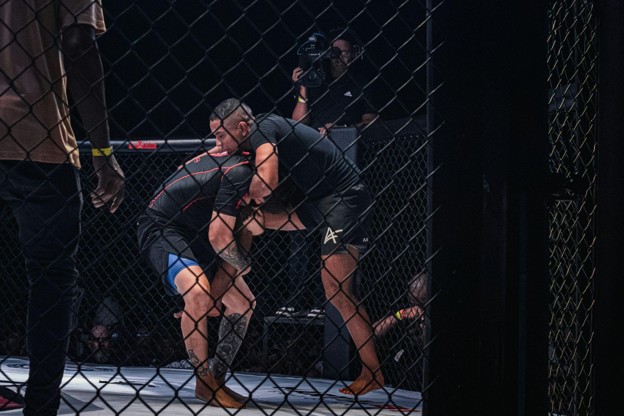
November brings two championship fights to Madison Square Garden and another compelling UFC card to Doha, Qatar. Champions, returning stars and rising contenders bring different expectations into the Octagon.
The November 14 and November 21 events feature five matchups with especially interesting tactical questions. Each fight offers more to consider than recent results. Fight cards can change, so the scheduled pairings should be checked again before publication.
1. Ciryl Gane vs. Josh Hokit: A Heavyweight Collision
Ciryl Gane is scheduled to defend the heavyweight championship against Josh Hokit at UFC 334 on November 14. Gane became undisputed champion after Tom Aspinall vacated the title, while Hokit earned his opportunity during a rapid climb through the division. The challenger’s rise included a TKO victory over Derrick Lewis in June.
Current UFC odds list Gane at -265 and Hokit at +200. The gap reflects Gane’s position as the defending champion, but Hokit’s recent rise and heavyweight power still give the matchup plenty of uncertainty.
Gane’s movement and measured striking can frustrate opponents who struggle to close the distance. His footwork can force opponents to reset. Hokit brings a more aggressive approach and will want to prevent the champion from settling into a comfortable rhythm.
That difference matters because heavyweight power can end a contest suddenly, even when one fighter has controlled several rounds. Gane may look to build advantages through patience, while Hokit needs to create exchanges where his pressure counts. Both must adjust as the fight develops.
The five-round format adds questions about endurance and pacing. A fast start means little if the challenger fades later. The matchup could turn on who dictates the distance rather than who throws the most punches.
2. Kayla Harrison vs. Amanda Nunes: A Long-Awaited Clash
Kayla Harrison’s bantamweight title defense against Amanda Nunes is another major attraction at UFC 334. Harrison, a two-time Olympic judo gold medalist, captured the championship by submitting Julianna Peña in 2025. Nunes returns after retiring in 2023, bringing the experience of a former champion in two weight classes.
Current UFC odds have Harrison at -210 and Nunes at +162. Harrison enters as the favorite, but Nunes’ championship experience and striking pedigree add another layer to how the matchup may develop.
The contest was originally planned for earlier in 2026 before Harrison withdrew and underwent surgery. That postponement makes preparation and readiness important considerations, although neither fighter’s condition can be judged from time away alone. Their achievements explain the anticipation.
Harrison’s grappling could allow her to control stretches of the fight against the fence or on the canvas. Nunes has the striking experience to punish careless entries and make Harrison work to reach those positions. Early exchanges could reveal whose approach prevails.
Championship experience can help fighters respond when an opening plan fails. Still, this contest may depend less on past titles than on how effectively each woman handles the other’s strongest weapons. Reputation alone offers few answers.
3. Jiří Procházka vs. Navajo Stirling: Experience Meets Momentum
Light heavyweight veteran Jiří Procházka meets unbeaten Navajo Stirling in Doha on November 21. Procházka has recorded 28 knockouts among his 32 victories, while Stirling enters with an 11-0 record and seven knockout wins. Stirling’s recent rise includes a first-round stoppage of former champion Jan Błachowicz.
Procházka attacks from unusual angles and often creates unpredictable exchanges. His risks create finishing chances and defensive openings. Stirling must decide when to engage rather than simply respond to every movement from the former champion.
Those contrasting styles give fans more to examine than the fighters’ records alone. Procházka brings experience against elite opponents, while Stirling has built momentum through convincing performances. The matchup will test whether Stirling can maintain that momentum against a former champion accustomed to high-level competition.
Five scheduled rounds create another challenge for Stirling, whose unbeaten record doesn’t eliminate uncertainty against an experienced former champion. Procházka, meanwhile, needs to balance his aggressive instincts with the patience required to avoid unnecessary risks. Control of the pace could be decisive.
4. Aljamain Sterling vs. Kevin Vallejos: Grappling Meets Power
Aljamain Sterling faces Kevin Vallejos in the featherweight co-main event in Doha. Sterling previously held the bantamweight championship and has since established himself in a higher division. Vallejos enters on a seven-fight winning streak, including knockouts against Giga Chikadze and Josh Emmett.
Sterling’s wrestling can disrupt a striker’s timing and force extended defensive work. A successful takedown does more than change position; it can prevent an opponent from building offensive momentum. Vallejos will want enough space to strike effectively without allowing Sterling easy entries.
The matchup creates pressure in both directions. Vallejos can make opponents hesitant with his punching power, while Sterling’s grappling threat can discourage aggressive combinations. Hesitation could prove costly.
Recent knockouts attract attention, but they don’t settle how Vallejos will handle a determined grappler. Fans following top UFC matchups can find additional fight previews and analysis ahead of the event. Sterling also needs to reach favorable positions without absorbing significant damage on the way in. The fight could hinge on small decisions during transitions rather than one sustained exchange.
5. Dan Hooker vs. Brian Ortega: A New Divisional Test
Dan Hooker meets Brian Ortega at lightweight on the November 21 card. Hooker has spent years competing against established opponents in the division, while Ortega is moving up after twice challenging for the featherweight title. Their different backgrounds introduce uncertainty without making either fighter an obvious choice.
Hooker is comfortable in demanding striking contests and can use his reach to work from distance. Ortega brings dangerous submission skills, particularly when an exchange moves to the ground. Careless transitions could prove costly.
Ortega’s move to lightweight adds another variable, but a higher weight limit isn’t automatically beneficial or harmful. His performance will depend on how he adapts against an opponent familiar with the division’s physical demands. Experience alone won’t neutralize Ortega’s grappling.
The most revealing moments may arrive when a striking exchange turns into a clinch or scramble. Hooker will want to maintain useful distance, while Ortega could find opportunities when the fight becomes less orderly. One well-timed transition could shift the contest quickly.
November’s Biggest Questions Remain Open
These five matchups offer different reasons to pay attention, from championship experience and returning veterans to unbeaten momentum and a divisional change. Their contrasting styles make preparation, positioning and tactical adjustments as important as previous results.
Odds can summarize expectations, but they can’t capture every decision made inside the Octagon. Fans who examine how each fighter’s strengths interact with an opponent’s weaknesses will have a fuller picture before fight night. The answers will ultimately come from the performances, not the predictions.
Content reflects information available as of 2026/11/02; subject to change.