
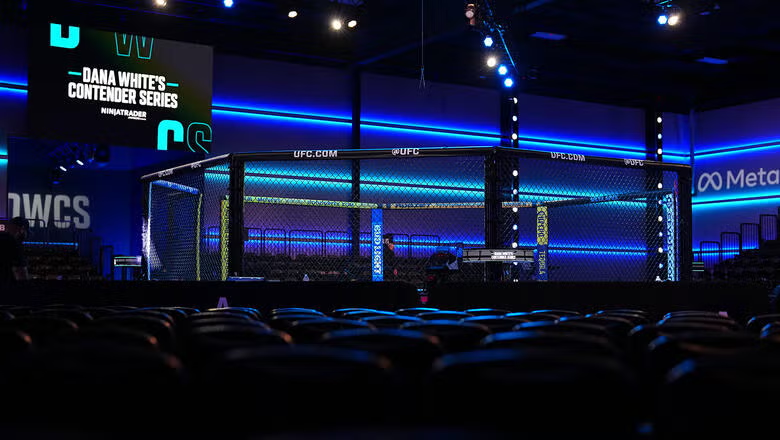
Greg Foster turned the season finale into a three-round war, Luis Francischinelli announced himself as a 6-foot-6 welterweight problem, Douglas da Lapa remained unbeaten, Smilla Sundell earned a UFC contract despite Dana White initially wanting more development, and Erick Visconde learned that even a dominant victory is not always enough on Contender Series.
Meta APEX, Las Vegas, NV — Dana White’s Contender Series has always existed somewhere between a fight card and a job interview, but the final night of Season 10 offered perhaps the cleanest reminder of what makes the show different from anything else in combat sports. Five fighters won Tuesday night at the Meta APEX in Las Vegas. Only four of them became UFC fighters. By the time Dana White finished handing out contracts, Greg Foster, Douglas da Lapa, Luis Francischinelli and Smilla Sundell had joined the roster, while main-event winner Erick Visconde walked away with a 30-27 sweep on the scorecards and no contract. The four additions pushed Season 10 to 46 total contracts, tying the highest mark in the show’s history and closing another season in which winning remained only the beginning of the audition.
The night began with exactly the kind of fight Contender Series was created to reward. Greg Foster and Jason Asher did not spend three rounds wondering what White wanted to see. They simply tried to beat it out of each other. Foster pressured almost constantly, Asher answered with his own offense, and the lightweight opener quickly became the kind of back-and-forth fight that can change the atmosphere of an entire card.
Foster’s nickname, “Punch First,” proved almost comically appropriate. He marched forward behind an exhausting pace and willingly accepted damage to create opportunities to land his own. Asher briefly turned the momentum with a spinning backfist that dropped Foster, then continued battling into the third round, where he caught a kick, secured a takedown and threatened to steal the fight late. Foster had already accumulated enough work to survive the rally, and all three judges scored the fight 29-28 in his favor.
White was sold. During the post-event press conference, he described Foster as the first 34-year-old prospect he could remember being genuinely excited to watch enter the UFC, although that assessment later became unintentionally funny when White learned he had been given incorrect age information elsewhere on his sheet. What mattered with Foster was not the number beside his birthday. White was impressed by the relentless cardio, constant pressure and willingness to remain directly in Asher’s face for essentially the entire fight. His advice for Foster’s UFC career was simple: fight exactly like that.
White was also asked whether Asher’s role in the fight had been impressive enough to warrant a second contract from the opener, something Contender Series has occasionally done after extraordinary battles. His answer was no, although he acknowledged that the UFC matchmaking team could continue watching Asher. Foster had entered as more than a two-to-one underdog, making the performance even more significant in White’s evaluation.
The second fight delivered the kind of sustained punishment that often produces a contract before the official announcement ever comes. Douglas da Lapa entered undefeated and considerably taller than Davi Cabral, and he repeatedly used that length to batter the smaller middleweight with combinations. Cabral refused to disappear, absorbing enormous damage while continuing to walk forward and even hurting da Lapa during the exchanges.
By the end of the second round, however, Cabral was barely surviving. Da Lapa trapped him along the fence and unloaded enough offense that the horn became the only thing preventing the fight from ending there. Nineteen seconds into the third, da Lapa removed the remaining doubt. A pair of hooks dropped Cabral, the follow-up attack forced the stoppage and da Lapa improved to 7-0 while earning a UFC contract.
The moment also produced one of the more amusing pieces of White’s press conference. White initially believed da Lapa was 34 because that was the age listed on his information sheet. After a reporter corrected him and explained that the Brazilian was actually 27, White immediately brightened. “Even better,” he responded, laughing as he acknowledged that the paperwork had apparently mixed up the ages of two fighters.
If da Lapa looked physically imposing at middleweight, Luis Francischinelli looked almost misplaced at welterweight. Standing 6-foot-6, the Brazilian entered the cage with the dimensions of a heavyweight but competed at 170 pounds, making him potentially the tallest welterweight on the UFC roster. Will Rentz immediately understood the problem and tried to eliminate the reach disadvantage by wrestling.
Rentz actually secured a takedown, but Francischinelli used his legs effectively to create space, scramble and return to his feet. Once the fight returned to striking range, the physical disparity became much harder to overcome. Francischinelli dropped Rentz with a short left hand and followed him to the canvas, where additional punches ended the fight at 2:18 of the first round.
The victory improved Francischinelli to 7-1, with all seven of his professional wins coming by knockout or TKO. The combination of height, reach and finishing power immediately makes him one of the more unusual physical puzzles entering the UFC through this season of Contender Series. At a weight class where six feet is already considered good size, Francischinelli arrives six inches beyond that and has now demonstrated that the frame comes with legitimate power.
Then came the most complicated contract decision of the evening. Smilla Sundell entered Contender Series as one of the youngest and most accomplished combat sports athletes on the card. The 21-year-old had already won a Muay Thai championship in ONE Championship but had only two professional MMA fights before stepping into the Meta APEX against Aline Pereira, the younger sister of UFC star Alex Pereira. Sundell’s striking pedigree was unquestioned. What remained uncertain was whether she had accumulated enough MMA experience to justify entering the UFC immediately.
Pereira largely allowed the fight to unfold in Sundell’s preferred arena. Rather than forcing extended wrestling exchanges, she engaged the former Muay Thai champion on the feet, where Sundell used forward pressure and volume to control much of the contest. The fight went the distance, but the judges were unanimous, scoring it 29-28 across the board for Sundell and improving her professional MMA record to 3-0.
Winning did not immediately convince White. He later revealed that his initial instinct was to send Sundell back for more development because she is only 21 and has so little MMA experience. Matchmaker Mick Maynard disagreed. According to White, Maynard argued that Sundell had serious potential and wanted her in the UFC immediately. White eventually yielded to his matchmaking team and awarded her the contract.
That disagreement may ultimately become one of the most interesting decisions of the entire season. Sundell is not entering the UFC because she has accumulated a deep MMA résumé. She is entering because the people responsible for identifying talent believe her ceiling may justify accelerating the process. White essentially preferred another year of development, while Maynard believed the development could continue inside the UFC.
The irony was impossible to miss for Aline Pereira. Her brother Alex became one of the fastest-rising stars in UFC history after arriving from elite kickboxing, but Aline’s attempt to follow a similar route ended with Sundell taking the contract instead. Pereira had entered the week with consecutive MMA victories and extensive striking experience of her own, but Tuesday belonged to the younger Swedish prospect.
The main event then provided the clearest example of why Contender Series remains uniquely unforgiving. Erick Visconde defeated undefeated featherweight Ilias Bulaid decisively. He immediately turned toward his grappling, secured takedowns and controlled large portions of the fight on the canvas. Bulaid, a decorated kickboxer who entered 9-0 with one no contest in MMA, struggled to create enough separation to turn the fight into the striking contest he wanted. Visconde never came particularly close to finishing him, but he controlled the matchup thoroughly enough that all three judges scored it 30-27.
Normally, sweeping an undefeated opponent 30-27 on every scorecard would feel like a successful UFC audition. On Contender Series, the reaction inside the building told a different story. The crowd booed as the fight progressed, and Visconde later revealed that he had broken his hand in the second round, limiting his ability to produce the offense he wanted. White acknowledged the victory and Visconde’s potential but declined to offer him a contract, telling him he would need to return and try again.
That decision captured the strange pressure built into Contender Series better than any finish could. Visconde did exactly what professional fighters are normally told to do. He recognized where he held the advantage, imposed that advantage and won every round. It simply was not the kind of performance White believed justified an immediate place on the UFC roster.
Sundell, meanwhile, won a competitive decision and received a contract even though White initially believed she needed more experience. Foster won a decision and earned one because the pace and violence of the fight convinced White that his style would translate. Francischinelli and da Lapa removed any uncertainty by finishing their opponents. Five winners produced four completely different evaluations, which is exactly what makes Contender Series both compelling and brutal.
That subjectivity remains both the appeal and cruelty of the show. Contender Series has never promised that victory equals employment. The fighters are competing against their opponents, but they are also competing against White’s expectations, the matchmakers’ projections, the crowd’s reaction and the possibility that another fighter on the same card produces something more memorable.
The final night also gave White an opportunity to reflect on how dramatically the show itself has grown. He described Contender Series as a “monstrous” success in the early stages of the UFC’s relationship with Paramount, saying the numbers have been extraordinary even though he could not disclose the company’s private data. White also reiterated his long-held belief that young fighters should compete as frequently as possible once they earn their contracts, particularly because several recent Contender Series graduates have turned around quickly and immediately won UFC fights.
The season finished with 46 contracts after entering Week 10 with 42 already awarded through the first nine episodes. It had also produced 32 finishes before the finale began, illustrating how aggressively this year’s prospects had approached the opportunity. The final week did not match the constant finishing pace of some earlier episodes, but Foster’s war, Francischinelli’s first-round stoppage and da Lapa’s third-round breakthrough provided enough violence to give the season a fitting conclusion.
White said the UFC would be interested in eventually extending Contender Series beyond its current season length, although he does not believe the available talent pool is deep enough yet to support adding another month or two. He suggested that could change in future seasons as the sport continues rebuilding its developmental pipeline, but for now he believes the current format is near the maximum the UFC can sustain without diluting the quality of prospects.
That is a remarkable position for a show that was once treated primarily as a feeder system. Contender Series has increasingly become its own destination, a weekly showcase where fighters can build recognition before ever making a formal UFC debut. White said the matchmaking department loves the show despite being notoriously difficult to excite, and he made clear that the company now views Contender Series as an essential part of its talent-development structure.
The UFC is also experimenting with how the experience itself might evolve. During the press conference, White discussed the renovated Meta APEX, public ticket access and future technology integrations. He said the company is working with a United Kingdom-based company on artificial intelligence technology capable of providing biometric readings while fights are taking place, part of a broader effort to incorporate emerging technology into UFC broadcasts and fan experiences.
The season finale also prompted White to look backward at the larger history of how the UFC has discovered stars. Asked whether the opening war between Foster and Asher reminded him of Forrest Griffin and Stephan Bonnar’s famous Ultimate Fighter finale, White explained why he still considers that 2005 fight impossible to replicate. He recalled how precarious the UFC’s future was at the time, how the television audience grew as the fight unfolded and how Griffin and Bonnar effectively helped change the trajectory of the company.
White’s retelling also revealed how close that history came to unfolding differently. He remembered having to convince Griffin to participate after Griffin had considered becoming a police officer, and he recalled Bonnar suffering a badly cut eyebrow during training before the finale. White said the show’s final episode had been underwhelming until the two light heavyweights entered the cage and produced the fight that changed everything. Modern Contender Series prospects can create unforgettable moments, but none enter the cage carrying the same existential pressure that surrounded Griffin and Bonnar during that era.
More than two decades later, the mechanism has changed but the basic pursuit has not. The UFC is still looking for fighters capable of forcing people to care. Sometimes that happens because of an extraordinary knockout. Sometimes it happens through relentless pressure. Sometimes a 21-year-old Muay Thai champion convinces a matchmaker that waiting another year would be a mistake. Sometimes a fighter wins every round and still leaves without the contract.
White’s press conference also wandered beyond the season itself, touching several of the UFC’s current storylines. Asked about Sean Strickland’s recent complaints regarding his contract, White pointed out that Strickland had signed a new deal in May and disputed the compensation figure Strickland had publicly discussed. White essentially treated the latest controversy as another chapter in the champion’s habit of publicly expressing frustration, although the disagreement surrounding Strickland and the UFC continues to create questions around the middleweight division.
White was also asked about former UFC fighter Tim Kennedy, who was recently reported to have been shot three times during an ambush in the Democratic Republic of Congo. White said he did not know the details of the incident but wished Kennedy well after being told that the former middleweight had survived and was back in the United States recovering at Walter Reed.
The UFC CEO also addressed Alex Pereira’s recent suggestion that Daniel Cormier had been encouraged by the promotion to help sell the upcoming Ciryl Gane fight against Josh Hokit. White rejected that idea entirely, saying he has never instructed Cormier, Joe Rogan or the UFC commentary team to push a specific narrative about a fighter. He argued that the company does not police what its fighters or commentators say and joked that if it did, Strickland would have disappeared from the conversation years ago.
Those side discussions reflected how much Contender Series has changed since its earliest seasons. What once felt like a small developmental show now ends with a press conference that moves from prospects to champions, contracts, global combat sports stories, boxing plans, broadcast technology and the future of the UFC itself. White repeatedly returned to the idea that the program has become far larger than the company originally imagined, and Season 10 provided another example of why.
The final week ultimately delivered everything that defines the format. Foster battered his way into the UFC through a three-round war, da Lapa remained undefeated by breaking an opponent who refused to stop coming, Francischinelli used a 6-foot-6 frame and finishing power to become one of the strangest physical additions to the welterweight division, and Sundell became a UFC fighter only after the matchmaking team persuaded White that her future should begin now rather than later.
Visconde provided the other side of the equation. He entered against an undefeated opponent, controlled him, broke his hand along the way and won every round on every scorecard. It still was not enough, and that contrast may be the most fitting way Season 10 could have ended.
Dana White’s Contender Series has never really been about simply winning a fight. It is about creating a moment convincing enough that the UFC wants to see the next one. On Tuesday night, four fighters accomplished exactly that, pushing Season 10 to a record-tying 46 contracts and sending another class of prospects toward the Octagon, while we all begin the long wait for Season 11.

Andrew Carswell is a combat sports columnist and college writing professor, based in Las Vegas, NV, whose work examines the intersection of fighting, media, business, and culture. His commentary and analysis have been featured in various magazines, newspapers, and media outlets, including Yahoo! News, and USA TODAY. Blending journalistic insight and experience with a fan’s perspective, Carswell writes about the fight game as both a cultural phenomenon and a global business.