
Every rating system for fighters is an estimate built from too little data. A fighter might compete twice a year, against opponents who are themselves only partly known. Compare that with a game whose edge is written into its rules and repeated millions of times. One number is a judgment under doubt. The other is close to a constant.

Photo by Redd Francisco on Unsplash
Baccarat is the cleanest example of the second kind. Its commercial online market includes Thai-language ranking pages such as บาคาร่า, which is meant only for adults in places where online gambling is lawful. The page is mentioned to illustrate that market, not to recommend it. Rules differ sharply by country: licensed markets in some places, a single state operator in others, and an outright ban elsewhere.
Why Does a Fighter’s Rating Carry So Much Doubt?
Sample size is the core problem. Fight Matrix data puts the average time between fights at about 203 days across all fighters. Since 2010 the figure rises to roughly 222 days. That works out to fewer than two bouts a year for a typical active fighter.
A ten-year career might hold 20 to 30 results. Each one depends on matchmaking, injuries, weight cuts and styles. No statistician would call that a large sample.
Rating designers have long known this. Mark Glickman built the Glicko rating system in 1995 to deal with a flaw in Elo. Elo treated a player returning after years away the same as one competing every week. Glicko adds a measure of how reliable each rating is, so a long layoff widens the doubt.
Fight Matrix itself offers more than one view. Alongside its standard CIRRS formula, current ranking pages can switch to ELO K-170 or a modified Elo version. When different formulas order the same division differently, that disagreement is a rough gauge of the doubt involved.
What Makes a Casino Edge Different From Skill?
A baccarat outcome does not depend on form, age or a training camp. The drawing rules are fixed, and the payouts are fixed. So the expected return on each bet can be worked out in advance.
Commonly cited figures for an eight-deck game look like this:
- A bet on the banker hand carries a house edge of about 1.06%, after a 5% commission on wins.
- A bet on the player hand carries a house edge of about 1.24%.
- A tie bet paying 8 to 1 carries a house edge of about 14.4%.
Those numbers do not drift between seasons, and no new data revises them. A fighter’s rating is a moving estimate. A house edge is a property of the rules.
Online and live tables follow the same drawing rules, so the same figures apply on a screen. The format changes the pace, not the arithmetic. A faster game simply reaches the long run sooner.
How Does the Law of Large Numbers Settle It?
The law of large numbers says that as an experiment repeats, the observed frequency moves closer to the true probability. That is the wording used in an introductory statistics text from OpenStax. The law explains why a small edge becomes visible only with volume.
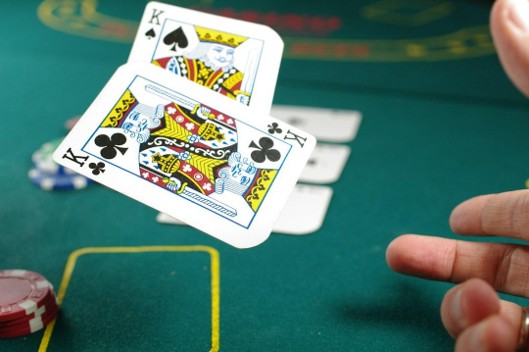
Photo by Michał Parzuchowski on Unsplash
Alt text: Two kings flicked onto a green card table beside stacks of chips
Take a $10 banker bet and follow the arithmetic:
- Over 1,000 hands, about $10,000 is wagered, and the expected cost is about $106.
- Normal luck over those hands can swing results by roughly $300 either way.
- Over 100,000 hands, the expected cost grows to about $10,600.
- The typical luck swing grows only to about $3,000, so the edge now dominates.
This is the gap that matters. Over a short session, luck is louder than the edge. Over a long run, the edge wins almost every time. No fighter ever gets 100,000 bouts to let the real number emerge.
Why Do Upsets and Streaks Feel So Similar?
Fight fans know the shock of a big upset. Fight Matrix ranks the biggest point-based upsets by the gap in rating points, not by betting odds. Matt Serra over Georges St. Pierre and Gabriel Gonzaga over Mirko Filipovic both appear on that list.
An upset carries information. It may reveal that a rating was wrong, or that a style matchup was misread. A rating system should move after it.
A long streak at a baccarat table carries no such message. The cards have no form to reveal, and the edge was never in doubt. The two events feel alike in the moment, but only one should change what you believe.
What Can a Rankings Reader Take From This?
Fixed-edge games make a useful benchmark for thinking about fighter ratings:
- Treat a rating built on a few fights as a wide range, not a point.
- Weight recent activity, because doubt grows during long layoffs.
- Expect upsets, since small samples guarantee some surprising results.
- Remember that a known edge is not the same as a known outcome.
What Should Anyone Know Before Playing?
Everything in this section is aimed at adult readers living where online gambling is permitted by law. The law in the reader’s own country is what decides whether any of it is permitted.
Please do not read any of this as legal or financial guidance. Gambling is a form of paid entertainment and never a way to earn income, because the edge always favors the house. In the US, free and confidential help is available by calling or texting 1-800-GAMBLER.
Frequently Asked Questions
What Is a House Edge?
It is the average share of each bet that a game returns to the operator over time. In baccarat it comes from the payout rules and the banker commission.
Why Do Fighter Rankings Change So Much?
Each result carries a lot of weight because fighters compete rarely. One loss can move a fighter sharply when the sample is small.
Can a Winning Streak Beat a House Edge?
Over a short run, luck can outweigh a small edge. Over a long run, the edge reasserts itself, as the law of large numbers predicts.
What Does the Glicko System Add to Elo?
It adds a reliability measure for each rating. Players who compete rarely carry more uncertainty than players who compete often.
Ratings, Edges and Honest Uncertainty
A good fighter ranking admits what it does not know. A house edge has nothing left to learn. Reading both with the same statistical eye makes each one clearer, and keeps the difference between a forecast and a certainty in plain view.