
6 Ways To Build Garage Gyms
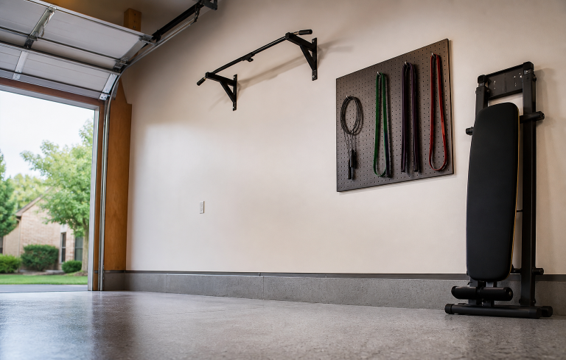
Building a garage gym fails at the floor plan stage rather than the budget stage. A standard 20×20 ft two-car garage, which sits on 65 percent of new single-family homes, leaves a usable strip of just 37.8 inches once both drivers open their doors.
The constraint is square footage, and it is fixed before a single purchase decision is made.
The Real Problem Isn’t Your Budget
The most common mistake is buying equipment first and discovering the space problem second. A squat rack arrives, the car stays parked, and the rack lives in the corner under a tarp.
This article reverses that sequence deliberately by eliminating specific friction points before any gear is ordered.
You must measure the real footprint, get the vehicle off the floor, mount equipment vertically, choose the right flooring system, control the climate, and build only for what you actually train.
1. Measure the Actual Usable Rectangle
Total garage dimensions are rarely the working dimensions. Three subtractions happen immediately. You lose the door swing arc on any hinged side entry, the parked vehicle footprint plus clearance lanes, and any fixed obstructions like a water heater.
What remains after those three cuts is the actual gym, and it is almost always smaller than the owner expects.
The math for a standard two-car garage illustrates this quickly. At 20×20 ft, the total area is 400 sq ft. Two parked vehicles with basic clearance lanes consume roughly 360 sq ft of that space.
The remainder is close to zero, offering barely enough room to roll out a yoga mat fully.
A single-car garage at 12×20 ft gives 240 sq ft total. Remove one car, and the usable training rectangle sits around 150 to 170 sq ft.
Ceiling height is the second measurement people skip entirely. Most garage ceilings run 8 to 9 ft at the peak, but the automatic opener mechanism drops effective clearance to roughly 7 or 7.5 ft directly underneath the rail.
A ceiling-hung heavy bag needs its mounting point roughly 7 to 8 ft up so the bag center sits at chest height, while jumping rope wants 9 to 10 ft of clear ceiling to keep the rope arc from catching. Measure ceiling height specifically under the opener rail to find your true working constraint.
Tape the usable rectangle on the floor, walk through it, and swing both arms to confirm the physical space.
| Warning/Important: Measure ceiling height directly under the automatic opener rail. This is your working clearance for overhead lifts and bags, not the peak. Most garages lose 1-2 feet here. |
2. Get the Vehicle Off the Floor
The instinctive solution to a car-filled garage is to park one vehicle outside permanently. That solves the floor space problem while creating reduced security, weather exposure, and driveway occupation. It also only frees one vehicle footprint.
If there are two cars, the second one is still sitting in the middle of the planned training zone.
Moving vertically solves the problem without leaving cars exposed outside. Both vehicles stack into a single bay, one elevated on the upper deck and the other parked underneath it on the ground level.
The second bay, previously surrendered to the other car, empties completely and becomes clear, flat, protected indoor space at full ceiling height.
That recovered bay yields 160 to 180 sq ft of usable area, providing enough room for a barbell, a bench, a mat zone, and a pull-up rig. The training zone sits beside the stacked vehicles rather than underneath them, since a raised car and a standing lifter cannot share the same 8 ft of headroom.
Two specifications require confirmation before selecting a lift model. First, check ceiling clearance. Most four-post storage lifts need roughly 9 to 10 ft to park one vehicle over another, and the number that matters is your own stack, which is the lower vehicle height plus runway thickness plus the upper vehicle height plus a buffer. Low-clearance models are built for garages at the 8 to 9 ft end, so measure before ruling the option out.
Second, verify the load capacity covers your vehicle weight. For owners mapping out this infrastructure decision before ordering training gear, a four-post Atlas lift from HeavyLift Direct represents the correct starting point.
The standard base footprint for a four-post storage lift runs approximately 10 ft wide by 18 ft long. That footprint occupies one full parking bay. Check the garage door opener before fixing the position, since a center-mounted rail runs straight through that bay and a jackshaft or side-mount opener clears it. The bay the lift frees up is what the training space is built from.
| Key Insight: A four-post lift doesn’t just store a car; it stacks both vehicles into one bay and frees the other, recovering 160-180 sq ft of protected indoor space at full ceiling height. This single decision is what makes a 150 sq ft gym plan possible. |
3. Hang Everything You Can
Every piece of equipment sitting on the floor costs twice. It claims its own footprint, and it requires clearance to use safely. A freestanding pull-up rack requires a minimum 4×4 ft base plus swing room, whereas a wall-mounted equivalent uses zero floor area.
In a 150 sq ft training zone, a single 16 sq ft floor anchor consumes roughly 10 percent of the total usable space.
Several categories mount cleanly without significant structural engineering. Wall-mounted pull-up rigs attach directly to studs and carry 300 to 400 lb of static load.
Folding wall-mount benches are available for under $200 and reduce to approximately six inches of wall projection when folded.
Ceiling-hung heavy bags, horizontal pegboard systems, and wall rail tracks move weight-bearing items off the ground and onto the garage structure.
Two structural requirements apply before drilling any holes. All wall and ceiling mounts must attach to solid studs or joists rather than just drywall.
A ceiling-hung heavy bag requires a dedicated cross-beam rated for dynamic loads exceeding 300 lb to account for swing forces. Hang the bag so its center sits at chest height, which puts the mounting point roughly 7 to 8 ft up and keeps the whole assembly inside a standard 8 to 9 ft garage ceiling.
4. Choose Dual-Purpose Flooring
Garage gym flooring fails when it is designed for one use and asked to perform two. Foam puzzle tiles are the most common mistake because they compress permanently under vehicle jacks and shift laterally under a loaded barbell drop.
They also absorb oil spills in a way that cannot be cleaned out. A garage that still parks a car cannot run on foam alone.
The correct approach is a two-layer system with a clear division of labor. The base layer is hard, sealed, and permanent. Epoxy-coated concrete or interlocking rigid PVC tiles seal the slab against oil while handling the point loads of vehicle weight.
DIY epoxy floor coating for a standard two-car garage runs $100 to $300 in materials and prevents moisture wicking from rusting iron plates.
The top layer is removable and zone-specific. Rubber horse stall mats are ideal because they are 3/4-inch thick and withstand repeated Olympic barbell drops without permanent compression.
A 10×10 ft training zone requires four to six 4×6 ft panels, which can be repositioned easily. Keep all foam products out of any area that sees vehicle traffic or oil contact.
5. Solve Heat and Damp Issues
A garage in July and a garage in January are functionally different rooms, and both destroy training equipment rapidly. Concrete slabs wick groundwater upward continuously, while uninsulated metal garage doors sweat condensation during temperature shifts.
Leather heavy bag surfaces crack within a single summer in unventilated warm-climate garages.
Address moisture and temperature before bringing equipment inside. Seal the floor with epoxy to cut moisture wicking at the source, then weatherstrip the main door and side entries to block humidity.
For healthy conditions, the Occupational Safety and Health Administration recommends maintaining a relative humidity control in the range of 20 to 60 percent. A dehumidifier rated for 1,000 to 1,500 sq ft easily handles a standard two-car garage.
For temperature control, a wall-mounted mini-split handles both heating and cooling in one permanent unit. A 400 sq ft space requires 9,000 to 12,000 BTU of capacity, costing between $800 and $2,500 installed.
The budget alternative for winter use combines a DIY garage door insulation panel kit with a portable electric space heater.
Target a training climate of 55 degrees minimum in winter and 80 degrees or below in summer.
6. Build for What You Actually Train
A full power cage requires roughly 8×8 ft of floor space plus exit clearance on every side. A dedicated Olympic lifting platform with bumper plate runout room needs at least 10×10 ft.
Acknowledging these constraints early prevents buying equipment that will never fit the space.
Write down the five exercises performed every single week without exception and build the gym for those movements. Add anything else only after the core setup has been used for 90 consecutive days without requiring reconfiguration.
A barbell, a flat bench, a wall-mounted pull-up bar, and 150 lb of plate cover 80 percent of recreational lifting needs. That combination fits a 10×12 ft footprint without overflow.
For conditioning, confirm ceiling clearance, hang a bag to the correct height, and recognize that a 200 sq ft space is a legitimate environment.
| Pro Tip: Use the 90-day rule: build the gym for the five exercises you do every single week. Add specialty gear only after the core setup works for 90 days straight. |
The Bottom Line
Floor space dictates every other decision in a garage setup. Measure the usable rectangle and the ceiling height first to establish the baseline.
From there, stacking both vehicles onto a lift in one bay frees the adjacent bay outright while keeping both cars protected indoors.
With the floor recovered, mount equipment on the walls and structure to keep the footprint open. A sealed hard base layer paired with removable rubber mats ensures the space handles both automotive traffic and barbell impacts.
The environment requires equal attention before outfitting the space.
Controlling humidity and temperature protects investments in cast iron and leather while keeping the space functional year-round.
| Author Profile: HeavyLift Direct is the leading online retailer of personal and professional vehicle lifts and automotive repair equipment for professional mechanics and home garage enthusiasts. |