
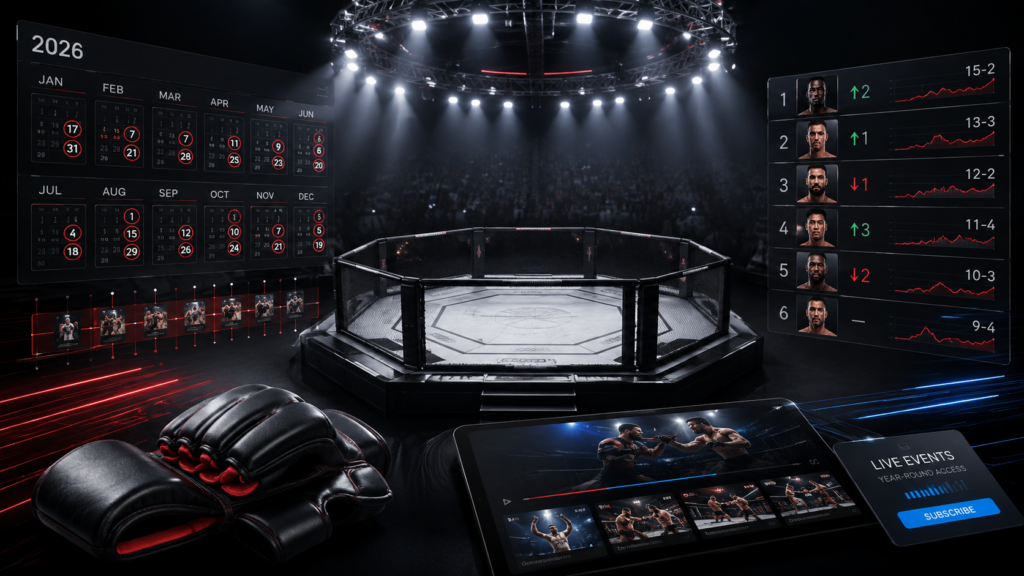
The biggest change to the UFC schedule in 2026 is not simply that there are more fights available under one subscription. It is that the calendar now gives ranked fighters fewer reasons to sit out.
The promotion has 12 numbered events, 30 Fight Nights and the White House card on its 2026 calendar. None requires fans to buy a separate traditional pay-per-view. For viewers following the sport across both broadcasts and betting markets, offers such as a bet365 bonus code sit alongside a much broader year-round UFC schedule than under the old PPV-heavy model.
At almost the same time, UFC introduced a new rankings system built with Meta that gives weight to recent competition and penalizes prolonged inactivity. Those two changes matter more together than they do separately.
A fighter who takes three meaningful bouts in a year is no longer just building a better résumé in the eyes of voters. Activity can affect the number that appears next to his or her name.
How busy is the UFC schedule in 2026?
Paramount+ lists 12 numbered cards, 30 Fight Nights and UFC at the White House for the year.
That produces roughly 43 scheduled dates, depending on how the White House event is classified. Coverage of the Paramount agreement has also referred to 13 major UFC events annually, with the unnumbered White House card effectively filling that extra marquee slot in 2026.
Dana White had signaled a similarly heavy calendar before the year began, saying the company expected to hold 44 events across its numbered shows and Fight Nights.
A crowded UFC calendar is not unusual. The promotion has operated above 40 events in previous years.
The difference is distribution.
Under the previous television structure, the most important cards also had to justify a separate pay-per-view purchase. In 2026, the schedule sits inside the Paramount ecosystem instead.
That changes how much commercial weight needs to be carried by any single Saturday night.
The disappearance of the PPV wall matters for matchmaking
Under the old model, a highly ranked fighter could be valuable partly because the UFC needed recognizable names to sell specific pay-per-view cards.
That encouraged a certain amount of scarcity.
A contender did not necessarily need to appear every few months if the promotion could save that fighter for a larger event, a title eliminator or a card that needed another strong name.
A subscription service has a different problem. It needs people to keep opening the app.
With more than 40 UFC dates spread through the year, there is value in having meaningful fights across the calendar rather than concentrating too much of the roster on a small number of premium events.
That does not mean the UFC suddenly wants every contender fighting four times per year. Injuries, negotiations, title timing and personal decisions still shape the schedule.
But the old reason to preserve a fighter specifically for a pay-per-view slot is weaker.
The Paramount+ deal also changed the economics for star fighters
The shift away from individual pay-per-view purchases is not automatically positive for everyone on the roster.
For most fighters, PPV points were never part of the deal. At the top of the card, however, certain champions and major draws could receive a percentage tied to pay-per-view sales.
Conor McGregor is the obvious example because so much of his earning power was historically connected to enormous PPV numbers.
Without traditional UFC pay-per-view sales, that revenue stream has to be replaced by another compensation structure.
Dana White has said the new media agreement would allow the company to increase bonuses, while fighter compensation continues to come from contracted purses and other negotiated incentives.
The broader UFC business entered the new era from a strong financial position. The company reported $401 million in first-quarter 2026 revenue, 12% higher than the same period a year earlier.
Why the Meta UFC rankings put a number on activity
The television deal changes the calendar. The new Meta UFC rankings change what fighters can gain from using it.
Introduced on June 22, the system replaced the familiar media voting panel with an algorithmic model.
The rankings are recalculated after events and take into account factors such as opponent quality, the manner in which a fight was won, recent results and divisional context.
Beating a strong opponent matters more than beating someone at the edge of the division. A finish can be treated differently from a routine decision. Results closer to the present carry more relevance than older ones.
Activity is part of that equation too.
UFC representatives have described the model as rewarding fighters for competing regularly and creating more movement within divisions. Published explanations of the system have also pointed to an inactivity penalty for fighters who go long periods without competing, with 18 months cited as an important threshold.
That changes the argument around an active contender.
Previously, fans could say Fighter A deserved to move above Fighter B because A had fought three times while B had spent most of the year inactive. Another voter could simply disagree.
Now activity is one of the things the system itself is designed to notice.
More dates give contenders more opportunities to build momentum
Consider two fighters beginning the year in roughly the same part of a division.
One fights in February, wins again in June and takes another bout in October.
The other fights once in March and then waits.
The first fighter has three opportunities to add value through victories, opponent strength and method of victory. The second has one.
There are obvious risks to being more active, and three wins are never guaranteed. But the important change is that the calendar provides enough dates for that strategy to be realistic while the ranking system gives it a measurable upside.
The effect should be most visible below the title picture.
Champions still have to work around title cycles. Fighters ranked somewhere between fifth and fifteenth usually have more flexibility, and one extra win can move them into an entirely different matchmaking tier.
The first Meta rankings produced some strange results
The transition has not been seamless.
Jan Blachowicz, for example, had been fourth under the previous media rankings but appeared at No. 15 when the Meta system was introduced. That dramatically changed the ranking context around his matchup with Azamat Murzakanov-era contenders and other names in the division.
Brian Ortega and Yair Rodriguez were among other established fighters whose algorithmic positions differed noticeably from where media voters had placed them.
There were also results that appeared harder to reconcile with the stated emphasis on recent performance.
Alex Pereira was positioned fourth at heavyweight despite losing his divisional debut to Ciryl Gane by second-round stoppage at the White House event. Jamahal Hill remained high at light heavyweight despite a long stretch without a victory. Kevin Borjas reached the flyweight top ten despite carrying a losing UFC record.
Those examples do not necessarily mean the model cannot work. They do show why its first few months should not be treated as a finished product.
Any ranking algorithm is shaped by the variables it values, the historical data fed into it and the rules governing eligibility.
There is also still a human layer. UFC matchmakers determine whether a fighter remains eligible to be ranked at all.
Can fighters climb faster under the new system?
Potentially, yes.
One of the most consequential features of the new structure is the importance assigned to direct results. If a fighter beats someone ranked above him, the system has a strong basis for moving the winner ahead.
A busy schedule makes those opportunities easier to find.
Merab Dvalishvili had already shown how much activity an elite fighter can pack into a relatively short period, pushing toward four title defenses in one calendar year before Petr Yan stopped the run.
That pace remains unusual for a champion.
For contenders, however, fighting two or three times in twelve months is far more realistic. A fighter who keeps winning no longer has to rely entirely on voters remembering the quality of those results several months later.
The ranking updates can reflect them directly.
There is a cost to rewarding activity
More activity sounds good when discussed as a rankings problem. It looks different when viewed from inside a training camp.
Every additional fight means another weight cut, another camp and another period of physical risk.
Short turnarounds also leave less time to recover from injuries that may not be serious enough to cancel a fight but still matter to an athlete preparing for the next one.
A ranking model that rewards frequency can therefore create an uncomfortable incentive.
The fighter who accepts an October bout after competing in July may gain more ranking momentum than someone who waits until January. The ranking benefit is real, but so is the additional exposure to damage.
That becomes more sensitive at the highest level because the transition away from traditional pay-per-view also changes the compensation conversation for fighters who previously received PPV points.
More opportunities to compete are not automatically the same thing as better economics for the athlete.
We still do not know whether UFC fighters are actually competing more often
This is where the 2026 story needs some patience.
There is a plausible mechanism for increased activity. The schedule is large, the separate PPV barrier has disappeared and the rankings explicitly care about recent competition.
What is missing is enough completed data.
UFC has not published a year-over-year figure showing the average number of appearances made by ranked fighters in 2026 compared with previous seasons.
Without that number, it would be premature to claim that the Paramount deal has already produced a specific percentage increase in fighter activity.
The structural incentives have changed. Whether fighter behavior changes with them is the next question.
The second half of 2026 will be more revealing
By December, the new ranking system will have had several months to process fighters moving at very different speeds.
That should make comparisons much more useful.
The most interesting names may not be the champions. Watch fighters sitting around Nos. 5 through 15 in competitive divisions.
If one contender fights three times, another fights once and both began the year in a similar position, their movement will provide a much cleaner test of how strongly the algorithm rewards activity.
The UFC schedule 2026 has already changed the number of premium events fans can watch without making an individual PPV purchase.
The larger question is whether it eventually changes the rhythm of a UFC career.
For the first time, there is a ranking system designed to give fighters a concrete reason not just to win, but to keep showing up.