
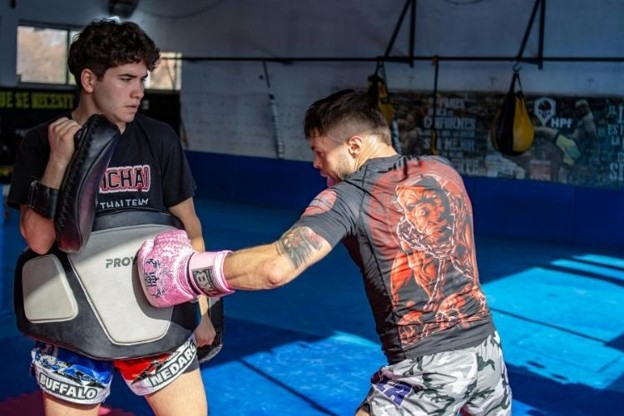
Photo by Franco Monsalvo from Pexels on Canva.
Participating in an MMA training camp can change your testosterone levels, but the change isn’t necessarily immediate or steady. During the earlier stages of camp, testosterone may remain relatively stable even as training becomes demanding. Levels can start to fall later if the fighter is losing weight and consuming too little energy for the amount of training they’re doing. The steepest declines documented in combat-sport research have occurred close to the weigh-in, when food restriction and weight-cutting practices become particularly aggressive.
Testosterone can then begin to increase again after the fighter eats and restores energy following the weigh-in. So, rather than a straight decline throughout camp, the pattern can range from little change to a pronounced late-camp drop followed by recovery.
Symptoms During Camp Can Be Misleading
Fatigue, slower recovery, low motivation, and weaker training sessions can all appear during an MMA camp. Those symptoms can overlap with symptoms associated with low testosterone, but they don’t tell you what your testosterone level is.
A fighter may be sleeping less, eating fewer calories, carrying accumulated training fatigue, or becoming dehydrated as the camp progresses. Any of those factors can affect energy and performance without necessarily causing a meaningful drop in testosterone.
That distinction is important when looking at what happens to testosterone across a full training camp. Feeling depleted doesn’t automatically mean levels are falling. In fact, research suggests that testosterone can remain relatively stable during demanding periods of MMA preparation, particularly before severe calorie restriction and weight cutting enter the picture.
Testosterone May Stay Stable Earlier in Camp
The start of camp usually brings an increase in structured training, but harder training doesn’t automatically send testosterone downward.
Tota and Wiecha (2022) followed 12 MMA athletes during a 12-week preparation period. Average testosterone was 4.97 ng/mL before the athletes began and 5.50 ng/mL after the preparation period, with no statistically significant change. Here, ng/mL means nanograms per milliliter. It’s simply a laboratory unit used to express the concentration of testosterone in the blood.
Those findings don’t mean testosterone will always remain stable during the first several weeks. The study was relatively limited, with only 12 athletes. Still, it provides useful evidence that a long period of MMA training can take place without testosterone falling significantly.
The picture can change once the fighter’s calorie deficit becomes deeper.
Testosterone Can Fall as the Calorie Deficit Deepens
Most fight camps involve some degree of weight loss, which means training often continues while calorie intake decreases. As that gap widens, the body has less dietary energy available after exercise for its other physiological functions.
A case study by Langan-Evans et al. (2021) gives an unusually detailed view of testosterone across an eight-week combat-sport preparation. The athlete began with a testosterone concentration of 21.5 nmol/L. It measured 18.7 nmol/L four weeks before competition and had fallen to 11.2 nmol/L with one week remaining.
The athlete was also progressively losing weight. Across the preparation period, he lost 13.5% of his body mass while completing technical sessions, sparring, resistance training, running, and high-intensity interval work. His average energy availability during the first seven weeks was about 20 kcal per kilogram of fat-free mass per day. During the final five days, it dropped below 10.
That sequence helps explain why a fighter’s testosterone may look very different late in camp from where it started.
Testosterone May Reach Its Lowest Point Near the Weigh-In
The final days can bring the largest change. In the Langan-Evans case study, testosterone had fallen to 9.4 nmol/L the day before the weigh-in. At the weigh-in itself, it was 4.0 nmol/L.
Research involving an MMA fighter has documented a similar late-camp decline. Kasper et al. (2019) followed an elite male fighter through eight weeks of preparation and found that his testosterone eventually fell below 3 nmol/L.
Both studies involved individual athletes whose weight-loss approaches were severe, so another fighter may not experience a drop of the same magnitude. Testosterone responses vary, and symptoms alone can’t tell you how much your levels have changed.
If you want to check your levels during or after a demanding training period, Feel30 offers physician-led hormone testing. At https://feel30.com/, you can arrange in-home blood collection and laboratory testing of total and free testosterone. That gives you an individual measurement instead of relying on the much steeper declines recorded in these extreme weight-cutting cases.
Testosterone Can Start Recovering After the Weigh-In
A low weigh-in measurement doesn’t necessarily describe where testosterone will remain after the fighter starts eating again.
The Langan-Evans case study tracked the athlete beyond the scale. Testosterone rose from 4.0 nmol/L at the weigh-in to 9.7 nmol/L after one day of recovery. One week later, it had climbed to 19.8 nmol/L, approaching the 21.5 nmol/L measurement recorded at the beginning of the study.
Recovery isn’t always immediate, however. Cannataro et al. (2020) studied male Muay Thai fighters through rapid weight loss and subsequent weight regain. Testosterone decreased significantly after weight loss and remained significantly reduced after the regain period.
Together, the studies suggest that testosterone can begin rising once severe energy restriction ends, but replacing weight after the scale doesn’t guarantee an immediate return to the fighter’s earlier concentration.
Conclusion
There isn’t one testosterone trajectory that applies to every MMA fighter. Levels can remain stable during much of camp, then fall as calorie restriction and weight loss become more severe, with the lowest measurements often appearing near the weigh-in. Testosterone may begin recovering once refueling starts, but the timing and extent of that recovery can vary.
References
- Cannataro, R., Cione, E., Gallelli, L., Marzullo, N., & Bonilla, D. A. (2020). Acute effects of supervised making weight on health markers, hormones and body composition in Muay Thai fighters. Sports, 8(10), 137.
- Kasper, A. M., Crighton, B., Langan-Evans, C., Riley, P., Sharma, A., Close, G. L., & Morton, J. P. (2019). Case study: Extreme weight making causes relative energy deficiency, dehydration, and acute kidney injury in a male mixed martial arts athlete. International Journal of Sport Nutrition and Exercise Metabolism, 29(3), 331–338.
- Langan-Evans, C., Germaine, M., Artukovic, M., Oxborough, D. L., Areta, J. L., Close, G. L., & Morton, J. P. (2021). The psychological and physiological consequences of low energy availability in a male combat sport athlete. Medicine & Science in Sports & Exercise, 53(4), 673–683.
- Tota, Ł. M., & Wiecha, S. S. (2022). Biochemical profile in mixed martial arts athletes. PeerJ, 10, e12708.