

You placed the bet before the weigh-in. One fighter comes in heavy. Does the ticket still count? A missed weight does not automatically cancel a UFC wager — but catchweights, cancellations, replacement fighters and sportsbook house rules can all change what happens next.
You place a UFC bet on Thursday.
The matchup looks good. You get the price you wanted. Then Friday morning arrives and one fighter steps onto the scale over the contracted limit.
Now the questions start.
Is the fight cancelled? Does the sportsbook refund the bet? Does your original price still count? What happens if the fighters agree to compete at a catchweight? And if the bout disappears from the card, what happens to the leg sitting inside a four-fight parlay?
The answer is not simply “missed weight = void bet.”
The weigh-in changes the fight first. What happens to the wager depends on whether the bout still takes place, whether the matchup changes and how the sportsbook’s settlement rules treat that situation.
For bettors placing wagers before official weigh-ins, that distinction matters just as much as analyzing striking, wrestling or recent form.
Missing Weight Does Not Automatically Cancel the Fight
UFC divisions have defined weight limits.
For most non-title bouts, fighters are normally allowed one pound above the division limit. A lightweight non-title fighter, for example, can weigh up to 156 pounds. In a lightweight championship fight, the fighter must make 155 pounds or less.
The UFC’s guide to weight classes and weigh-ins explains the distinction between title and non-title limits.
Missing that limit does not automatically mean the bout disappears.
UFC history includes fights that continued after one competitor missed weight, sometimes under an agreed catchweight. There have also been championship situations where a fighter missed the title limit while the bout itself still went ahead under altered title conditions.
For the bettor, that produces the first important rule:
A weight miss and a fight cancellation are two separate events.
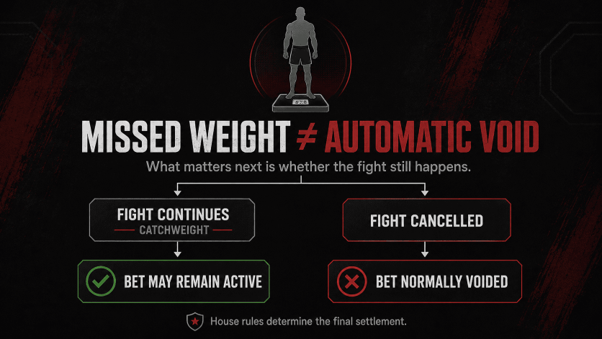
Do not assume that a ticket has been voided simply because a fighter came in heavy.
Wait for the official status of the bout.
What Changes When the Fight Becomes a Catchweight?
A catchweight means the fight takes place at a weight different from the originally scheduled divisional limit.
From a sporting perspective, that can change the matchup.
A fighter who missed weight may have suffered through a difficult cut and still look badly depleted. Another may have stopped cutting earlier and enter fight night with a possible size or recovery advantage.
Neither outcome is guaranteed.
A missed weight is information, not a prediction.
The betting market may react quickly. Odds can move after the weigh-in as bettors reassess conditioning, size, recovery and how seriously they interpret the miss.
But market movement and bet settlement are separate things.
Suppose you backed a fighter at +145 on Thursday.
After the weigh-in, the opponent misses weight and the market reprices your selection to +110.
The live market can reprice. Your accepted ticket normally does not.
The sportsbook accepted the earlier wager at the displayed odds, subject to its house rules and any event change that allows the original market to be voided.
Bettors should therefore separate three things:
- the status of the fight
- the current betting line
- the settlement status of the original ticket
They can all change independently.
The Weigh-In Can Change the Market Without Changing Your Bet
FightMatrix readers already know why weigh-ins matter beyond the number displayed on the scale.
A fighter can technically make weight and still look exhausted. Another can miss by a small amount but appear relatively healthy. Neither observation guarantees what happens in the cage, but both can influence how bettors price the matchup.
FightMatrix’s own MMA betting strategy guide includes weight class, cut history, missed weights and conditioning among the factors worth examining before a wager.
The market can react to:
- visible dehydration
- a repeated history of missed weight
- unusual difficulty standing on the scale
- a late decision to stop cutting
- a move to another weight class
- the size of the miss
- new information about illness or preparation
Any of these can produce significant line movement.
That still does not tell you how the sportsbook will settle an existing bet if the fight structure changes.
For that, the house rules matter.
When Does a UFC Bet Actually Get Voided?
This is where bettors should stop focusing only on the scale and start looking at the event attached to the ticket.
The same missed weigh-in can lead to several different outcomes.
| Situation | Fight status | Common betting implication under typical house rules |
| Fighter misses weight but same matchup continues | Fight remains on the card, potentially at catchweight | Original wager may remain active |
| Bout is cancelled | Fight does not take place | Original fight markets are normally void |
| Replacement fighter enters | Original matchup changes | Bets on the original matchup are typically void |
| Official No Contest | Fight has no official winner | Affected markets are commonly void |
| Championship eligibility changes | Fight may continue | Title-specific markets require separate checking |
These are common outcomes, not universal rules.
The sportsbook’s own house rules take priority.
For example, FanDuel’s current MMA rules state that substituting one fighter makes wagers on the original contest void. They also provide for bets to be void when a bout is declared a No Contest, subject to exceptions where an outcome was already unequivocally determined.
Its MMA betting rules are a useful example of why bettors should check the actual operator rulebook instead of assuming every sportsbook follows identical settlement standards.
Clear settlement terms are also one reason independent gambling research platforms such as CasinoIndex look beyond headline odds and promotions when assessing betting operators.
The problem is rarely that rules exist.
The problem is discovering what they mean only after a valuable ticket has been affected.
Moneyline and Prop Bets Can React Differently
A moneyline is relatively straightforward.
You are betting on which fighter wins the bout.
If the same two fighters still compete and the sportsbook keeps the original market valid, the central question remains answerable.
Prop markets can become more complicated.
Consider a championship fight where one competitor misses the title limit.
The fight may still happen, but the championship implications can change. A wager connected specifically to winning or retaining a title may no longer describe the same event condition as a simple moneyline.
The same issue can appear with:
- title winner markets
- method of victory
- exact round
- fight to go the distance
- total rounds
- fighter-specific performance props
Some markets remain completely valid as long as the fight takes place.
Others depend on a condition that has changed.
This is why bettors should not ask only:
Is the fight still happening?
They should also ask:
Is the exact event described by my market still happening?
That difference can determine how the ticket is graded.
What Happens if the Bout Is Cancelled?
Cancellation is cleaner than a catchweight change.
If the fight does not take place, there is no result to grade for the original fight market.
A sportsbook will normally void the affected wager according to its cancellation rules.
For a straight bet, that generally means the stake is returned.
Parlays create more confusion.
Suppose a bettor has four selections:
- Fighter A moneyline
- Fighter B moneyline
- Fighter C moneyline
- Fighter D moneyline
Fighter C’s bout is cancelled after the weigh-in.
Many sportsbooks will remove the voided selection and effectively treat that leg at odds of 1.00. The remaining selections continue, but the potential payout falls because one multiplier has disappeared.
That leads to another useful rule:
A voided leg does not necessarily mean a voided parlay.
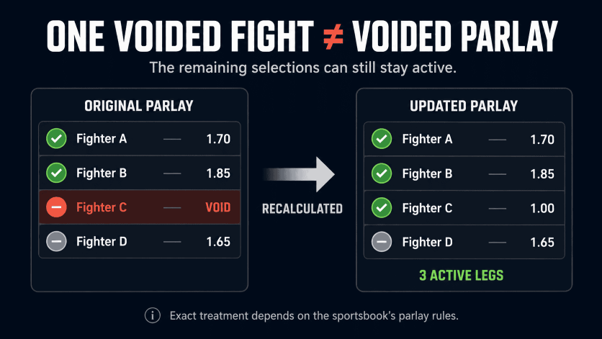
However, bettors should not assume every operator or betting product works identically.
Same-event parlays, boosted bets and promotional wagers may carry separate conditions.
If you regularly build large MMA combinations, check what happens to cancelled selections before the first cancellation affects one.
Replacement Fighters Create a New Matchup
A replacement fighter changes more than one name on the card.
It changes the wager itself.
Fighter A versus Fighter B might be attractive because of a clear wrestling advantage.
Fighter A versus Fighter C may present a completely different stylistic problem.
The market needs new odds because the probability has changed.
That is why sportsbooks normally treat a replacement as a new betting event rather than transferring bets from the old opponent to the new one.
FanDuel’s rules, for example, state that where one fighter is substituted, wagers on the original contest are void.
This approach protects both sides.
A bettor should not be forced into an entirely different matchup at odds created for the original opponent.
The sportsbook should not have to honor a price calculated for a fight that no longer exists.
If a replacement is announced, check your ticket rather than assuming the wager transferred automatically.
What About a No Contest?
A No Contest is different from a cancellation.
The fight happened.
The official result simply does not produce a conventional winner and loser.
That can happen for different reasons depending on what occurred during the bout and the ruling of the relevant commission.
For betting purposes, the operator’s No Contest rules determine settlement.
FanDuel, for example, states that MMA bets are void when a No Contest is declared, with exceptions for outcomes that had already been unequivocally determined.
That qualification matters.
Imagine a sportsbook offered a market whose outcome became fully settled before the incident that eventually produced a No Contest.
Depending on the operator’s terms, that specific market may still stand.
This is why broad statements such as:
“No Contest means every bet is refunded.”
can be too simplistic.
Often the main fight markets will be void.
A specialized market may require a separate check.
A Fighter Can Make Weight and Still Give Bettors a Warning
The official weigh-in creates a simple result:
made weight or missed weight.
The information available to bettors is less binary.
A fighter can make the limit while showing signs that cause the market to reassess the matchup.
That does not mean bettors should diagnose an athlete from a five-second social-media clip.
Appearances can mislead.
But weigh-in information becomes more useful when combined with history.
A fighter who repeatedly struggles with a division, has previously missed weight and again appears depleted creates a different research question from someone who consistently makes weight without incident.
A sensible process is:
- Check the official weight.
- Compare it with previous weigh-ins.
- Confirm whether the matchup or fight conditions changed.
- Check how the betting market reacted.
- Decide whether the new price still reflects your own assessment.
Do not turn one visual observation into certainty.
MMA already contains enough variance.
Crypto Sportsbooks Follow the Same Fight Rules
Using Bitcoin, USDT or another digital asset does not change how a UFC result should be graded.
Crypto changes the payment rail.
It does not change:
- the weigh-in
- a catchweight agreement
- the official result
- a replacement fighter
- a No Contest ruling
- the betting market on the ticket
The fight must first be settled.
Only after the sportsbook updates the account balance does the payment process become relevant.
That distinction matters when comparing crypto-focused betting platforms. A sportsbook can support fast blockchain transactions while still having vague market rules, restrictive betting limits or weak payment conditions.
Bettors who prefer digital assets can compare how crypto sportsbooks differ on limits, payments and withdrawals before deciding where to place MMA wagers.
Fast crypto does not compensate for unclear settlement rules.
Five Checks Before Betting Ahead of the Weigh-In
Betting before the official weigh-in can sometimes secure a better price.
It also means accepting more uncertainty.
Before placing the wager, make five checks.
1. Know Exactly Which Market You Bought
A moneyline, championship prop and method-of-victory wager may react differently if the fight conditions change.
2. Read the Cancellation and Replacement Rules
Do it before an event forces you to care.
Look specifically for fighter substitutions and cancelled bouts.
3. Check the No Contest Policy
Do not assume every sportsbook treats all markets identically.
4. Understand What Happens to a Voided Parlay Leg
Know whether the operator removes the leg, cancels the entire product or applies special promotional rules.
5. Save the Ticket and Accepted Price
Keep a record of:
- fighter
- market
- odds
- stake
- time placed
- event
- ticket number
If the line changes substantially after the weigh-in, you then have a clear record of what the sportsbook originally accepted.
The official weigh-in is also a good moment to reconsider the bet.
Not necessarily to place another one.
Sometimes the best reaction to new information is no reaction at all.
Final Thoughts
A fighter missing weight changes the context of a UFC fight.
It does not automatically cancel the wager.
The bout may continue at a catchweight. The market may reprice. The existing ticket may remain active. Or the fight may be cancelled, replaced or later declared a No Contest.
Those are different events with different settlement consequences.
The safest habit is simple: check the official fight status first, then find the sportsbook rule that applies to the exact market you bought.
Do not assume the scale settles the ticket.
It does not.
The scale determines whether the contracted weight was met.
The sportsbook rules determine what happens to the bet.
18+ only. Sports betting involves financial risk. Set a fixed budget, never chase losses and do not bet with money needed for essential expenses.