
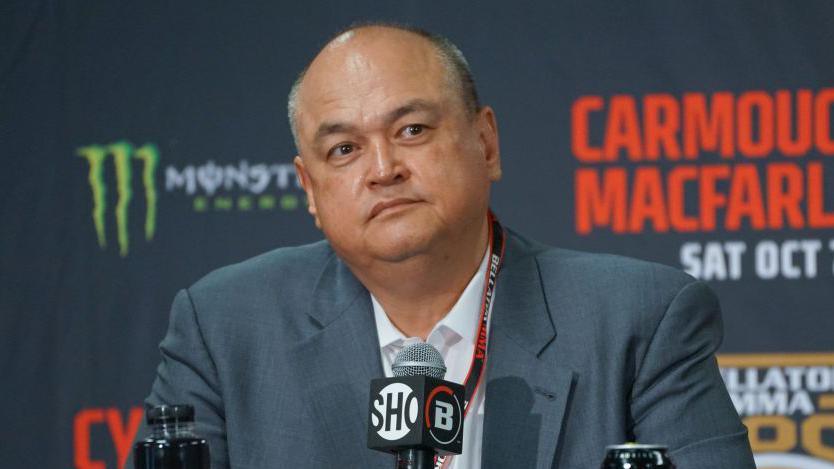
Scott Coker did not return to mixed martial arts with fireworks, trash talk, or a manufactured feud. He returned with something far more dangerous in the fight business: a plan. In a sport currently split between the UFC’s empire, PFL’s search for identity, and Jake Paul’s Netflix-powered spectacle machine, Coker is stepping back into MMA with a new global league targeted for 2027. There is no official name yet, no signed roster, and no announced media deal, but this is not some random rich-guy vanity project with gloves, a cage, and a press release. This is Scott Coker doing what Scott Coker has always done best. He is building.
The former Strikeforce and Bellator boss has secured $60 million in backing for the venture, with investors that include Tony Hawk, Upper Deck, Steve Kaplan, Swimmy Minami, and Dean Dakolias. Coker also said his group could have raised another $40 million but capped the round to avoid giving away too much control. That matters because in MMA, money is important, but control is survival. Promotions do not usually collapse because they lack ambition. They collapse because ambition gets too expensive, too quickly.
Coker appears to know exactly what he wants this league to be. Not another UFC clone. Not another promotion promising to “revolutionize combat sports” before disappearing after two cards. Not another celebrity fight factory. His vision is a tournament-driven, fighter-first, globally scouted MMA league built around the old Strikeforce formula: discover future stars, develop them properly, and then add established names who can move the needle. That is the part that should make the fight business pay attention.
Coker is targeting a January 2027 launch, and he made it clear this will not be one lonely debut card followed by months of silence. He described the early schedule as a “bang-bang-bang” run of events in the first half of the year. The plan calls for 12 events in year one, 18 in year two, and 22 in year three. For a new promotion, that is not a soft launch. That is a statement.
The centerpiece will be a Grand Prix tournament built around one weight class for the entire year. Coker said the field will be “way north of eight” fighters, with a champion crowned over a 12-month run. In an era where rankings often feel decorative and title shots can depend on social media heat, that format immediately gives fans something they have been missing: stakes that are easy to understand. Win and advance. Lose and go home.
That simplicity is powerful because MMA used to thrive on that kind of anticipation. Fans followed brackets. They argued about prospects. They watched unknown fighters become problems in real time. Tournament formats made the sport feel like a journey, not just another content schedule. Coker understands that because he has already done it. Strikeforce helped launch names that became central to modern MMA history, including Daniel Cormier, Ronda Rousey, Luke Rockhold, Miesha Tate, and Robbie Lawler. Coker’s combat sports history stretches back to Strikeforce kickboxing events in 1985 before the company moved into MMA in 2006.
That history is the sales pitch. Coker is not promising fans he can beat the UFC tomorrow. He is not standing on a table screaming that Dana White should be scared. In fact, he has framed the new league as additive to the sport, not destructive to anyone else’s business. That is smart, because trying to “kill the UFC” has been the graveyard speech of failed MMA promotions for two decades. The better lane is different. Be the place where fans discover the next great fighter before the rest of the world catches up. Be the place where martial arts still feels like martial arts. Be the place where the tournament tells the story instead of the algorithm.
That is where Coker can win, but it is also where history warns him to be careful. The MMA landscape is full of promotions that sounded great on paper and vanished when the math stopped working. EliteXC was once a major threat because it put MMA on network television, but its parent company ProElite collapsed in 2008 after funding dried up and the company’s financial position became unsustainable. The promotion had visibility, but visibility was not enough. Without a durable business model, even national television could not save it.
Affliction had a different problem. It entered MMA with star power, expensive heavyweight names, and a splashy pay-per-view model, but it burned bright and fast. Its third event, Trilogy, was canceled in 2009 after Josh Barnett tested positive in pre-fight screening, and the promotion folded its MMA operation shortly afterward, returning to its role as a UFC sponsor. The lesson was brutal but obvious: high-priced talent can create attention, but if one major event collapses, an entire business can fall with it.
The International Fight League also tried to rethink MMA with a league-style team format, but it closed in 2008 after failing to turn its unusual structure into a sustainable business. The IFL had a creative concept, but creativity alone was not enough. MMA fans still needed stars, stakes, promotion, broadcast stability, and a format that felt urgent instead of complicated. In other words, the idea had to be more than different. It had to be profitable.
That is the line every new MMA venture has to walk. Too little ambition and nobody cares. Too much spending and the runway disappears. Too many old names and fans call it a nostalgia act. Too many unknowns and nobody tunes in. Too much structure and the product feels confusing. Too little structure and it becomes another random fight card in a crowded market. Coker’s advantage is that he has lived through enough MMA eras to understand those traps before stepping into them.
He is also returning at a fascinating time. The UFC remains the industry giant, now backed by a massive $7.7 billion rights deal with Paramount. Jake Paul’s Most Valuable Promotions just entered MMA through Netflix, with a Ronda Rousey vs. Gina Carano main event that reportedly drew 12.4 million viewers. That Netflix event showed there is still a huge appetite for MMA when the packaging feels big, but it also showed the difference between spectacle and infrastructure. MVP can create noise. Netflix can create reach. Jake Paul can create attention. Scott Coker creates leagues.
That distinction is everything. Paul has already thrown the first public jab, reacting to Coker’s new promotion by saying the investors are “gonna lose all their money.” It was classic Jake: dismissive, loud, and engineered for engagement. But it also revealed something important. The new MMA business is crowded enough now that everyone is watching everyone. The moment Coker announced his return, the promoter who just staged Netflix’s MMA debut felt the need to comment. That means the move registered.
Many fight fans say that this all good news, because MMA needs that tension. For years, the sport has badly needed a credible alternative ecosystem. Not because the UFC is going anywhere. It is not. But because fighters need leverage, prospects need platforms, and fans need more than one vision of what elite MMA can look like. Coker’s vision is not mysterious. He laid it out clearly: tournament format, global scouting, free-agent additions, martial arts culture, and storytelling around the fighters. He said the league will search worldwide for “diamonds in the rough” and give them a platform to make a “big pot of gold.”
Of course, skepticism is fair. MMA history is littered with promotions that arrived with big announcements and vanished with unpaid bills. A strong press release does not build a roster. Investors do not guarantee matchmaking. A tournament format sounds great until injuries, contracts, visas, commissions, and broadcast demands start punching back. Coker knows all of that, which may be why this feels different from the usual startup hype. He is not some outsider discovering MMA because the market looks hot. He is a lifer, a martial artist, and a promoter who has already built, sold, rebuilt, and survived in this business.
Right now, the opening is obvious. MMA has become enormous, but parts of it feel strangely stale. Coker said the sport is in “a little bit of a rut,” noting that even serious fans he knows cannot name several current champions the way they once could. That is the line that should scare people, not because every fan has disappeared, but because the sport’s emotional connection with its hardcore base has frayed. The UFC has become a machine. PFL has struggled to fully define itself. Bellator is gone as fans once knew it. And the newest MMA headlines are being driven by Netflix stunts and influencer promoters.
There is room for someone to bring the fight back to the fighters. That is Coker’s lane. If he can execute, this new league does not have to beat the UFC to matter. It only has to become credible. It has to give fighters another serious place to work. It has to give fans a reason to follow a bracket for 12 months. It has to produce one or two stars the industry did not see coming.
That is how movements start. Not with a press release. Not with a logo. Not even with $60 million. They start when fans look at a fight card and feel like something new is possible again. Scott Coker is back, and for the first time in a long time, MMA’s next challenger may not be another circus. It may be a league.

Andrew Carswell is a combat sports columnist and college writing professor, based in Las Vegas, NV, whose work examines the intersection of fighting, media, business, and culture. His commentary and analysis have been featured in various magazines, newspapers, and media outlets, including Yahoo! News, and USA TODAY. Blending journalistic insight and experience with a fan’s perspective, Carswell writes about the fight game as both a cultural phenomenon and a global business.
Scott Coker the serial MMA promoter. Does he build leagues just to sell them or is he in for the long haul this time?