
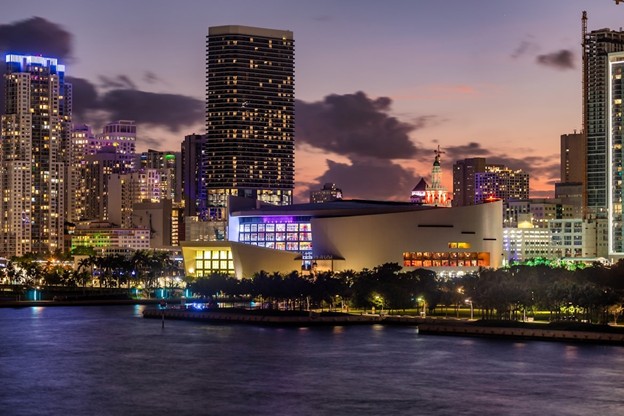
For the first three minutes of his light heavyweight title fight in the main event of UFC 327, Jiří Procházka was picking Carlos Ulberg apart. The Czech star was finding his range in the Kaseya Center, landing clean, moving well, and his Australian opponent was limping, favoring a knee that looked like it might give out beneath him at any moment. That’s what makes this defeat, the 33-year-old’s third straight in title challenges, so hard to take.
Online betting sites consider the fight a genuine pick ’em. One popular sports betting outlet had positioned both men as 1.90 shots to leave Miami with the gold, but with Procházka smelling the blood of an opponent hobbling around on one leg, he would rush in for the kill. Then Ulberg threw a left hook out of hope rather than expectation, a shot that had no business landing.
But it did. And it flattened Procházka, who went down like a man who’d been hit by a truck. The fight was over via first-round knockout, and once again, it was “Denisa” staring up at the lights.
Procházka did once hold the gold, beating Glover Teixeira at UFC 275 back in June 2022 in a fifth-round comeback that people will describe to their grandchildren. He had that — the belt, the moment, the validation. Then, Alex Pereira stripped it from him twice before Ulberg closed Procházka’s run as a genuine title challenger with a single punch. But at least he had that reign. Some superstars never even had one, despite challenging for the gold on multiple occasions.
Dustin Poirier
Dustin Poirier earned his interim strap the hard way — winning a brutal five-round war against Max Holloway at UFC 236. But an interim strap isn’t undisputed gold, something that the Diamond has explicitly found out in Abu Dhabi five months after beating the Blessed One. That’s when Khabib Nurmagomedov happened, suffocating Poirier with the kind of relentless grappling that doesn’t offer exits, submitting him in round three at UFC 242 and sending him back to the drawing board.
But the drawing board wasn’t a bad place to be. The Louisiana native stopped Conor McGregor in back-to-back fights, becoming a bona fide superstar in the process. He rebuilt his stock, and he would get his shot again, this time opposite champion Charles Oliveira.
Do Bronx was hurt in round one — hurt badly, wobbling, eyes going glassy. Poirier had him. Anyone who was watching felt it. The belt was there. You could feel the whole building straining toward it. Then Oliveira survived, found the mat, and locked in a rear-naked choke in the third in a moment that felt like the sport reaching up and slamming a door shut in Poirier’s face.
Once again, he rebuilt, this time with stoppage wins against Michael Chandler and Benoît Saint Denis, and he would duly get his third shot at UFC 302 in June 2024. Islam Makhachev took four full rounds of everything Poirier had and remained in control before closing the show at 2:42 of the fifth in a D’Arce choke that left him bloodied and finished at championship level once and for all.
Chael Sonnen
Can anyone claim bad luck three times? Not Chael Sonnen — because what happened at UFC 117 in Oakland in August 2010 was not bad luck. It was something stranger and more painful than that.
Anderson Silva was untouchable. That was the established reality of the middleweight division when Sonnen climbed into the cage with the 185-pound king that night. No one gave the American Gangster a chance. What followed over the next 23 minutes and 10 seconds was one of the most disorienting performances in UFC history — 320 strikes landed to 64, nearly 20 minutes of wrestling control, an arena going genuinely silent because nobody had a frame of reference for what they were watching. Sonnen was dismantling the man who wasn’t supposed to be dismantlable and well on his way to a lopsided unanimous decision victory.
Then 3:10 of round five arrived. Triangle armbar. In three seconds, Silva submitted a fighter who was three minutes from being the middleweight champion of the world, and suddenly the sport had its most mythologized near-miss. The rematch at UFC 148 — years of venom distilled into one night in Las Vegas — ended in round two, Silva finishing Sonnen with strikes after an ill-fated spinning back fist attempt. Sonnen moved to light heavyweight, coached TUF 17 opposite Jon Jones, and arrived at UFC 159 in April 2013 for a third attempt in a second weight class. Jones submitted him relatively simply.
Three shots. Two divisions. Zero gold. But his four and a half rounds at UFC 117 are still invoked in reverent tones because what he did that night — against that opponent — remains one of the sport’s genuine sacred texts.
Alexander Gustafsson
Alexander Gustafsson never held interim gold, never held undisputed gold, never held anything. What he held was a reputation as the man who came closest to ending Jon Jones — twice — without ever having the belt to prove it.
UFC 165 in Toronto, September 2013. Gustafsson took Jones down — the first man ever to do so in the UFC. He cut him over the eye. He out-landed him on the feet across five rounds that Jones himself called the hardest fight of his life. Three judges scored it 48-47, 48-47, 49-46. One judge’s extra point — a single round scored differently — is the margin between Gustafsson being the light heavyweight champion and Gustafsson being a footnote. MMA Junkie named it Fight of the Year. Gustafsson was the moral victor in defeat, which is a beautiful and completely worthless distinction.
Instead of an immediate rematch, matchmaking sent him to Daniel Cormier at UFC 192 in Houston — another war, a split decision where one judge had The Mauler winning, the narrowest margin the scoring system allows. Then the Jones rematch finally arrived at UFC 232 in December 2018 — under a cloud of controversy over Jones’s failed VADA tests, in a fight relocated to Los Angeles at the last moment — and Jones stopped him by TKO in round three. Two different champions. Three challenges across five years. Not one belt claimed.