

Blackjack is one of the most popular casino games, but many beginners approach it the wrong way. Learning how to deal with blackjack like a pro isn’t about luck or copying other players, it’s about understanding the game, staying disciplined, and making smart decisions consistently. Professional players don’t chase wins or rely on feelings. Instead, they follow proven principles that reduce mistakes and improve long-term results. This guide is designed for new and casual players who want to learn how to play blackjack like a pro, avoid common beginner errors, and feel more confident at both online and live blackjack tables.
Key Takeaways
|
Understanding Blackjack
To play blackjack like a pro, especially in Live Table Games, the first thing you need to understand is that you are only playing against the dealer, not the other players at the table. What other players do may feel important in the moment, but it has no real impact on your long-term results. Professional blackjack players focus entirely on their own hand and the dealer’s visible card.
Another key concept beginners often misunderstand is the number 21. While blackjack is about getting close to 21, 21 is a threshold, not a target. You don’t need to hit 21 to win, you only need to have a higher total than the dealer without going over. Chasing high numbers often leads to unnecessary busts.
Knowing the Rules Before You Sit at a Table
Before you can truly learn how to deal with blackjack like a pro, you need a solid understanding of the rules. Many beginner mistakes don’t come from bad luck, they come from not fully knowing how blackjack works. Rule literacy is essential because even small rule differences can affect your decisions and long-term results.
Core Blackjack Rules Every Player Must Know
At its core, blackjack is a simple card game. Each card has a fixed value. Number cards (2 through 10) are worth their face value. Face cards, Kings, Queens, and Jacks, are worth 10. Aces are special because they can count as either 1 or 11, depending on which value benefits your hand most.
As a player, your goal is to build a hand that beats the dealer without going over 21. If your hand exceeds 21, you bust and automatically lose, regardless of what the dealer has. If the dealer busts and you do not, you win. If both you and the dealer end with the same total, the result is a push, meaning your bet is returned.
One important point for new blackjack players is that you act first. This means the dealer always has the advantage of reacting to your final hand. Understanding this dynamic helps explain why smart decision-making is critical when learning how to play blackjack like a pro.
Rule Variations That Change the Odds
Not all blackjack tables follow the same rules, and these variations can significantly affect the house edge. One of the most important differences is whether the dealer hits or stands on soft 17. A soft 17 is a hand totaling 17 that includes an Ace counted as 11. When the dealer is required to hit soft 17, the house gains a slightly higher advantage.
Another key factor is the number of decks used. Blackjack can be played with one deck or multiple decks, commonly six or eight. Fewer decks generally favor players because the odds are slightly better and card patterns are easier to track mentally.
Blackjack payout rules also matter more than many beginners realize. The standard payout for a natural blackjack is 3:2, meaning you win 1.5 times your bet. Some tables offer 6:5 payouts, which significantly increase the house edge. Professional-minded players avoid these tables whenever possible.
Understanding these rule variations before sitting down helps you choose better games and is a crucial step in learning how to deal with blackjack like a pro as a player.
Blackjack Hand Types Every Player Must Recognize
To deal with blackjack like a pro, you must first learn to identify the type of hand you’re holding. Many beginners focus only on the total number, but professional blackjack players think in terms of hand categories. Each type of hand behaves differently, carries different risks, and affects how much flexibility you have during a round.
Hard Hands Explained
A hard hand is any blackjack hand that either contains no Ace or contains an Ace that can only be counted as 1 without busting. For example, a hand like 10 and 6 is a hard 16. A hand with an Ace, 5, and 10 is also hard because counting the Ace as 11 would push the total over 21.
What makes a hand “hard” is the lack of flexibility. Once your total is fixed, every additional card carries a real risk of busting. Hard hands are more rigid and less forgiving than other hand types, which is why beginners often struggle with them.
Hard hands limit your options because there’s no safety cushion built in. If you’re sitting on a hard 15 or 16, even a small card can push you over 21. Professional players understand this limitation and treat hard hands cautiously, focusing on minimizing losses rather than forcing big wins. Recognizing a hard hand quickly is an essential step toward learning how to play blackjack like a pro.
Soft Hands Explained
A soft hand includes an Ace that is currently being counted as 11. For example, Ace and 6 is a soft 17. The key advantage of a soft hand is flexibility. If you draw a card that would normally cause a bust, the Ace automatically adjusts from 11 to 1, keeping your hand alive.
The Ace plays a crucial role in soft hands because it gives you a built-in safety net. This allows players to take calculated risks without the same fear of busting. That’s why soft hands are often considered more playable and more forgiving, especially for beginners.
Soft hands offer a strategic advantage because they allow you to gather more information before committing to a final total. Professional blackjack players see soft hands as opportunities to improve their position while controlling risk. Understanding the difference between soft and hard hands helps you stay calm, avoid panic decisions, and approach blackjack with a more professional mindset.
Paired Hands and Their Significance
Paired hands occur when your first two cards are of the same value, such as two 8s or two face cards. These hands are treated differently because they give you the option to separate them into two independent hands, each with its own bet and outcome.
The reason pairs matter is that they create unique decision scenarios. Some pairs are weak when played together but stronger when split, while others perform better as a single hand. This makes paired hands one of the most misunderstood aspects of blackjack for beginners.
A common misconception is that all pairs should be split or that splitting is always aggressive. In reality, splitting is about improving your long-term odds, not chasing excitement. Professional players evaluate pairs based on probability, not emotion. Recognizing paired hands correctly and understanding why they are handled differently is a major step in learning how to deal with blackjack like a pro from a player’s perspective.
Basic Blackjack Strategy (The Foundation of Pro Play)
To truly understand how to deal with blackjack like a pro, you need a strategic foundation that removes guesswork from your decisions. This foundation is known as basic blackjack strategy. It is not a system, trick, or betting pattern, it’s a mathematically proven framework that helps players make the best possible decision in every common situation.
Professional players rely on basic strategy because it replaces emotion with logic and creates consistency over time. Without it, even experienced players end up making costly mistakes that slowly increase the house advantage.
What Basic Strategy Actually Is?
Basic strategy is based entirely on probability and expected value. It tells you the statistically best move to make based on:
- Your current hand total
- The dealer’s visible card
Every decision has been tested across millions of simulated hands to determine which option performs best over the long run.
What basic strategy focuses on:
- Minimizing losses on weak hands
- Maximizing value on strong situations
- Avoiding unnecessary risks
What it avoids:
- Guessing
- “Feeling lucky” decisions
- Copying other players at the table
At a professional level, blackjack is about making the least bad decision when no perfect option exists. That’s why basic strategy consistently outperforms intuition.
Why Do Pros Never Deviate Randomly?
One of the biggest differences between casual and professional blackjack players is discipline. Pros understand that short-term luck is meaningless compared to long-term math. Deviating from strategy because of emotions, whether excitement or frustration, slowly erodes any advantage you might have.
Common emotional traps players fall into:
- Changing decisions after a loss
- Playing more aggressively during winning streaks
- Second-guessing correct plays because “it feels wrong”
Professional players avoid these traps by trusting the numbers, not the moment. They accept that losses are part of the game and focus on making the correct decision every single time.
Pro mindset tip:
- One hand means nothing
- One session means little
- Thousands of hands reveal results
This disciplined approach is essential when learning how to play blackjack like a pro.
How Basic Strategy Reduces the House Edge?
Blackjack already has one of the lowest house edges in casino games. Basic strategy helps push that edge even lower by eliminating poor decisions.
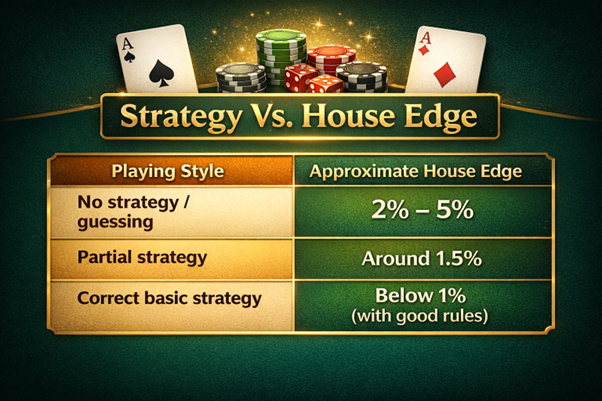
This doesn’t mean you’ll always win. What it means is:
- You lose less during bad runs
- You capitalize better during good runs
- You stay competitive over time
What basic strategy can do:
- Reduce costly mistakes
- Improve consistency
- Build confidence at the table
What basic strategy cannot do:
- Guarantee profits
- Eliminate variance
- Overcome poor table rules
Understanding both the strengths and limits of basic strategy keeps expectations realistic and helps players approach blackjack in a professional, controlled way.
Learning When to Hit, Stand, Double, or Split
Once you understand how blackjack strategy works, the next step in learning how to deal with blackjack like a pro is knowing when to take action. Every decision in blackjack is about balancing risk and reward. Professional players don’t act randomly or emotionally, they follow clear decision logic based on math, probability, and the dealer’s visible card.
Hit and Stand Decisions Simplified
The decision to hit or stand is the most common choice you’ll make in blackjack. It depends heavily on two things: your hand total and the dealer’s upcard. Professional players view the dealer’s card as a signal that tells them how risky the situation is.
When the dealer shows a strong upcard (such as 7 through Ace), there’s a higher chance the dealer will reach a strong total. In these situations, standing on a weak hand often leads to a loss, so taking calculated risks becomes necessary. When the dealer shows a weak upcard (typically 2 through 6), the dealer is more likely to bust, and players can afford to be more cautious.
Risk management principles behind hit and stand decisions:
- Stand when the dealer is likely to bust and your hand is stable
- Hit when standing gives you little chance to win
- Avoid hitting purely out of fear or impatience
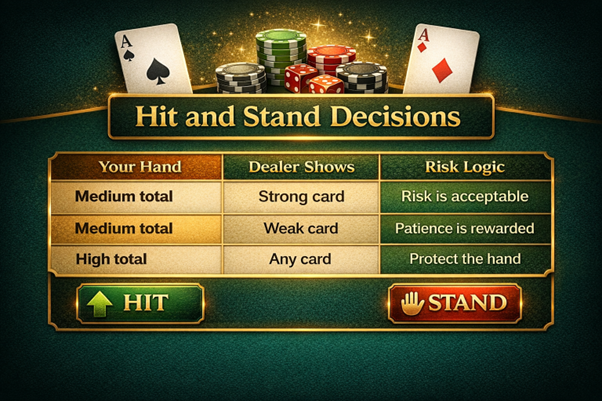
Understanding this balance helps players make calm, logical decisions instead of reacting emotionally, which is essential when learning how to play blackjack like a pro.
When Doubling Down Makes Sense?
Doubling down is one of the most powerful moves in blackjack, but it’s also one of the most misunderstood. Doubling is not about being aggressive, it’s about capitalizing on high-value situations where the odds strongly favor you.
When you double down, you’re committing more money in exchange for receiving only one additional card. This move makes sense only when your expected value is higher than average.
High-value situations where doubling is logical:
- Your hand has strong improvement potential
- The dealer shows a weak upcard
- The probability of winning outweighs the risk
| Doubling Down Reality | What It Means |
| One-card limit | You must be confident |
| Increased bet | Higher expected return |
| Not flexible | Decision must be precise |
Professional players double down selectively and without hesitation. They don’t double because they feel lucky, they double because the math supports it. Understanding this difference prevents costly mistakes and helps maintain long-term consistency.
Smart Splitting Decisions
Splitting pairs creates two separate hands and doubles your exposure for that round. Because of this, splitting should always be approached with logic rather than excitement. Some pairs perform far better when separated, while others lose value when split.
Pairs that generally create advantage when split:
- Aces
- Eights
These hands are weak or awkward when played together but become stronger as separate hands.
Pairs that often hurt long-term results when split:
- Tens and face cards
- Fives
Keeping these hands intact usually provides better winning potential than splitting them.
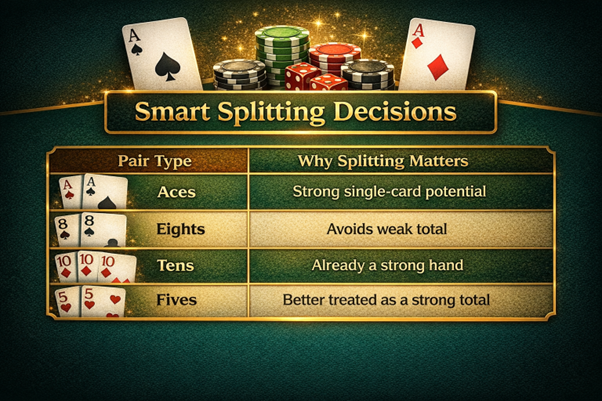
A common beginner mistake is splitting based on excitement rather than probability. Professional players split only when it improves their expected outcome, reinforcing a disciplined approach to blackjack decision-making.
Reading the Table and the Dealer
One of the biggest shifts players make when learning how to deal with blackjack like a pro is separating facts from myths. Many players believe they can influence outcomes by reacting to other players, changing seats, or blaming the dealer. Professional players take a more grounded approach. They focus on what actually matters, ignore what doesn’t, and make decisions based on logic rather than superstition.
What Players Can and Cannot Influence?
A common belief among casual blackjack players is the idea of a “hot” or “cold” dealer. In reality, the dealer does not control outcomes. Cards are dealt randomly, and each hand is independent of the last. Whether the dealer has been winning or losing has no effect on future hands.
What players cannot influence:
- The order of the cards
- The dealer’s final hand
- The outcome of previous rounds
Blaming the dealer or other players for losses creates emotional frustration and leads to poor decisions. Professional players avoid this mental trap by staying focused on what they can control.
What players can influence:
- Their own decisions
- Their betting discipline
- Their emotional state
By accepting randomness as part of the game, players stay calm and consistent. This mindset is critical for anyone serious about learning how to play blackjack like a pro.
Table Pace and Seat Selection
While players cannot control outcomes, they can control their environment. Table pace plays a subtle but important role in decision quality. Faster tables move quickly, giving players less time to think. Slower tables allow for more deliberate decisions and often feel less stressful.
Differences between table speeds:
- Faster tables suit confident, experienced players
- Slower tables help with focus and accuracy
- Rushed decisions increase mistakes
Seat selection is more about comfort and visibility than superstition. Some players prefer seats with a clear view of the dealer and betting layout, while others choose positions that minimize distractions.
Comfort and focus factors to consider:
- Clear line of sight to cards and chips
- Comfortable distance from distractions
- Enough time to make decisions calmly
| Table Factor | Why It Matters |
| Pace of play | Affects decision quality |
| Seating comfort | Improves focus |
| Dealer visibility | Reduces confusion |
Professional players treat the table like a workspace. By choosing an environment that supports concentration and emotional control, they create better conditions for consistent play and smarter decision-making.
Common Beginner Mistakes in Blackjack
Many losses in blackjack don’t come from bad luck, they come from repeatable mistakes. Learning how to deal with blackjack like a pro means recognizing these errors early and avoiding habits that slowly drain your bankroll. Professional players don’t aim to play perfectly; they aim to eliminate unnecessary mistakes.
Ignoring Basic Strategy
One of the most common beginner errors is knowing basic strategy but choosing to ignore it. Players often deviate because a move “feels wrong” or because they’re reacting to previous hands. This emotional decision-making increases the house edge over time. Professionals trust the math, even when a decision looks uncomfortable.
Playing Side Bets Blindly
Side bets are designed to look exciting, but they usually carry a much higher house edge than the main blackjack game. Beginners often place side bets without understanding the odds, treating them as harmless extras. Over time, these bets quietly undo the benefits of disciplined blackjack play.
Betting Inconsistently
Another mistake is changing bet sizes randomly based on mood or recent results. Increasing bets after a loss or lowering them after a win may feel logical, but it’s rarely supported by probability. Professional players keep their bets controlled and consistent to manage variance and protect their bankroll.
Blaming Variance on “Bad Dealers”
It’s easy to blame losses on a “bad dealer” or other players at the table. In reality, variance is a natural part of blackjack. Assigning blame creates frustration and leads to rushed, emotional decisions. Pro-level players accept short-term swings and stay focused on making correct choices, hand after hand.
Final Thoughts – Playing Blackjack the Smart Way
Blackjack rewards players who treat it as a skill-based probability game, not a guessing game or a test of luck. Learning how to deal with blackjack like a pro is less about winning every hand and more about making the right decisions consistently, even when the outcome isn’t immediately in your favor.
Smart blackjack play comes from discipline, patience, and a clear understanding of how this live table game works. By focusing on proven strategy, managing emotions, and avoiding common mistakes, players give themselves the best possible chance to succeed over time.
Short-term wins and losses are part of the experience, but long-term thinking is what separates casual play from professional-level approach. When you commit to informed decisions and steady habits, blackjack becomes a more controlled, enjoyable, and rewarding game.
FAQs
1. What does “deal with blackjack like a pro” actually mean for players?
It means playing blackjack with discipline, strategy, and emotional control rather than relying on luck, guesses, or superstition.
2. Is blackjack more skill-based or luck-based?
Blackjack is a probability-based game where skill significantly influences long-term results, even though short-term outcomes are affected by luck.
3. Do other players at the table affect my blackjack results?
No. Your long-term results depend only on your decisions and the dealer’s hand, not on what other players do.
4. Why is basic strategy so important in blackjack?
Basic strategy reduces mistakes by showing the statistically best decision for each situation, lowering the house edge over time.
5. Can basic strategy guarantee winning in blackjack?
No. Basic strategy does not guarantee wins, but it minimizes losses and improves consistency across many hands.
6. What is the biggest mistake beginners make in blackjack?
Ignoring basic strategy and making emotional decisions based on recent wins or losses is the most common and costly mistake.
7. Are side bets worth playing in blackjack?
Most side bets have a much higher house edge and are not recommended for players focused on long-term results.
8. Why do professional players avoid chasing losses?
Chasing losses leads to emotional decisions and poor bankroll control, which increases long-term losses.
9. Does seat position at the blackjack table matter?
Seat position does not affect card outcomes, but choosing a comfortable seat can improve focus and decision-making.
10. Is there such a thing as a “hot” or “cold” dealer?
No. Each blackjack hand is independent, and dealers do not influence card outcomes.
11. When should a player double down in blackjack?
Doubling down makes sense only in high-value situations where probability strongly favors the player.
12. Why is splitting pairs treated differently in blackjack?
Splitting creates two separate hands, which can improve or reduce expected value depending on the pair.
13. Is it bad to change bet sizes frequently in blackjack?
Yes. Inconsistent betting based on emotions increases risk and makes bankroll management harder.
14. How does bankroll management help in blackjack?
It protects players from variance, prevents emotional betting, and allows longer, more controlled play sessions.
15. Is online blackjack better for beginners than live tables?
Online blackjack often allows more time to think, making it easier for beginners to follow strategy accurately.
16. Can beginners really play blackjack like a pro?
Yes. With basic strategy, discipline, and practice, beginners can adopt professional-level habits quickly.
17. Why do professionals care more about long-term results than single sessions?
Because blackjack outcomes balance out over thousands of hands, not individual games or short sessions.
18. Does winning streaks mean strategy is working better?
No. Winning streaks are part of variance and do not indicate improved odds in the short term.
19. How long does it take to improve at blackjack?
Most players see improvement quickly once they consistently follow strategy and manage emotions.
20. What is the smartest way to approach blackjack overall?
Treat blackjack as a disciplined probability game, focus on correct decisions, and ignore short-term outcomes.