
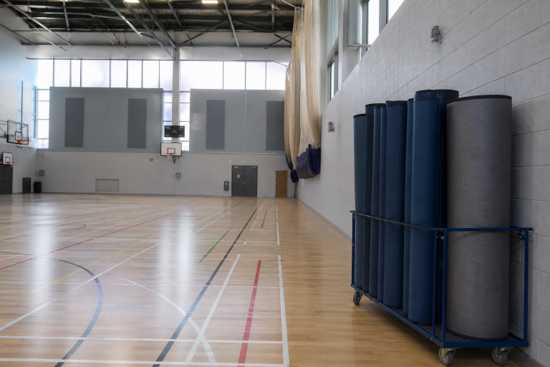
A coach has the qualifications. Fifteen families have confirmed interest. The facility has a free Wednesday evening slot. On paper, that is everything a youth grappling program needs to launch, and in practice, it is not close to enough. The building is not ready for children.
That distinction, between a room that is available and a program that a parent will actually commit to, is where most youth grappling programs stall, and it rarely becomes obvious until month two or three, when enrollment quietly collapses without a single dramatic incident.
This guide is written for the facility manager and the coach working through the launch together. When only one side understands what needs to be in place before the first session, the gap shows up later in safeguarding conversations nobody prepared for.
It also becomes obvious when a mat system has nowhere to live or a dark waiting corridor drives families away before the term finishes.
Forward-thinking facilities solve this waiting issue early by moving siblings outside, utilizing exterior spaces enclosed by WillyGoat’s playground borders to contain safe surfacing. Six things have to exist before the first child walks through the door.
They must be solved in sequence because each step enables the next.
1. The Insurance and Safeguarding Position
No facility manager will commit a calendar slot or sign a hire agreement until liability is confirmed in writing. Until insurance and safeguarding documentation are both verified, the program does not have a start date.
Insurance for youth grappling has two components that must both be checked explicitly.
The first is who carries the policy, whether it is the coach through a governing body or the facility through public liability cover. The second is scope, as a blanket sports clause may not explicitly cover contact sports.
Confirm that grappling and wrestling are named in the policy wording directly with the insurer rather than assuming coverage from a summary document.
Safeguarding documentation requires the same specificity. The coach must hold a current, valid background check rather than a certificate that expired eighteen months ago.
A recognized child protection qualification is also mandatory, and a one-time online module completed three years ago does not meet the standard. The facility should have its own child protection policy that the program formally operates under.
Coaches outside any governing body structure must source a standalone policy and an external safeguarding course separately. Both need to be in hand before the first conversation about scheduling even begins.
A grappling instructor with fifteen interested families and a confirmed Tuesday slot but no current safeguarding certificate is still not ready to launch.
Request both the insurance certificate and the safeguarding documentation before any marketing or timetable announcement goes out. If either document is missing, the program does not move forward.
2. Mat Specification and the Storage Reset
A hall used for yoga on Monday and badminton on Tuesday cannot keep a permanent grappling mat on the floor. Without planning, you end up with mats that are unsafe for children and a storage arrangement that causes constant friction.
Thickness is the initial factor when selecting mats, and 1.5 to 2 inches is the standard requirement to absorb takedown impacts properly for younger athletes.
Interlocking puzzle mats are inexpensive and portable, but they develop edge gaps across a session of active children that become severe trip hazards.
Tatami-style rollout panel mats hold position more reliably across a fast-paced class and are easier to inspect for surface damage.
Vinyl-covered mats can be cleaned with a standard disinfectant between sessions, which is a mandatory operational requirement in any shared facility. Storage is just as critical and must be agreed upon before purchase.
Rolled mats need a trolley and enough floor space to maneuver them into a dedicated closet, while panel mats require wall-mounted brackets. A mat system with no confirmed home gets left out, walked on by other users, and damaged within a single term.
Reset time must also be calculated before the hire agreement is finalized. Allow fifteen to twenty minutes before each session for mat setup and the same amount of time afterward for breakdown.
A 45-minute grappling class effectively occupies one hour and twenty-five minutes of room time. Hire agreements that price only the session length will create a financial dispute with the facility manager by the end of term one.
| Warning/Important: Interlocking puzzle mats may seem portable, but edge gaps appear across a session, creating trip hazards for active children. Use tatami-style rollout panels that hold position better. |
3. Qualified Supervision Ratios for the Age Group
A coach who runs a smooth adult grappling class of twenty people without an assistant cannot apply that logic to a group of seven-year-olds. The ratios are stricter and the consequences of under-supervision are severe.
The visible ratio is also something parents actively evaluate when they look through the door on their first visit.
Youth grappling programs typically operate at approximately one qualified adult per six to eight children for ages five to seven. For ages eight to eleven, the ratio moves to one qualified adult per eight to ten children.
Those figures set the maximum class size directly, which then establishes the revenue ceiling per session. Attempting to run twelve young children with a single adult is both an operational risk and a visible signal that the program lacks proper structure.
A second adult in a supervisory role must meet the same documentation requirements as the lead coach. An appropriate background check and a basic safeguarding awareness qualification are non-negotiable.
A parent who offers to stay and help does not satisfy this legal requirement. A trained assistant coach increases the class size ceiling, distributes the supervisory load, and reduces per-session liability.
The facility manager should ask the coach how ratios will be met at each age group before signing off on any timetable. If the answer is a vague promise to manage things on the fly, the plan is incomplete.
Build the timetable around the required ratios from the beginning so you avoid retroactive scheduling conflicts later in the term.
4. Managing Waiting Parents and Siblings
A standard children’s grappling class creates nearly an hour of downtime for a parent who likely brought a younger sibling along. That waiting experience is one of the strongest predictors of whether the family renews their enrollment.
A cold corridor with one plastic chair and a small reinforced window is not a functional waiting area. It serves as a quiet reason to stop attending after week five.
A bored five-year-old accompanying their older sibling needs somewhere safe to be for the duration of the session. Standing in a narrow hallway is genuinely unpleasant, so a designated outdoor waiting space changes the dynamic completely.
A surfaced and sheltered exterior area gives the sibling somewhere to play that does not require constant management from the parent.
Rubber mulch and wet-pour rubber are established, low-maintenance surfacing choices that meet standard safety requirements for areas where children play unsupervised. These materials will not stay contained without proper perimeter edging in place.
Without durable borders, loose mulch migrates onto adjacent pathways and hard surfaces within a few weeks of installation.
Concrete mow strips, pressure-treated timber edging, and purpose-built commercial boundary systems hold the surfacing material tight while giving the outdoor area a finished appearance.
A canopy or shade sail over the waiting area extends its usability in hot or rainy conditions.
This is a facility manager decision representing a low-cost addition relative to the retention benefit it delivers. It should be costed into the facility development plan before the program launches rather than added as a reactive fix after the first term.
| Key Insight: A cold corridor with one plastic chair is not a waiting area; it’s a quiet reason to stop coming after week five. A surfaced, sheltered outdoor play space retains families. |
5. A Fee Structure the Community Can Actually Pay
Monthly rolling fees feel administratively flexible to the program organizer, but they create a low-friction exit for the family.
Canceling in month two requires no real decision when the novelty fades or holiday spending starts. The family simply does not renew, causing the program to lose an enrollment it never had to lose.
Term-based pricing aligns with how families already think about children’s activities. An eight-to-ten-week block matches the school rhythm that most households already use to organize their calendars. It establishes a defined commitment with a clear end date.
A family that pays for a full term makes a deliberate decision, whereas a family on a monthly fee makes that decision again every four weeks.
Term-based pricing should include a household-level sibling discount rather than per-child rates that penalize larger families. A clear illness and absence policy reduces dropout while demonstrating that the operation runs with reasonable flexibility.
Offering credit toward the following term for extended illness works better than issuing a full refund.
When setting the per-term rate, benchmark against comparable local youth activities like recreational swimming lessons or community gymnastics. The program must sit within the range that local families already budget for children’s activities.
If the pricing sits too high above standard community hall rates, the fee structure itself becomes the primary reason families leave.
6. A Retention Plan Past the First Eight Weeks
Youth programs rarely fail because nobody signed up. They fail because the children who originally enrolled simply stopped coming. Low sign-up is a visible problem that shows up immediately, while low retention arrives on a predictable schedule.
It looks like interest fading naturally, but it is almost always a structural design problem that existed from day one.
The enrollment drop typically lands around weeks six to eight. The novelty of a new activity wears off before the child develops the skill level or social bonds necessary to make quitting feel like a loss. The plan for surviving this specific drop-off must be built before session one.
Four concrete tactics address the week-six cliff directly.
First, provide a progression marker at the end of the term. A colored band or a printed skills certificate gives the child a tangible achievement to return for next term.
Second, send a week-four parent communication that names specific progress each child has made. Week four is when the re-enrollment decision forms, so waiting until week eight means arriving after families have made up their minds.
Third, encourage social pairing by offering a free trial session for a named friend, which grows class size and increases the retention rate of the referring child.
Fourth, host a brief open session for parents and siblings in the final week. This creates a performance moment the children want to repeat while giving parents concrete proof that the program is worth continuing.
| Pro Tip: Send parents a brief progress update at week four, previewing term two content. This is when the re-enrollment decision forms waiting until week eight means arriving after it’s already made. |
The Path Forward
Securing liability insurance, sourcing thick rollout mats, and establishing strict supervision ratios create the necessary foundation for safety. Adding dedicated outdoor waiting spaces with durable boundary systems keeps parents comfortable while keeping siblings occupied.
Establishing a term-based fee structure and an eight-week retention plan ensures those families stay committed past the second month.
The operations that run successfully for five years are not always the ones with the most decorated coaches.
They are the ones whose structural foundation was entirely solid before the first child ever stepped onto the mat. Build these six components in sequence, and the rest of the schedule will hold firm.
| Author Profile: WillyGoat is the leading online retailer of commercial playground equipment for schools, parks, churches, daycares, and communities across America. |