
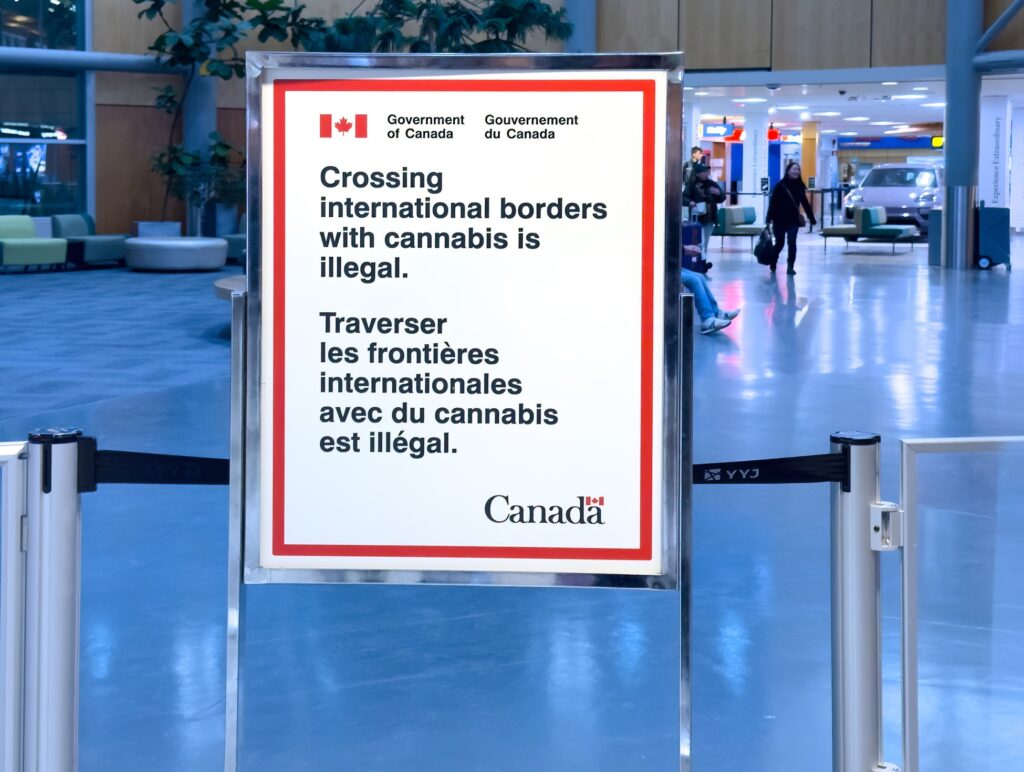
Here is the rule that catches American travelers in Alberta every single year: cannabis is fully legal to buy and use in Canada, and it is a serious criminal offence to carry any amount of it across the Canadian border, in either direction, no matter where you bought it, no matter that it was legal on both sides of the line. The dispensary in Edmonton is legal. The dispensary in Denver is legal. The forty minutes between the duty-free shop and the US checkpoint is where a souvenir becomes a criminal charge. This article explains how Canadian drug law actually works for a visiting American, in three layers: cannabis inside Canada, the border in both directions, and everything that is not cannabis.
What Are the Cannabis Rules Inside Alberta?
Simple and genuinely permissive, which is exactly why the border rule blindsides people. Adults 18 and over in Alberta can buy cannabis from licensed retailers, possess up to 30 grams in public, and consume it subject to provincial and municipal rules that work roughly like liquor rules: not in vehicles, not in most public spaces where children gather, and never behind the wheel, since drug-impaired driving carries its own Criminal Code offences based on blood THC concentration.
For a visiting American, everything in that paragraph is available to you while you are in the province. The mistake is treating that legality as portable. It is not. Cannabis legality in Canada stops precisely at the border, and so does cannabis legality in whatever US state you are returning to, because the US border is federal jurisdiction, where cannabis remains a controlled substance regardless of state law. Legal in Alberta plus legal in your state still equals illegal at every point where you cross between them.
What Happens if You Cross the Border With Cannabis?
Entering Canada, failing to declare cannabis in your possession is itself a serious criminal offence, on top of the import prohibition; declared or not, bringing it across without a federal permit is illegal in any amount and in any form, including edibles, oils, topicals, and CBD products. The Government of Canada states the rule without exceptions on its official cannabis and the border page: no amount is permitted, medical authorization does not create an exemption, and travelling between two legal jurisdictions changes nothing. Mailing or couriering cannabis into or out of Canada is equally illegal, which closes the workaround people invent at the airport.
Leaving Canada toward the United States, the exposure doubles. Canadian law makes exporting cannabis a serious offence, and US federal law makes importing it one, so the same forgotten package in a backpack can generate legal consequences on both sides of a single crossing. There is also a quieter, longer-lasting American risk that has nothing to do with possession: admissions. A US border officer can ask an American citizen or a foreign traveler about drug use, and a non-citizen who admits prior cannabis use, or involvement in the legal cannabis industry, can face US inadmissibility consequences that outlast any trip. The practical rule experienced cross-border travelers follow is the one this article can print in six words: what is legal in Canada stays in Canada.
What About Drugs Other Than Cannabis?
Everything other than cannabis falls under the Controlled Drugs and Substances Act, Canada’s federal drug statute, and the framework will feel familiar and unforgiving to American readers: simple possession, trafficking, possession for the purpose of trafficking, and production, with penalties that scale steeply by substance and quantity. Two features matter most to a visitor.
First, trafficking in Canadian law is broader than street-level selling. Giving drugs to a friend, transporting them, or offering to do either can meet the definition, and quantity plus packaging can convert a possession file into a possession-for-the-purpose file, which is a different order of seriousness. Second, the border is the highest-risk environment a traveler passes through, because border officers hold search powers far wider than police powers inside the country, and that includes searches of phones and laptops. Alberta’s Court of Appeal confronted the constitutional limits of device searches at the border in a 2020 case that began exactly that way, with charges arising from a border examination of electronic devices, and the practical takeaway survives every appeal since: evidence found at a crossing is difficult to keep out of a courtroom.
A US visitor charged under the CDSA in Alberta enters the Canadian criminal process like anyone else: Charter right to counsel on detention, release conditions, Crown disclosure, and a prosecution that proceeds summarily or by indictment. The border-adjacent geography matters too; files arising from airport seizures in Edmonton or from the highway corridors north run through Alberta courts, and it is routine for drug charge lawyers in Edmonton to be retained by out-of-province and American accused precisely because release conditions and travel permissions are the first practical battleground for someone whose life is in another country. And one more cross-border fact worth knowing before any of this ever happens: a drug conviction on a record, Canadian or American, is among the most reliable triggers of inadmissibility at the border of the other country, sometimes for life. The cheapest legal advice in this entire article is to arrive clean and leave clean.
Frequently Asked Questions
Can I bring legally purchased cannabis home from Canada? No. Taking any amount of cannabis across the Canadian border, in any form including CBD, is a criminal offence in both directions, regardless of where it was purchased and regardless of cannabis being legal on both sides of the crossing.
Is cannabis legal for American visitors in Alberta? Yes. Adults 18 and over can legally purchase, possess up to public limits, and consume cannabis in Alberta subject to provincial rules, exactly as residents can. The legality applies only inside Canada and ends at the border.
What happens if an American is charged with a drug offence in Alberta? The charge proceeds under Canadian law through Alberta’s courts, beginning with the Charter right to counsel on detention. Release conditions and permission to return home pending proceedings become the immediate practical issues, and the outcome of the case can affect future admissibility to Canada and the United States alike.
About the author: Edmond O’Neill has practised criminal defence for more than 35 years. He is a past president of the Criminal Trial Lawyers’ Association, an instructor at the University of Alberta Faculty of Law, and a partner at Liberty Law LLP, a criminal defence law firm with offices in Edmonton, Grande Prairie, and Fort McMurray. Nothing in this article is legal advice; every situation is individual and deserves individual advice.