


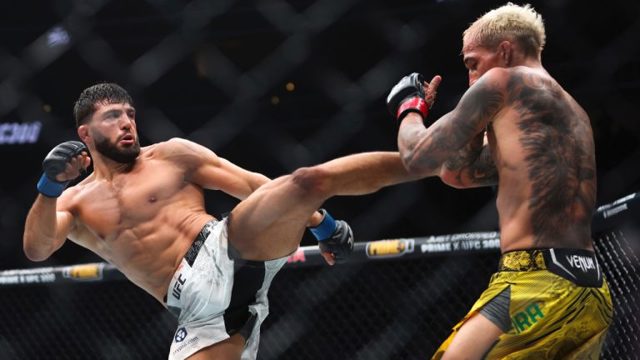
You go into a fight night expecting chaos. It’s the nature of the beast. But even by the volatile standards of the Ultimate Fighting Championship, the recent card in Qatar felt different. It wasn’t just a collection of fights; it was a demolition of the status quo.
We aren’t just talking about a few guys moving up a rung or two on the ladder. We are talking about a complete restructuring of the pecking order. When the dust settled and the adrenaline faded, the release of the updated FightMatrix rankings (Release #1000, for those keeping score) confirmed what everyone watching already knew in their gut: the landscape has changed. The old guard is looking over their shoulders, and the new blood isn’t just knocking on the door. No, they are kicking it down.
The Lightweight Coronation
Let’s be honest: the lightweight division has felt jammed for a while. It’s a shark tank, yes, but the hierarchy has been stagnant. That ended in Qatar.
The biggest story, without question, is the fallout at 155 pounds. Arman Tsarukyan didn’t just beat Dan Hooker; he dismantled a narrative. Hooker walked into that cage with momentum, a veteran’s grit and a winning streak that had people believing in one last title run. Tsarukyan extinguished that hope with a submission victory that was terrifyingly clinical.
It wasn’t just the win; it was the way he won. You could see the shift in real-time. Tsarukyan displayed a level of grappling control and patience that we haven’t seen from him before. He didn’t rush. He suffocated. By the time the tap came, there was zero doubt left in the building. He is the number one contender. The path to Ilia Topuria is now wide open, and frankly, it’s the only fight that makes sense.
This result forces a hard reset for the rest of the division. For Hooker, the road back to the top just turned into a vertical climb. For the matchmakers, the headache is gone. They don’t have to guess anymore. The performance drove engagement through the roof, and not just on social media. If you were watching the lines on platforms like Trustly Kasino, you saw the money shifting aggressively as the first round played out. Fans vote with their wallets, and the betting patterns during that fight showed that the public realized, perhaps even before the ref stepped in, that a new king was being crowned.
Heavy Hitters and Historic Returns
Elsewhere on the card, the violence was less strategic and more concussive. In the bantamweight mix (and shaking up the heavier conversation depending on where he lands next), Waldo Cortes-Acosta reminded everyone why you can’t blink when he’s throwing leather.
Securing his fourth win of 2025, Cortes-Acosta delivered a knockout that will be replayed on highlight reels for the rest of the year. When you have that kind of “touch of death” power, rankings almost become secondary. You become an attraction. His trajectory right now is nearly vertical, and the FightMatrix algorithm loves a fighter who finishes fights. He’s moving from the “undercard threat” category straight into “main card staple” territory.
Then, there was the moment that felt like a time warp. Kyoji Horiguchi.
Nine years. That is a lifetime in this sport. Fighters have entire careers, retire and open gyms in the time Horiguchi was away from the UFC Octagon. For him to come back and submit a shark like Tagir Ulanbekov isn’t just impressive; it’s practically unheard of. It rattled the flyweight division to its core. This wasn’t an old legend coming back for a paycheck; this was an elite martial artist showing that his timing and precision haven’t aged a day. Every flyweight in the top 15 woke up the next morning realizing they have a new, very dangerous problem to solve.
Adaptation is Everything
When you step back and look at the big picture, UFC Qatar was a lesson in adaptation. The fighters who evolved (Tsarukyan, Garry) survived. The ones who relied on old tricks got left behind.
It’s a concept that applies everywhere, not just in the cage. You see it in tech, in business and even in how we navigate our cities. Look at something unrelated, like the auto industry in Helsinki. You see a shift there where traditional ownership is giving way to flexible, on-demand mobility solutions. People are adapting to new systems because the old ways don’t work as efficiently anymore.
The fight game is exactly the same. The “old vehicles” (the strategies and fighters that worked five years ago) are being swapped out for newer, faster, more efficient models. Horiguchi is the rare classic car that still runs like a dream, but he’s the exception. The rule is simple: evolve or disappear.
The Road Ahead
So, where does this leave us?
We are heading into the winter months with a completely revitalized set of divisions. The lightweight title picture is clearer than it has been in two years. The welterweight division has a new villain that is impossible to ignore. And we have wildcards like Cortes-Acosta and Horiguchi throwing wrenches into the gears.
UFC Qatar wasn’t just a card. It was a pivot point. The narratives have shifted. The hierarchy has been reshuffled. And if the FightMatrix rankings tell us anything, it’s that the next few months of matchmaking are going to be absolutely fascinating to watch.