


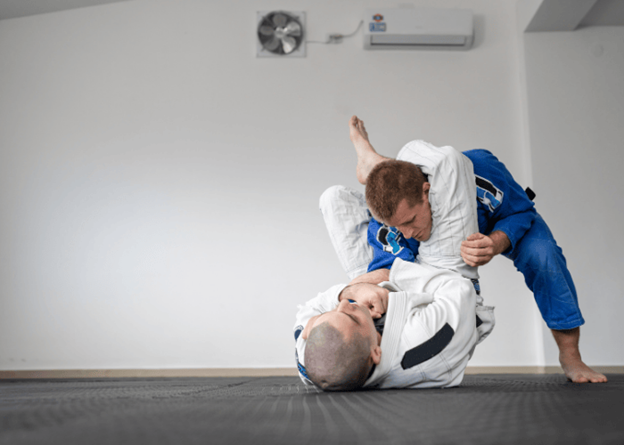
Image by Miljan Živković from Getty Images via Canva.com
Mixed Martial Arts has evolved into one of the most strategically complex combat sports on the planet. In the early days, brute force and single-discipline dominance often decided fights. Today, fighters must master multiple disciplines to stay competitive.
Among these, Brazilian Jiu-Jitsu (BJJ) stands out as a game-changer. Fighters across the board are refining their grappling skills, understanding that BJJ in MMA is no longer just an asset; it’s a requirement.
The Rise of BJJ in MMA
Brazilian Jiu-Jitsu catapulted into the spotlight during the inaugural UFC events in the 1990s. Royce Gracie, representing the Gracie family, stunned the world by submitting larger, stronger opponents using pure technique, leverage, and ground control. His dominance proved that technical grappling could neutralize raw power and striking.
Fast forward to today, and BJJ has become embedded in MMA culture. Fighters now routinely incorporate Brazilian Jiu-Jitsu into their MMA training. They recognize that success in the cage depends on what happens when the fight hits the mat. Whether to finish opponents or to escape dangerous positions, BJJ plays a crucial role.
Training Smarter With the Right Gear
As fighters push themselves on the mats, the importance of dependable training gear grows. Consistent training demands comfort, freedom of movement, and durability. That’s why professional and amateur athletes alike rely on quality kimonos during their gi training sessions.
For serious practitioners, investing in reliable men’s kimonos for BJJ can make a significant difference. A well-designed gi allows athletes to focus fully on their techniques without distraction. Whether drilling sweeps, practicing guard retention, or sparring full-intensity rounds, your kimono must endure it all. Kingz offers a wide selection of gear tailored to both new students and seasoned fighters who demand function and performance.
Ground Control in MMA
Ground control has transformed the landscape of MMA. Fighters who excel in positional dominance can control pace, dictate where the fight takes place, and score crucial points in judges’ eyes. They minimize damage from strikes while setting up submissions or maintaining dominant positions, such as mount or back control.
For example, take Demian Maia’s ability to transition to the back and secure submissions demonstrated how ground control leads directly to victory. Similarly, Charles Oliveira and Brian Ortega have used the ground game to turn the tide in what would otherwise be difficult fights. These athletes highlight how fighters who master BJJ can manipulate opponents and force them into vulnerable positions.
Submission Success Stories
Submissions remain one of the most thrilling and definitive ways to finish an MMA bout. Fighters like Oliveira, who holds the record for the most submissions in UFC history, have turned BJJ into a career-defining weapon. Rear-naked chokes, guillotines, and arm-triangle chokes regularly end high-stakes fights.
For instance, Islam Makhachev submitted Charles Oliveira with an arm-triangle choke in a title bout. That moment showcased the value of precision, control, and calm execution under pressure. These outcomes reinforce that BJJ submission techniques can instantly shift momentum and secure a win, even against elite competition.
Defensive Utility: Surviving and Countering
Offense often grabs headlines, but BJJ’s defensive prowess deserves equal recognition. Fighters use BJJ to submit and survive. Athletes like Nate Diaz and Tony Ferguson rely on BJJ to neutralize ground-and-pound, escape from bad positions, and mount counters from their guard.
BJJ empowers fighters to remain dangerous even off their backs. A well-timed sweep, submission attempt, or transition can frustrate opponents who rely heavily on top control. It teaches awareness, patience, and strategy, which allow fighters to stay calm and active under pressure. Effective defensive grappling often extends careers by reducing the damage absorbed on the ground.
The Modern Fighter: A Hybrid Athlete
Today’s MMA fighter is a hybrid, part striker, part grappler, and 100% adaptive. However, even the most well-rounded athletes know that control often starts with grappling. Fighters such as Gilbert Burns, a world-class BJJ black belt, bring aggressive takedowns, slick submissions, and positional control to every bout. This versatility keeps opponents guessing.
Combining BJJ with MMA enhances both disciplines. Fighters who adopt submissions add depth to their ground game, while BJJ athletes who master takedowns can decide when and how the fight hits the ground.
BJJ’s Tactical Edge in Championship Fights
Championship fights, which stretch into five rounds, put a premium on energy management, strategy, and control. BJJ gives fighters an edge in all three areas. Grappling allows athletes to slow the fight down, control breathing, and conserve energy while still scoring.
Grapplers often stall or advance positions without taking damage, setting up submissions without high-risk exchanges. Khabib Nurmagomedov built an undefeated legacy largely by employing pressure, positional awareness, and controlled aggression rooted in grappling. While not a traditional BJJ stylist, his style mirrored many of BJJ’s control and pressure principles.
BJJ also helps in recovery mid-fight. Fighters can clinch, pull guard, or transition into rest positions, buying time to reset without appearing inactive. This subtle yet powerful advantage shapes outcomes in long, grueling battles.
What This Means for Future Fighters
Young fighters grow up studying transitions, escapes, and submissions just as much as they shadowbox or drill takedowns. MMA coaches now emphasize complete fighters who can strike, wrestle, and grapple with equal confidence.
More MMA schools are offering dedicated BJJ classes, encouraging fighters to compete in grappling tournaments to sharpen their technique. Many up-and-comers also train in both gi and no-gi formats to develop grip strength, posture awareness, and fluid movement.
This new wave of hybrid athletes views BJJ as a versatile toolkit, not just a plan B. When fighters understand how to control the ground, they stop fearing takedowns and embrace them. They see opportunity in every transition and every scramble. That mindset is changing the sport.
Conclusion
Brazilian Jiu-Jitsu has influenced MMA and reshaped its identity. Fighters now train BJJ to submit opponents but to survive, recover, and control fights strategically. BJJ in MMA has grown from a niche skill to a defining characteristic of elite competition.
As MMA evolves, BJJ remains the blueprint for dominance on the ground. From classic submissions to positional control, its relevance only grows. For fans watching closely, the ground game reveals the chess match beneath the chaos. And for fighters looking to sharpen their edge, embracing BJJ is a smart strategy.